Kindergarten Grade
Project
2 weeks
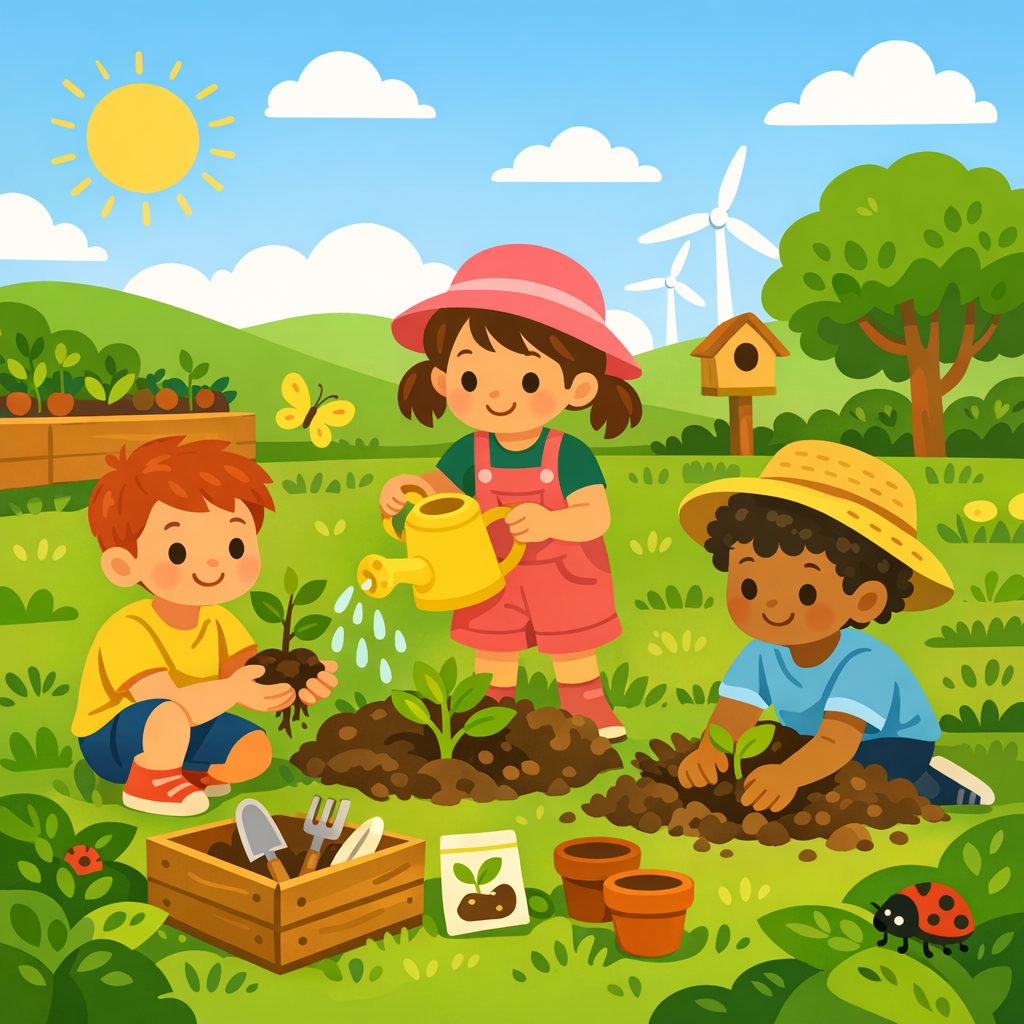
Little Sprouts: Kindergarten Plant Adventure!
Updated
K-ESS3-1
K-ESS2-2
K-PS3-1
K-LS1-1
1-pager
Identify & Define the Problem or Opportunity
Identify & Define the Problem or Opportunity
Students will observe plants in their real environment, notice how sunlight and location affect them, and interview high school agriculture partners to understand how people help plants meet their needs. They will document observations and questions to define what plants need to live and grow healthy.
Days 1 - 2
Research & Gather Insights
Research & Gather Insights
Students will gather deeper insights about plant needs by organizing interview information, observing patterns in sunlight and plant growth, and mapping how plants interact with their environment. They will synthesize user feedback and create visual experience maps that show relationships between plants, people, and places.
Days 3 - 4
Develop Ideas & Plan
Develop Ideas & Plan
Students will analyze what plants need most in their environment and plan user-centered designs for their garden habitat models and Plant Knowledge Fair displays. They will define key plant “user” needs, prioritize usability (sunlight, water access, space), and create simple plant personas and design criteria to guide their upcoming prototypes.
Day 5
Improve & Refine
Improve & Refine
Students will refine their Kindergarten Garden Habitat Models and Plant Scientist Posters by analyzing usability feedback, improving clarity of plant needs and environment connections, and creating a simple evidence-based usability report to prepare for the Plant Knowledge Fair.
Day 7
Launch & Share
Launch & Share
Students will launch and share their finalized plant models and posters during the Plant Knowledge Fair, demonstrating how plants meet their needs in specific environments and how people and plants change their surroundings. They will present evidence from their journals, ensure their displays are understandable for different visitors, and complete a final accessibility and evidence-based mastery check.
Day 8
15 min over capacity (30 min available across 1 day)
Evaluate & Iterate
Evaluate & Iterate
Students will observe how visitors and classmates interact with their Kindergarten Garden Habitat Models and Plant Scientist Posters, gather simple feedback, and revise their models and explanations to better show how plants meet their needs in specific environments.
Day 9
Reflect on Competency Growth
Reflect on Competency Growth
Students will reflect on how they have grown as plant scientists and designers by revisiting their journals, models, and presentations, identifying evidence of their learning about plant needs, sunlight, environments, and how people and plants change their surroundings. They will share concrete examples of growth connected to BCPS competencies and celebrate their progress during the Plant Knowledge Fair.
Day 10
30 min over capacity (30 min available across 1 day)
Identify & Define the Problem or Opportunity
Days 1–2
Day 1
Day 2
Research & Gather Insights
Days 3–4
Day 3
Develop Ideas & Plan
Days 5–5
Day 5
Create & Test Prototype(s)
Days 6–6
Day 6
Improve & Refine
Days 7–7
Day 7
Launch & Share
Days 8–8
Day 8
Evaluate & Iterate
Days 9–9
Day 9
Reflect on Competency Growth
Days 10–10
July 2026
Mon
Tue
Wed
Thu
Fri
20
Day 1
Identify & Define the Problem or Opportunity
🌿 Plant Adventure Walk Observations
🌿 Plant Adventure Walk Observations
☀️ Sunlight & Shade Temperature Check
☀️ Sunlight & Shade Temperature Check
21
Day 2
🗺️ Sunny vs. Shady Plant Map
🗺️ Sunny vs. Shady Plant Map
👩🌾 Interview with Ag Buddies
👩🌾 Interview with Ag Buddies
📝 Plant Interview Notes & Drawings
📝 Plant Interview Notes & Drawings
22
Day 3
Research & Gather Insights
🌞 Sunlight & Soil Warmth Lab
🌞 Sunlight & Soil Warmth Lab
🧠 Sorting Plant Needs Patterns
🧠 Sorting Plant Needs Patterns
🗣️ Plant Interview Highlights Chart
🗣️ Plant Interview Highlights Chart
23
Day 4
🗺️ Plant & Place Model Demo
🗺️ Plant & Place Model Demo
🧩 My Plant Experience Map
🧩 My Plant Experience Map
24
Day 5
Develop Ideas & Plan
🌱 What Do Plants Need Most?
🌱 What Do Plants Need Most?
☀️ Sunny Spot or Shady Spot?
☀️ Sunny Spot or Shady Spot?
🪴 Our Plant Persona Cards
🪴 Our Plant Persona Cards
🏗️ Garden Habitat Must-Haves Chart
🏗️ Garden Habitat Must-Haves Chart
27
Day 6
Create & Test Prototype(s)
🧱 Quick Garden Habitat Model
🧱 Quick Garden Habitat Model
👀 Peer Plant Test Walk
👀 Peer Plant Test Walk
🗣️ Explain & Defend Our Design
🗣️ Explain & Defend Our Design
28
Day 7
Improve & Refine
🔍 Feedback Sorting with Smile Cards
🔍 Feedback Sorting with Smile Cards
✏️ Garden Model Fix-It Plan
✏️ Garden Model Fix-It Plan
🛠️ Habitat Model Improvements
🛠️ Habitat Model Improvements
🖍️ Poster Label & Evidence Upgrade
🖍️ Poster Label & Evidence Upgrade
🎤 Practice Share & Peer Feedback
🎤 Practice Share & Peer Feedback
📋 Usability Improvement Report
📋 Usability Improvement Report
29
Day 8
Launch & Share
🌱 Plant Knowledge Fair Showcase
🌱 Plant Knowledge Fair Showcase
🔎 Visitor Accessibility & Evidence Check
🔎 Visitor Accessibility & Evidence Check
30
Day 9
Evaluate & Iterate
👀 Watching Visitors Use Our Garden Models
👀 Watching Visitors Use Our Garden Models
💬 Plant Feedback Circle
💬 Plant Feedback Circle
🛠️ Improving Our Habitat Models
🛠️ Improving Our Habitat Models
☀️ Checking Sunlight Evidence
☀️ Checking Sunlight Evidence
📝 Our Model Improvement Plan
📝 Our Model Improvement Plan
31
Day 10
Reflect on Competency Growth
🌱 Revisiting My Plant Journal Wall
🌱 Revisiting My Plant Journal Wall
🪴 My Growth as a Plant Scientist
🪴 My Growth as a Plant Scientist
☀️ Sunlight & Soil Evidence Share
☀️ Sunlight & Soil Evidence Share
🌼 Explaining Our Garden Habitat Model
🌼 Explaining Our Garden Habitat Model