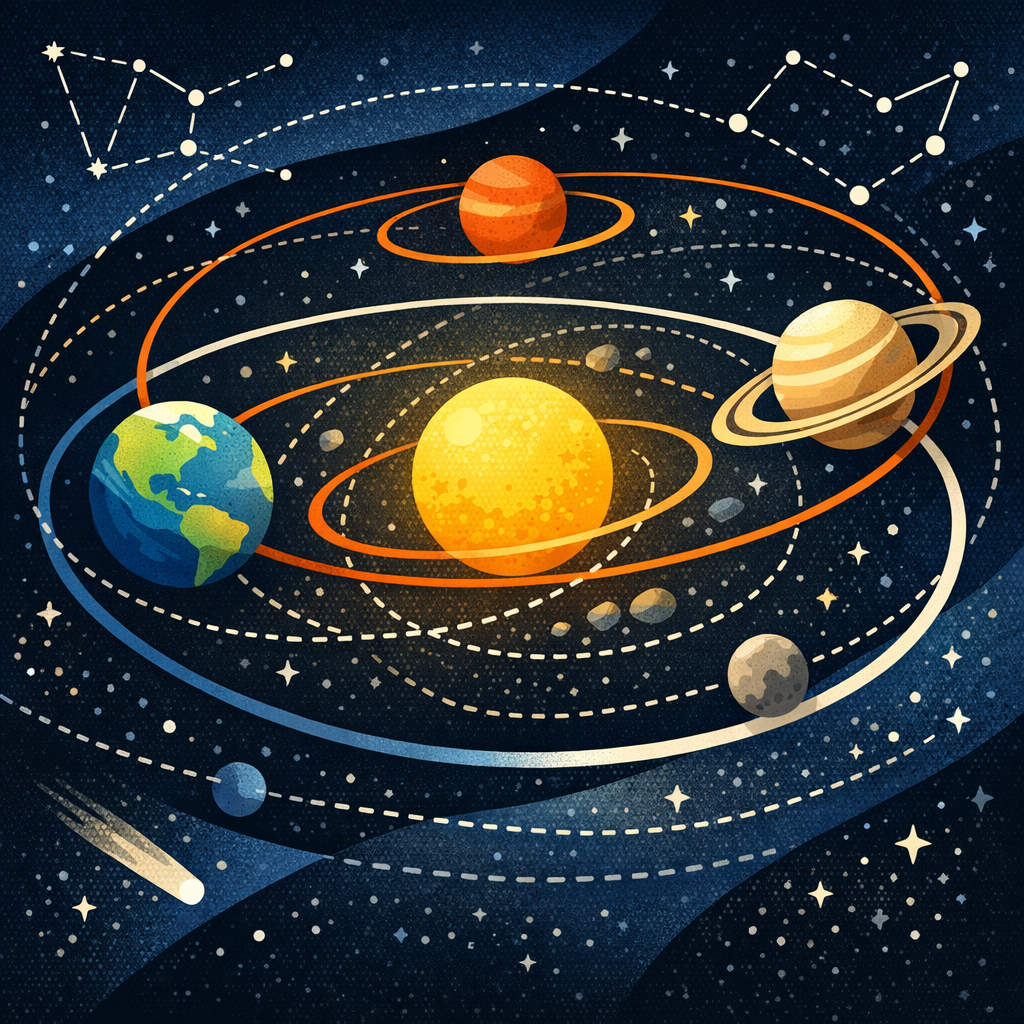
Students investigate moon phases, constellations, planets, and Earth-space systems to answer how patterns in the sky help us understand our place in space. Through a moon-finding launch, a partner message from Fleet Science Center or Palomar Observatory, outdoor observations, shared research, drawing, counting, and writing, they build science understanding alongside literacy and math skills. Their work leads to a class constellation guide and a shared sky-mapping mural that they present during a Constellation Celebration Walk for families and school staff. Ongoing audio or drawing reflections help students notice how their ideas change over time and strengthen communication, collaboration, and critical thinking.
Learning goals
Students will observe and describe patterns in the sky, including moon phases, constellations, and the movement and features of planets, using drawings, shared discussions, and simple sky maps. They will ask questions, record observations, and use pictures, writing, and audio reflections to explain how sky patterns help people understand Earth’s place in space and how Earth systems connect to weather, light, and change over time. Students will apply math by identifying, creating, and comparing number and shape patterns in constellations, and they will apply literacy by participating in shared research, labeling diagrams, writing captions and short facts, and contributing clear information to a class constellation guide and sky-mapping mural. Throughout the project, students will collaborate with peers, respond to feedback, and present their learning to families and community partners during the Constellation Celebration Walk.
Standards
[Next Generation Science Standards] ESS.1.A - The Universe and Its Stars
[Next Generation Science Standards] ESS.1.B - Earth and the Solar System
[Next Generation Science Standards] ESS.1.C - The History of Planet Earth
[Next Generation Science Standards] ESS.2.D - Weather and Climate
[Next Generation Science Standards] PS.2.A - Forces and Motion
[Common Core] CCSS.ELA-Literacy.W.2.7 - Participate in shared research and writing projects (e.g., read a number of books on a single topic to produce a report; record science observations).
[Next Generation Science Standards] K-2.AF.4.2 - Use and share pictures, drawings, and/or writings of observations.
[Next Generation Science Standards] ESS.2.A - Earth Materials and Systems
[Next Generation Science Standards] ESS.2.B - Plate Tectonics and Large-Scale System Interactions
[Next Generation Science Standards] K-2.AF.4.3 - Use observations (firsthand or from media) to describe patterns and/or relationships in the natural and designed world(s) in order to answer scientific questions and solve problems.
Competencies
Effective Communication - Students practice listening to understand, communicating with empathy, and share their learning through exhibiting, presenting and reflecting on their work.
Critical Thinking & Problem Solving - Students consider a variety of innovative approaches to address and understand complex questions that are authentic and important to their communities.
Collaboration - Students co-design projects with peers, exercise shared-decision making, strengthen relational agency, resolve conflict, and assume leadership roles.
Self Directed Learning - Students use teacher and peer feedback and self-reflection to monitor and direct their own learning while building self knowledge both in and out of the classroom.
Content Expertise - Students develop key competencies, skills, and dispositions with ample opportunities to apply knowledge and engage in work that matters to them.
Academic Mindset - Students establish a sense of place, identity, and belonging to increase self-efficacy while engaging in critical reflection and action.
Products
Students will create observation sketches, moon-phase and planet notes, number-pattern recordings, and short audio or drawing reflections after each science session to document how their ideas change over time. In teams, they will build pieces for a shared sky-mapping mural that includes constellations, labeled planet facts, and student writing explaining how sky patterns help us understand our place in space. As a culminating product, the class will publish a constellation guide with student-drawn star patterns, captions, and simple math connections for families to use during the Constellation Celebration Walk. These products will be displayed as interactive exhibits with labeled visuals and reflection stations for families and school staff.
Launch
Begin with a “Finding the Moon” challenge by showing recent moon photos and asking students to predict when and where they might spot it, then head outside for a brief sky observation walk to notice visible patterns in the sky. Follow this with a live or virtual welcome from Fleet Science Center or Palomar Observatory, where students hear how scientists use observation, maps, and patterns to study space. Back in class, students join an inquiry circle to sketch what they noticed, share questions about constellations, planets, and moon phases, and start a class wonder chart. Close by introducing the Constellation Celebration Walk so students know they will create a constellation guide, a shared sky-mapping mural, and audio or drawing reflections to teach families what they discover.
Exhibition
Host a Constellation Celebration Walk in a hallway or outdoor path where students display the class constellation guide pages and sections of the shared sky-mapping mural. Include labeled star drawings, planet facts, student writing, number patterns, and simple audio reflection stations where visitors can hear students explain how their ideas about moon phases, planets, and constellations changed over time. Invite families, school staff, and partners from Fleet Science Center or Palomar Observatory to walk the exhibits, ask questions, and leave wonder notes or compliments for each group. End with a short student-led share-out in which pairs present one sky pattern they studied and explain how it helps us understand our place in space.