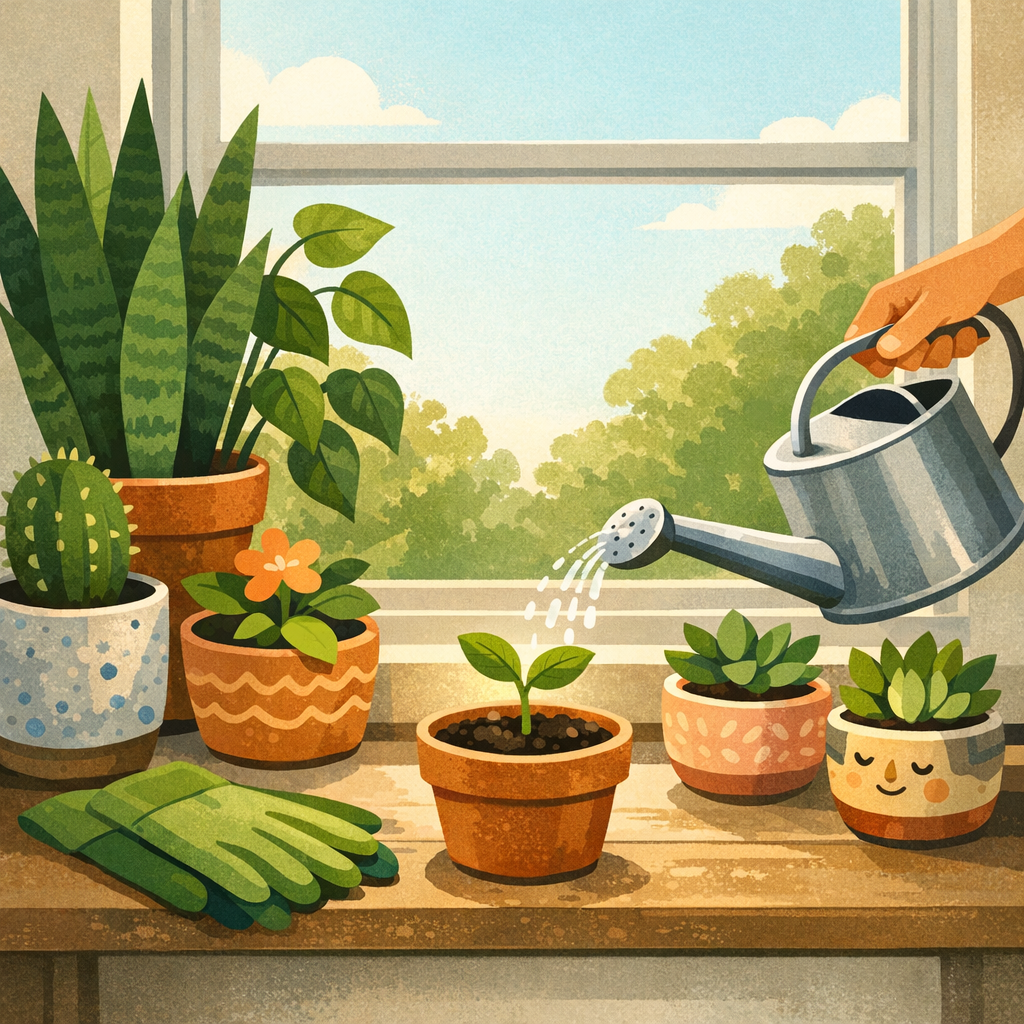
You will investigate how to keep a beginner houseplant healthy by testing how light, water, soil, and indoor climate affect growth, stress, and infestation over time. Your goal is to ask testable care questions, collect evidence through weekly observations and measurements, and use that data to revise your care routine as conditions change. By the end, you will create a plant health portfolio and a beginner care guide, then share your findings in a Leaf Lab Showcase with classmates and community plant experts.
Learning goals
You will ask testable questions about plant health, investigate how light, water, soil quality, pests, and indoor climate affect growth, and use measurements, photos, and observations to track change over time. You will explain how plant structures and ecosystem relationships support growth, and how weather, seasonal shifts, and room conditions influence care decisions. You will build and revise a care routine using feedback, soil tests, infestation notes, and evidence from your weekly reflections and critique cycles. You will communicate your findings through a plant health portfolio, a beginner care guide, and a public showcase where you justify your conclusions with data.
Standards
[Next Generation Science Standards] ESS.2.D - Weather and Climate
[Next Generation Science Standards] LS.1.B - Growth and Development of Organisms
[Next Generation Science Standards] 9-12.AF.1.2 - Evaluate a question to determine if it is testable and relevant. (a) Ask questions that can be investigated within the scope of the school laboratory, research facilities, or field (e.g., outdoor environment) with available resources and, when appropriate, frame a hypothesis based on a model or theory. (b) Ask and/or evaluate questions that challenge the premise(s) of an argument, the interpretation of a data set, or the suitability of a design. (c) Define a design problem that involves the development of a process or system with interacting components and criteria and constraints that may include social, technical, and/or environmental considerations.
[Next Generation Science Standards] LS.2.A - Interdependent Relationships in Ecosystems
[Next Generation Science Standards] 9-12.AF.1.1 - Ask questions (a) that arise from careful observation of phenomena, or unexpected results, to clarify and/or seek additional information. (b) that arise from examining models or a theory, to clarify and/or seek additional information and relationships. (c) to determine relationships, including quantitative relationships, between independent and dependent variables. (d) to clarify and refine a model, an explanation, or an engineering problem.
Competencies
Critical Thinking & Problem Solving - Students consider a variety of innovative approaches to address and understand complex questions that are authentic and important to their communities.
Effective Communication - Students practice listening to understand, communicating with empathy, and share their learning through exhibiting, presenting and reflecting on their work.
Content Expertise - Students develop key competencies, skills, and dispositions with ample opportunities to apply knowledge and engage in work that matters to them.
Self Directed Learning - Students use teacher and peer feedback and self-reflection to monitor and direct their own learning while building self knowledge both in and out of the classroom.
Collaboration - Students co-design projects with peers, exercise shared-decision making, strengthen relational agency, resolve conflict, and assume leadership roles.
Products
You will build a 12-week plant health portfolio that includes weekly care notes, growth measurements, before-and-after photos, soil test results, infestation observations, and short voice or written reflections on each care change you test. As you gather evidence, you will also create simple journal pages, data tables, and comparison charts that show how light, water, soil, and indoor climate affected your plant’s growth and health. By the end, you will design a beginner-friendly houseplant care routine guide that shares your best recommendations for watering, lighting, soil care, and spotting early signs of stress or pests. You will use these products during the Leaf Lab Showcase gallery walk to explain your findings to classmates and community plant partners.
Launch
Start with a Plant Rescue Sprint using several mystery houseplants that show different problems such as drooping, yellow leaves, dry soil, or possible pests. In teams, inspect each plant, compare before-and-after photos of healthy and stressed plants, test basic soil moisture and light conditions, and choose one care question you want to investigate over the next 12 weeks. Then move into a Mini Greenhouse Challenge by setting up identical starter plants with different beginner care routines and predicting which combination of water, light, and soil will lead to the healthiest growth. End the launch by creating your first weekly care goal and sharing your hypothesis with classmates and a local garden center or plant expert through a short feedback check-in.
Exhibition
Host a Leaf Lab Showcase as a gallery walk where you present your 12-week plant health portfolio, beginner care routine guide, before-and-after photos, soil test results, growth measurements, and infestation notes. Invite classmates, families, and a local garden center partner or houseplant expert to visit your display, ask questions, and compare how different light, water, and soil choices affected plant health. Include a short live explanation of your investigation question, the care changes you tested, and how indoor climate or seasonal conditions influenced your results. End with a feedback station where visitors leave comments on which evidence was most convincing and which care advice would help other beginner plant owners.