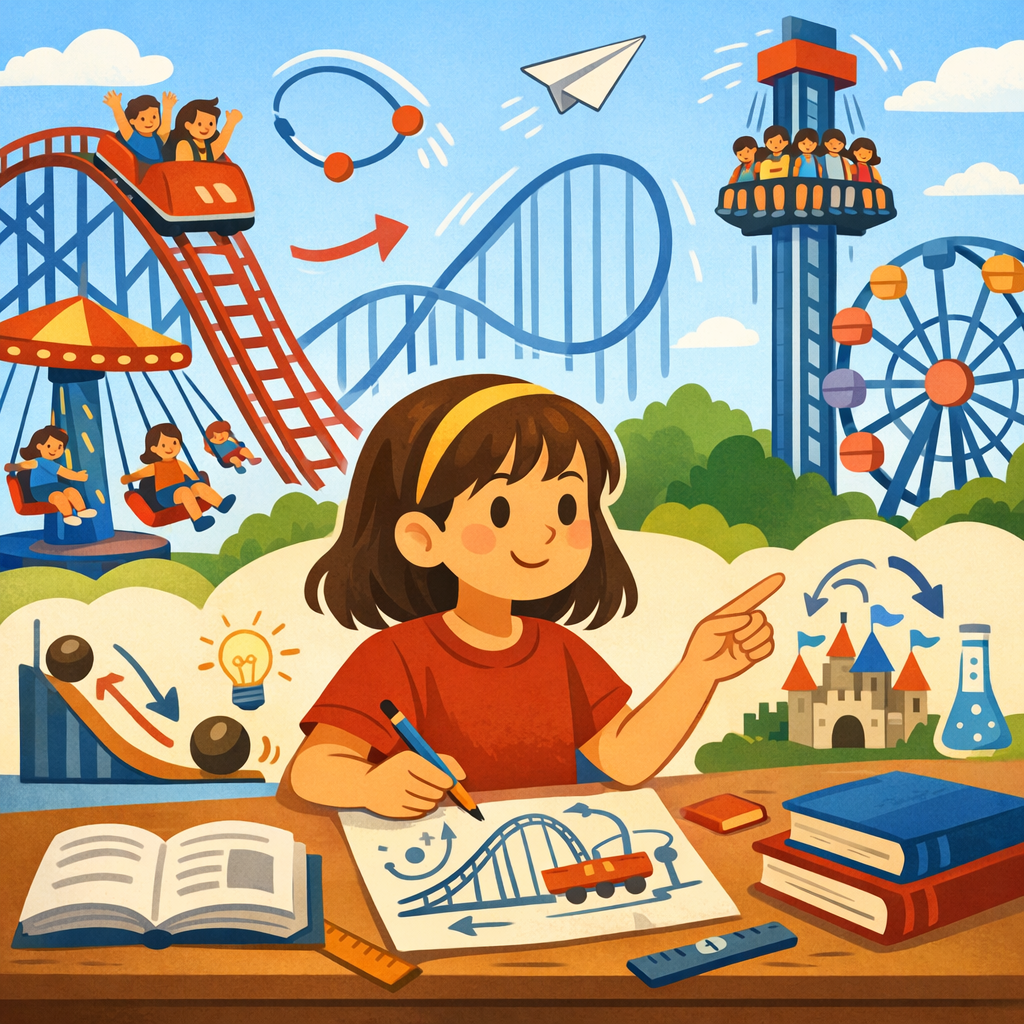
The purpose of this learning experience is to integrate physics and literature by having students design theme park rides that reflect the themes of their chosen books. Through hands-on projects, students will apply scientific principles to real-world scenarios while deepening their understanding of narrative storytelling. This interdisciplinary approach encourages creativity, critical thinking, and collaboration as students engage in literature circles and fishbowl discussions, preparing to present their innovative designs to a diverse panel.
Learning goals
Students will apply Newton's laws of motion to design a theme park ride, demonstrating an understanding of force, acceleration, and energy conservation. They will analyze and interpret themes from selected literature, connecting narrative elements to ride design. Through collaboration and critique, including literature circles and fishbowl discussions, students will refine their designs, enhancing both their technical skills and storytelling abilities. They will effectively communicate their ideas to a diverse audience, showcasing their mastery of physics concepts and thematic integration.
Products
Students will develop a comprehensive design portfolio featuring blueprints, thematic elements, and physics calculations for their theme park ride. They will also construct a scale model of their ride, integrating narrative aspects from their chosen book to demonstrate the connection between physics and storytelling. Literature circles will contribute insights to refine the narrative elements, while fishbowl discussions will facilitate deeper understanding of thematic connections. Both the portfolio and model will be showcased at the 'Ride & Read Gala,' where students will present their work through interactive demonstrations and explanations of their ride's impact and thematic relevance.
Launch
Begin the project with "Theme Park Tales," a storytelling session where students share their favorite theme park experiences and discuss how these rides tell a story. Invite a local theme park owner to speak about the storytelling elements in ride design, sparking curiosity about the connection between physics and narrative. Incorporate literature circles and fishbowl discussions to explore themes from the books, encouraging students to brainstorm initial ideas for their own theme park rides that integrate these themes.
Exhibition
Host the "Ride & Read Gala," where students present their theme park ride designs and scale models alongside live readings from the books that inspired their themes. Integrate literature circles and fishbowl discussions into the exhibition, allowing students to engage with peers and community partners in a dynamic dialogue about their creative and technical processes. Invite the local theme park owner, engineer, and investor to participate in a Q&A session, fostering deeper connections between storytelling and ride mechanics.