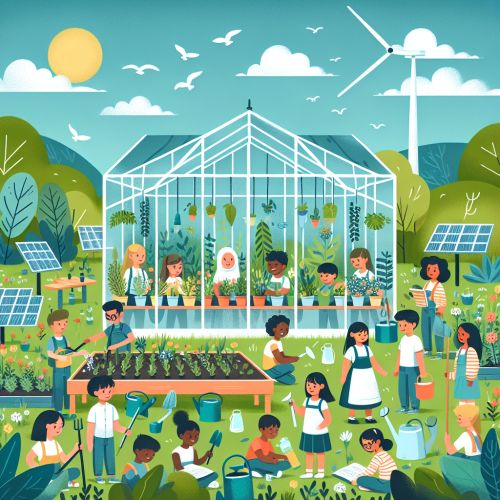
This project aims to immerse students in the practical application of chemistry by designing sustainable greenhouses or outdoor classrooms. Through hands-on experimentation, students will explore the chemistry behind sustainable materials and how construction choices impact the environment and society. By collaborating with professionals and engaging in reflective practices, students will develop critical thinking and problem-solving skills, fostering a sense of identity and belonging within their community.
Learning goals
Students will delve into the chemistry of sustainable materials, conducting experiments to understand properties like durability, insulation, and environmental impact. They will synthesize eco-friendly materials, such as bioplastics, to comprehend chemical reactions and assess their construction potential. Through these activities, students will enhance their critical thinking and problem-solving skills, refining their designs with peer and expert feedback. Self-directed learning will be nurtured through reflective practices, allowing students to monitor their progress and deepen their understanding of chemistry's role in sustainable construction.
Standards
[Next Generation Science Standards] 9-12.AF.6.5 - Design, evaluate, and/or refine a solution to a complex real-world problem, based on scientific knowledge, student-generated sources of evidence, prioritized criteria, and tradeoff considerations.
[Next Generation Science Standards] MS-PS1-6 - Undertake a design project to construct, test, and modify a device that either releases or absorbs thermal energy by chemical processes.
[Next Generation Science Standards] 6-8.AF.6.7 - Undertake a design project, engaging in the design cycle, to construct and/or implement a solution that meets specific design criteria and constraints.
Competencies
Self Directed Learning - Students use teacher and peer feedback and self-reflection to monitor and direct their own learning while building self knowledge both in and out of the classroom.
Academic Mindset - Students establish a sense of place, identity, and belonging to increase self-efficacy while engaging in critical reflection and action.
Critical Thinking & Problem Solving - Students consider a variety of innovative approaches to address and understand complex questions that are authentic and important to their communities.
Products
Throughout the project, students will create detailed design plans and scale models of their greenhouse or outdoor classroom, focusing on the chemistry of sustainable materials and construction techniques. They will develop a comprehensive portfolio that includes photos, design sketches, and calculations demonstrating their understanding of chemistry principles applied in their designs. By the end of the project, students will present their models and deliver an elevator pitch to the board of directors, showcasing their design choices and sustainability strategies. Additionally, students will maintain a 'Materials Impact Journal' to document their reflections and insights on the environmental and social implications of their chosen materials.
Launch
Kick off the project by delivering a letter to students, inviting their "firm" to participate in designing a sustainable greenhouse or outdoor classroom. Students will explore potential building sites, capturing detailed photographs and discussing their vision and needs with peers and partners. Launch the project with a chemistry-focused 'Materials Exploration Challenge,' where students conduct hands-on experiments to investigate the properties of various sustainable materials, such as thermal conductivity and biodegradability, setting the stage for their design process.
Exhibition
Students will showcase their greenhouse or outdoor classroom models at a community exhibition event, where they will present their designs to peers, educators, and local stakeholders. Each student or team will deliver an elevator pitch to the board of directors, focusing on the chemistry behind their material choices, such as chemical bonding and reactions that contribute to sustainability. The exhibition will also feature interactive stations where visitors can engage with the students' chemistry experiments, gaining insights into the chemical properties and reactions of the sustainable materials used in construction.