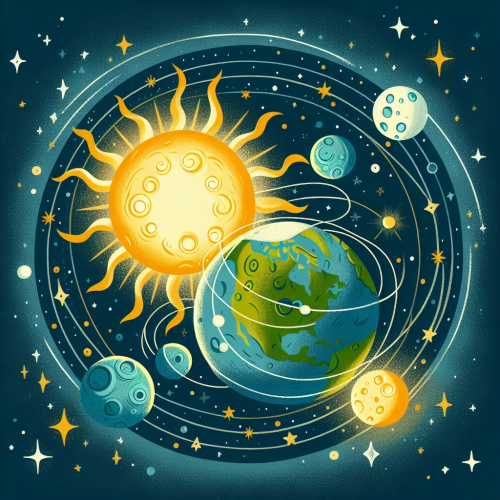
This project aims to deepen students' understanding of the Earth-sun-moon system through hands-on modeling and data analysis, fostering a comprehensive grasp of celestial phenomena such as lunar phases, eclipses, and seasons. By engaging in interactive workshops, narrative creation, and community collaborations, students will develop critical thinking and scientific literacy. The project encourages students to apply their learning to real-world contexts, promoting awareness of human impact on Earth's systems and inspiring thoughtful solutions for environmental challenges.
Learning goals
Students will develop a comprehensive understanding of the Earth-sun-moon system, including how their interactions lead to observable phenomena such as lunar phases, eclipses, and seasons. They will learn to construct and use models to explain these natural occurrences and analyze data to understand the scale and properties of solar system objects. Through the project, students will also explore the role of gravity in the motions within galaxies and the solar system, and they will critically assess human impacts on Earth's systems, proposing strategies to mitigate these effects. Additionally, students will enhance their literacy skills by interpreting scientific texts and constructing narratives that integrate their scientific understanding with creative storytelling.
Standards
MS-ESS1-1 - Develop and use a model of the Earth-sun-moon system to describe the cyclic patterns of lunar phases, eclipses of the sun and moon, and seasons.
MS-ESS1-3 - Analyze and interpret data to determine scale properties of objects in the solar system.
MS-ESS1-2 - Develop and use a model to describe the role of gravity in the motions within galaxies and the solar system.
MS-ESS2-2 - Construct an explanation based on evidence for how geoscience processes have changed Earth's surface at varying time and spatial scales.
MS-ESS2-4 - Develop a model to describe the cycling of water through Earth's systems driven by energy from the sun and the force of gravity.
MS-ESS3-1 - Construct a scientific explanation based on evidence for how the uneven distributions of Earth's mineral, energy, and groundwater resources are the result of past and current geoscience processes.
MS-ESS3-3 - Apply scientific principles to design a method for monitoring and minimizing a human impact on the environment.
MS-ESS3-4 - Construct an argument supported by evidence for how increases in human population and per-capita consumption of natural resources impact Earth's systems.
CCSS.ELA-Literacy.RI.6.1 - Cite textual evidence to support analysis of what the text says explicitly as well as inferences drawn from the text.
CCSS.ELA-Literacy.RI.6.2 - Determine a central idea of a text and how it is conveyed through particular details; provide a summary of the text distinct from personal opinions or judgments.
CCSS.ELA-Literacy.RI.6.3 - Analyze in detail how a key individual, event, or idea is introduced, illustrated, and elaborated in a text (e.g., through examples or anecdotes).
CCSS.ELA-Literacy.RI.6.4 - Determine the meaning of words and phrases as they are used in a text, including figurative, connotative, and technical meanings.
CCSS.ELA-Literacy.RI.6.5 - Analyze how a particular sentence, paragraph, chapter, or section fits into the overall structure of a text and contributes to the development of the ideas.
CCSS.ELA-Literacy.RI.6.8 - Trace and evaluate the argument and specific claims in a text, distinguishing claims that are supported by reasons and evidence from claims that are not.
CCSS.ELA-Literacy.L.6.4 - Determine or clarify the meaning of unknown and multiple-meaning words and phrases based on grade 6 reading and content, choosing flexibly from a range of strategies.
CCSS.ELA-Literacy.L.6.5 - Demonstrate understanding of figurative language, word relationships, and nuances in word meanings.
CCSS.ELA-Literacy.W.6.3 - Write narratives to develop real or imagined experiences or events using effective technique, relevant descriptive details, and well-structured event sequences.
Products
Students will create a 3D model of the Earth-sun-moon system, demonstrating the natural phenomena observed on Earth, such as lunar phases and eclipses. Accompanying their model, students will craft a narrative myth that explains these phenomena in a creative and engaging way. Throughout the project, students will also develop data interpretation reports and strategies for minimizing human impact on Earth's systems, which they will present during the final 'Celestial Showcase' exhibition.
Launch
Kick off the learning experience with a 'Galactic Journey' field trip to the local planetarium, where students can immerse themselves in interactive workshops. They will explore the Earth-sun-moon system and witness simulated lunar phases and eclipses firsthand. This engaging experience will spark curiosity and provide a foundational understanding of the celestial phenomena they will model and analyze throughout the project.
Exhibition
Host a 'Celestial Showcase' where students present their 3D models and narrative myths to family members, local community leaders, and peers. Create an interactive experience with hands-on model demonstrations and storytelling sessions that highlight the students' understanding of the Earth-sun-moon system. Incorporate opportunities for guests to engage with the models, ask questions, and provide feedback, fostering a community dialogue around the students' work and insights.