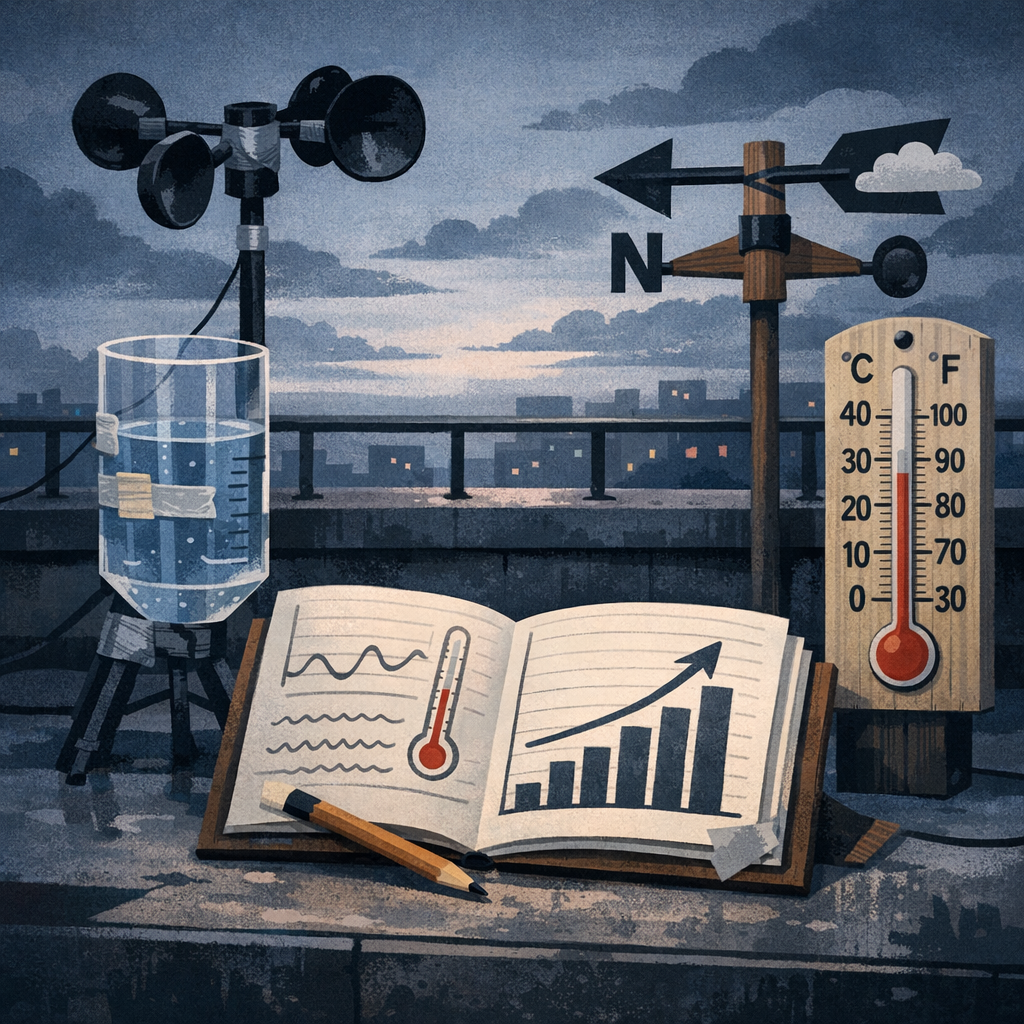
You will investigate the question, “What can your weather data tell you about how the weather changes from day to day and week to week?” by building simple weather tools, observing the sky, and recording patterns over time. Your goal is to create a class weather station display with your instruments, daily recordings, and a simple chart that shows weather changes across days and weeks. Along the way, you will make predictions, compare them to what actually happens, and share how your evidence answers the question during your presentation. After recording your data, you will turn and talk with a partner about one time your prediction was correct and one time your evidence changed your thinking.
Learning goals
You will ask questions, make observations, and build simple weather tools to gather information about daily weather. You will record data, look for patterns, and compare your predictions to what really happened to answer: What can your weather data tell you about how the weather changes from day to day and week to week? You will work with classmates to create a class weather station display with instruments, recordings, and a chart, then present how your evidence answers the question. You will also reflect with a partner about a time your prediction was correct and a time new evidence changed your thinking.
Standards
[Next Generation Science Standards] ESS.2.D - Weather and Climate
[Next Generation Science Standards] K-2.AF.4.3 - Use observations (firsthand or from media) to describe patterns and/or relationships in the natural and designed world(s) in order to answer scientific questions and solve problems.
[Next Generation Science Standards] K-2.AF.4.4 - Compare predictions (based on prior experiences) to what occurred (observable events).
[Next Generation Science Standards] K-2.AF.4.1 - Record information (observations, thoughts, and ideas).
[Next Generation Science Standards] K-2-ETS1-1 - Ask questions, make observations, and gather information about a situation people want to change to define a simple problem that can be solved through the development of a new or improved object or tool.
Competencies
Effective Communication - Students practice listening to understand, communicating with empathy, and share their learning through exhibiting, presenting and reflecting on their work.
Critical Thinking & Problem Solving - Students consider a variety of innovative approaches to address and understand complex questions that are authentic and important to their communities.
Content Expertise - Students develop key competencies, skills, and dispositions with ample opportunities to apply knowledge and engage in work that matters to them.
Self Directed Learning - Students use teacher and peer feedback and self-reflection to monitor and direct their own learning while building self knowledge both in and out of the classroom.
Collaboration - Students co-design projects with peers, exercise shared-decision making, strengthen relational agency, resolve conflict, and assume leadership roles.
Products
You will build simple weather tools, such as a rain gauge, wind sock or pinwheel, and a thermometer tracker, then use them to collect daily observations. Throughout the project, you will create a weather journal with drawings, numbers, labels, predictions, and short notes about patterns you notice from day to day. By the end, you will help create a class weather station display with your instruments, daily recordings, and a simple chart that shows how the weather changes from day to day and week to week. You will also prepare a short presentation to explain how your tools and data answer the question of what weather data can tell you about changing weather patterns.
Launch
Start by going outside to observe the sky, temperature, wind, and clouds, then make a quick prediction about what the weather will do later in the day. Return inside to examine simple weather tools and ask, “What can your weather data tell you about how the weather changes from day to day and week to week?” In teams, build one simple instrument prototype, test it right away, and record your first observations in a class chart. End with a turn-and-talk about one prediction you feel confident about and what evidence you will need to check if your thinking is correct.
Exhibition
Host a Weather Watch showcase where you present your class weather station display to families, another 2nd grade class, or school staff and explain how your tools, daily recordings, and chart show patterns from day to day and week to week. Set up each part like a mini museum with labeled instruments, data journals, prediction notes, and a speaking spot where you share one time your prediction matched the weather and one time your evidence changed your thinking. Invite visitors to ask questions about how you built and used your tools, then let them leave simple feedback with picture or sentence cards. End with a short gallery walk so you can celebrate each display and notice different weather patterns your class discovered.