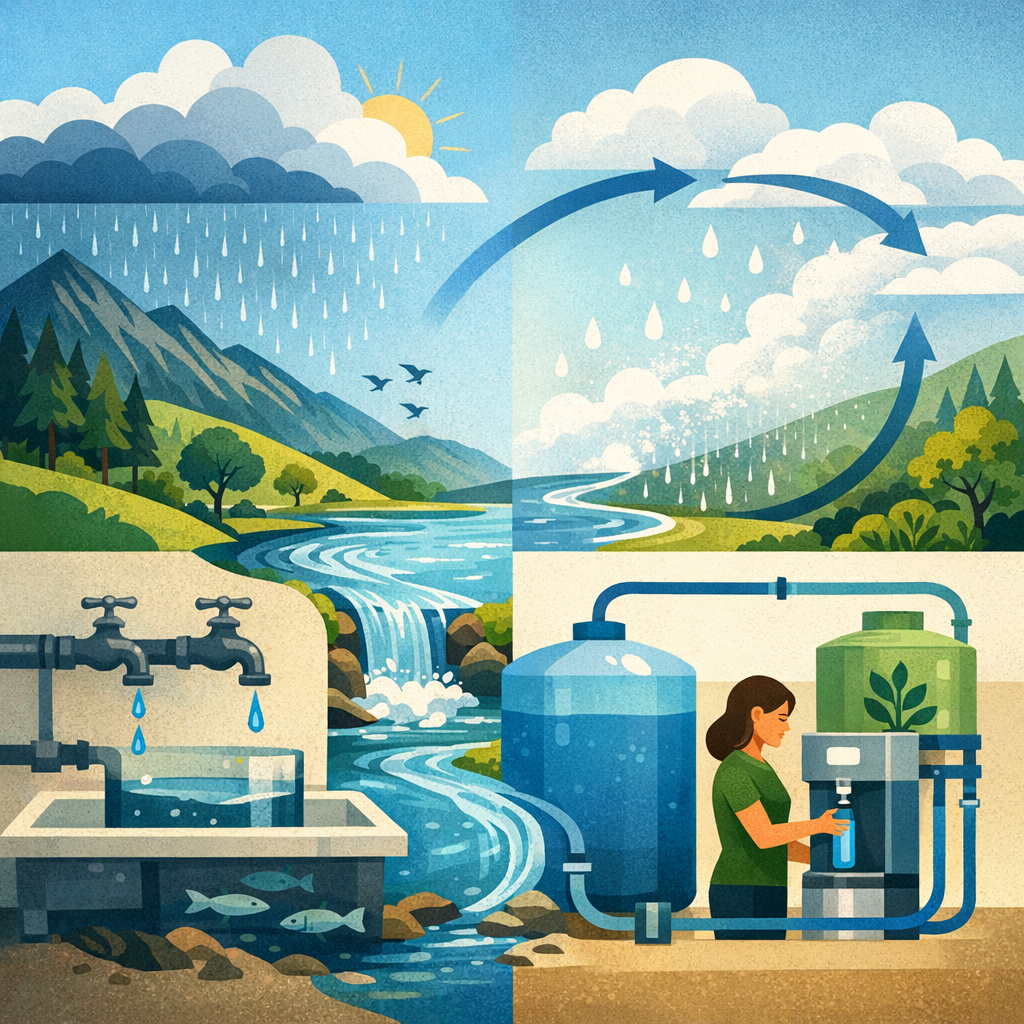
Students investigate how water moves through the environment and how waste is created in their own school so they can answer a real community problem with evidence-based solutions. Through the MOSI Weather Wonders launch, hands-on data collection, and peer critique circles, they build science understanding of the water cycle and weather while applying math, reading, and collaboration skills to analyze cafeteria waste and resource use. The learning experience leads students to create and revise products including a labeled 2D water-cycle model, waste-data posters, recycled paper, and a technology-based dye sublimation model that they will share with school leadership. By the end, students connect scientific ideas to daily school decisions and propose practical actions that support a more sustainable future.
Learning goals
Students will explain and model how water moves through the water cycle, including evaporation, condensation, precipitation, collection, and the ocean’s role in connecting Earth’s water reservoirs. They will investigate how temperature, humidity, and forms of precipitation relate to local weather and use observations, texts, and the MOSI experience to support scientific claims. Students will collect and graph cafeteria waste data, calculate mean, median, mode, and range, and use the results to identify patterns and propose realistic ways to reduce water misuse and food waste at school. They will communicate their ideas clearly through labeled models, posters, peer critique, and a presentation to school leadership.
Standards
[Florida] SC.5.E.7.1 - Create a model to explain the parts of the water cycle. Water can be a gas, a liquid, or a solid and can go back and forth from one state to another.
[Florida] SC.5.E.7.2 - Recognize that the ocean is an integral part of the water cycle and is connected to all of Earth's water reservoirs via evaporation and precipitation processes.
[Florida] SC.5.N.1.1 - Define a problem, use appropriate reference materials to support scientific understanding, plan and carry out scientific investigations of various types such as: systematic observations, experiments requiring the identification of variables, collecting and organizing data, interpreting data in charts, tables, and graphics, analyze information, make predictions, and defend conclusions.
[Florida] SC.5.E.7.7 - Design a family preparedness plan for natural disasters and identify the reasons for having such a plan.
[Florida] SC.5.E.7.5 - Recognize that some of the weather-related differences, such as temperature and humidity, are found among different environments, such as swamps, deserts, and mountains.
Competencies
Effective Communication - Students practice listening to understand, communicating with empathy, and share their learning through exhibiting, presenting and reflecting on their work.
Critical Thinking & Problem Solving - Students consider a variety of innovative approaches to address and understand complex questions that are authentic and important to their communities.
Collaboration - Students co-design projects with peers, exercise shared-decision making, strengthen relational agency, resolve conflict, and assume leadership roles.
Content Expertise - Students develop key competencies, skills, and dispositions with ample opportunities to apply knowledge and engage in work that matters to them.
Self Directed Learning - Students use teacher and peer feedback and self-reflection to monitor and direct their own learning while building self knowledge both in and out of the classroom.
Products
Students will create a labeled 2D water cycle model and a technology-based dye sublimation product that explains evaporation, condensation, precipitation, collection, and the ocean’s role in Earth’s water system. Teams will produce tables, line plots or graphs, and a poster that interprets cafeteria breakfast and 5th grade lunch food-waste data using mean, median, mode, and range to support a school conservation plan. Students will also make recycled paper from used classroom paper and use it as part of their awareness materials or final display. By the end, each team will present a school-focused proposal for reducing water misuse and food waste to school leadership, supported by scientific models, data displays, and evidence-based recommendations.
Launch
Kick off the project with the MOSI Outreach Program’s “Weather Wonders” presentation as a shared experience that sparks curiosity about the water cycle, weather, and extreme storms through interactive demonstrations like creating a cloud and crushing a can. Right after the presentation, students complete a quick notice-and-wonder protocol focused on where water is used and wasted in the school and what happens to food and paper after students are done with them. In teams, students take a short campus walk to photograph or sketch examples of water use, recycling, and cafeteria waste, then post their observations around the essential question to identify early problems they want to investigate. Close the launch by introducing the final products and exhibition for school leadership so students know their data, models, and conservation ideas will be shared with a real audience.
Exhibition
Host a Sustainability Showcase for school leadership where teams present their dye-sublimation water cycle models, recycled-paper samples, and posters analyzing cafeteria breakfast and 5th grade lunch waste data. Students should explain their claims, evidence, and recommendations for conserving water and reducing waste, using revised graphs and calculations from their peer critique cycles. Include a gallery walk with leadership feedback forms so students can gather responses on which proposed actions the school should adopt. End with brief student reflections at the class reflection wall, connecting their science learning to real school decisions.