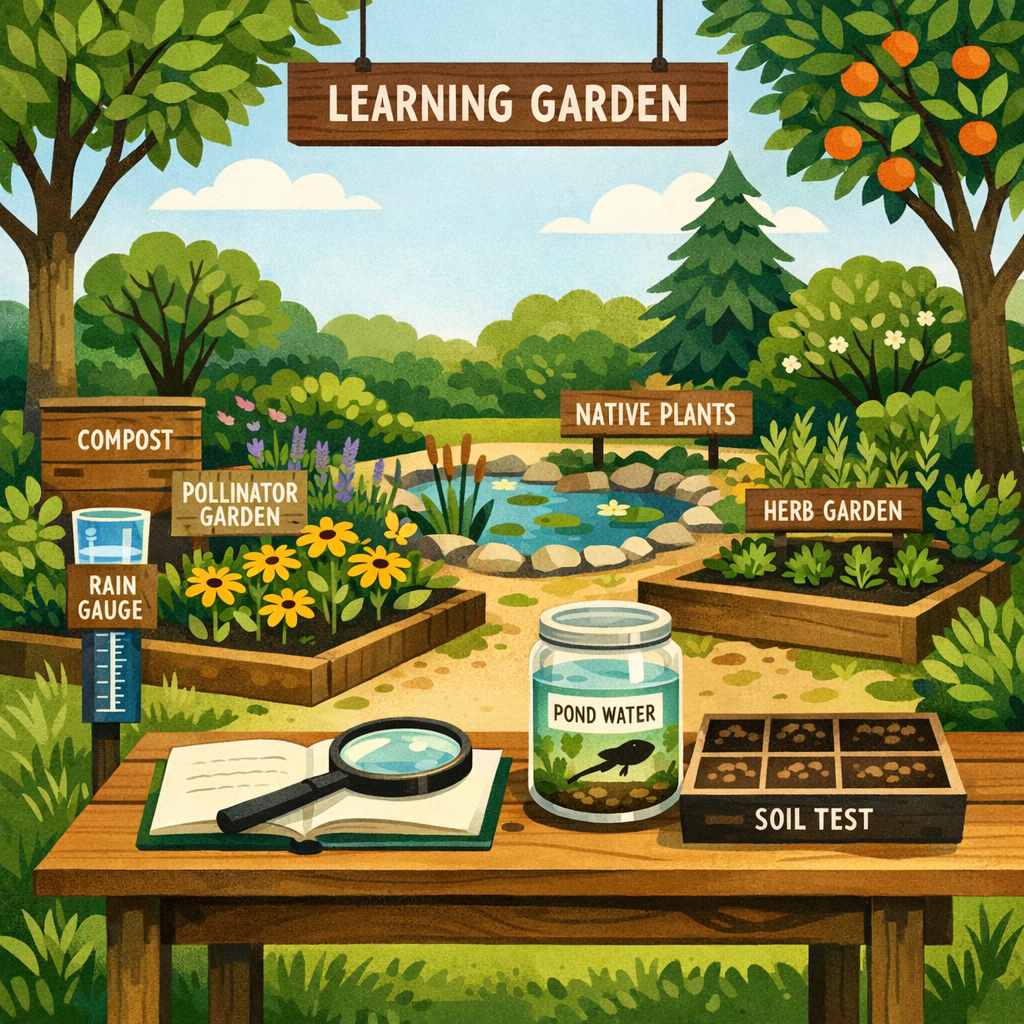
Students design and build an outdoor science lab that serves the whole school as a living botanical garden for observation, research, experimentation, and reflection. Through creating themed garden areas, they investigate what plants need to grow, use scientific naming and morphology to classify what they plant, and apply Earth and life science concepts to real conditions such as soil, weather, biodiversity, natural resources, and human impact on the environment. Working with University of California Riverside, California Rare Fruit Growers, and VESD Grounds and Maintenance Workers, students launch the project through hands-on garden design, document learning in nature journals, poems, and observation diagrams, and improve their work through peer critique and revision. The experience builds self-direction, collaboration, problem solving, communication, and academic identity as students create a lasting space for NGSS-aligned learning.
Learning goals
Students will explain what plants need to grow, using observations and investigations to support arguments that plants get key materials chiefly from air and water, and they will connect plant growth to weather, soil, climate, and human impact on the environment. They will apply scientific principles to help design and monitor themed garden areas as an outdoor science lab, using nature journals, poems, and observation diagrams to study biodiversity, seasonal change, and earth systems. Students will build content expertise in plant morphology and scientific naming while collaborating with peers and community partners to create, critique, revise, and communicate garden plans and findings. They will strengthen self-direction, problem solving, and academic mindset by using feedback, reflection, and shared decision-making to improve the garden’s design and its usefulness for the whole school community.
[Next Generation Science Standards] MS-ESS3-3 - Apply scientific principles to design a method for monitoring and minimizing a human impact on the environment.
[Next Generation Science Standards] ESS.2.A - Earth Materials and Systems
[Next Generation Science Standards] ESS.2.D - Weather and Climate
[Next Generation Science Standards] ESS.1.B - Earth and the Solar System
[Next Generation Science Standards] ESS.3.D - Global Climate Change
[Next Generation Science Standards] LS.4.D - Biodiversity and Humans
[Next Generation Science Standards] 5-LS1-1 - Support an argument that plants get the materials they need for growth chiefly from air and water.
[Next Generation Science Standards] MS-ESS3-3 - Apply scientific principles to design a method for monitoring and minimizing a human impact on the environment.
Competencies
Self Directed Learning - Students use teacher and peer feedback and self-reflection to monitor and direct their own learning while building self knowledge both in and out of the classroom.
Critical Thinking & Problem Solving - Students consider a variety of innovative approaches to address and understand complex questions that are authentic and important to their communities.
Collaboration - Students co-design projects with peers, exercise shared-decision making, strengthen relational agency, resolve conflict, and assume leadership roles.
Content Expertise - Students develop key competencies, skills, and dispositions with ample opportunities to apply knowledge and engage in work that matters to them.
Effective Communication - Students practice listening to understand, communicating with empathy, and share their learning through exhibiting, presenting and reflecting on their work.
Academic Mindset - Students establish a sense of place, identity, and belonging to increase self-efficacy while engaging in critical reflection and action.
Products
Students will create botanical garden design plans, plant selection guides using scientific and common names, and ongoing nature journals with observation notes, poems, and labeled diagrams. As they build and study the space, they will also produce monitoring tools such as weather logs, soil and water data charts, biodiversity counts, and proposals for reducing human impact in the garden. The final products will be themed garden areas designed as outdoor science lab stations for observation, experimentation, and reflection, along with student-made signage that explains plant needs, ecosystem connections, and stewardship practices. Students will share their work through presentations and a public garden walkthrough for peers, staff, and community partners.
Launch
Begin with a site walk and design challenge in which students explore the future garden space with partners from UC Riverside, California Rare Fruit Growers, and VESD Grounds and Maintenance, documenting sunlight, soil, wind, water flow, and existing human impacts in field notes and quick sketches. In mixed-grade teams, students handle sample plants, decode scientific names, and test what plants need to grow by comparing different microhabitats and discussing how each area could support observation, research, and experiments. Teams then create and share a first-draft map for themed garden zones that could function as an outdoor science lab, using peer feedback to revise their ideas. Close the launch with the driving question, “How can we create an outdoor science lab?” and a first nature journal entry, diagram, or poem capturing what they noticed and want to investigate.
Exhibition
Host a student-led Botanical Garden Opening where mixed-grade teams guide classmates, families, and partners from UC Riverside, California Rare Fruit Growers, and VESD Grounds and Maintenance through the themed observation areas they designed. At each stop, students share nature journals, poems, labeled scientific diagrams, and brief explanations of plant needs, scientific naming, biodiversity, weather impacts, and how the garden design helps monitor or reduce human impact on the environment. Install durable student-made signs and QR codes so the whole student body can continue using the garden as an outdoor science lab after the event. End with a reflection gallery where visitors leave feedback and students identify how peer critique and revision strengthened their final work.