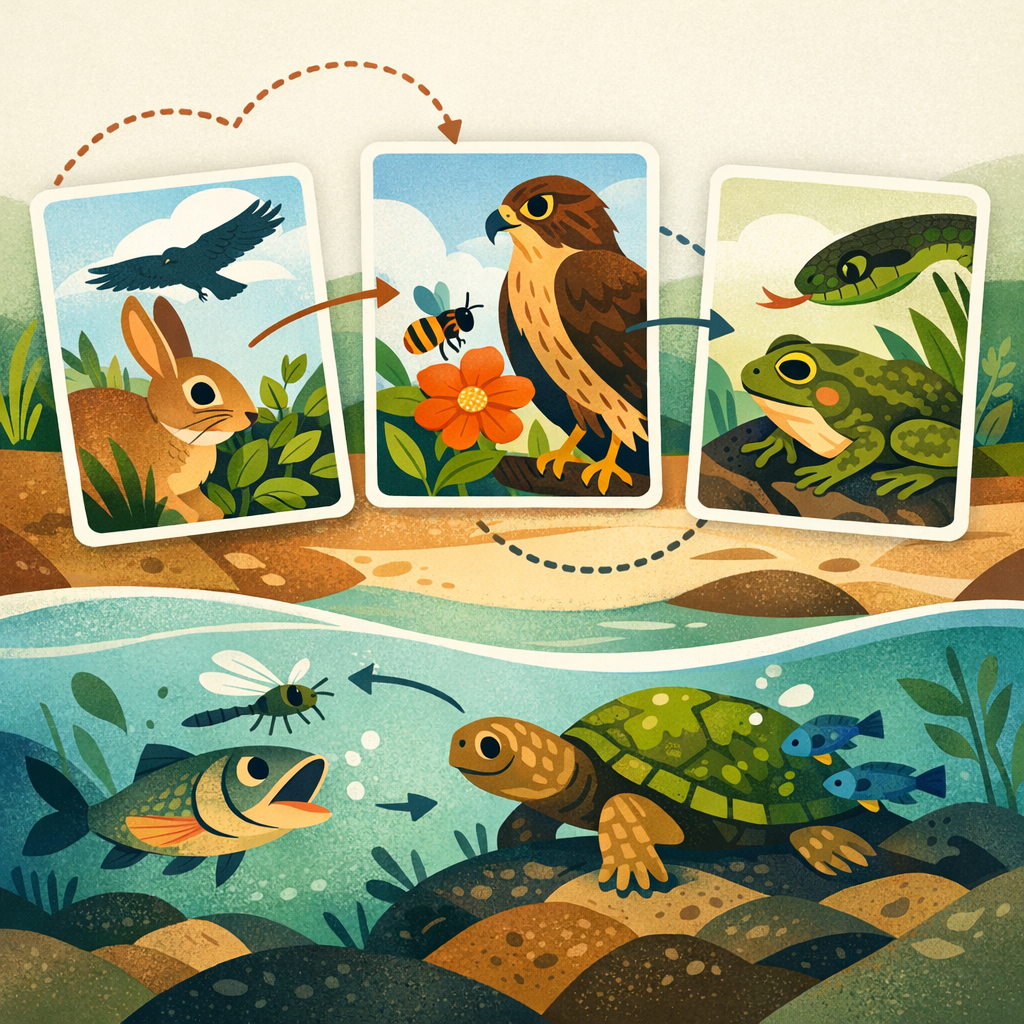
Students investigate how ecosystem dynamics, animal adaptations, natural selection, climate change, and human actions affect survival over time by designing and testing a card game for younger learners. Through the Survival Showdown launch, repeated playtesting, partner feedback, and revisions with input from a local wildlife organization, they build accurate animal, plant, habitat, rule, and event cards that model interdependence and change. The work culminates in a public tournament and expo where students explain their design choices, show how humans can shift ecosystem balance, and demonstrate collaboration, critical thinking, communication, and self-directed learning through a playable product.
Learning goals
Students explain how adaptations, natural selection, and ecosystem interactions affect whether animals and plants survive in changing habitats. Students design and revise a card game and tournament kit that accurately models ecosystem dynamics, climate-change events, and human impacts on Earth systems over time. Students collaborate to playtest, give and use feedback from peers and a local wildlife organization, and improve cards, rules, and habitat connections based on evidence from gameplay. Students communicate their scientific thinking through game explanations, reflections, and a public tournament where they show how species, habitats, and human actions are interconnected.
[Next Generation Science Standards] ESS.3.C - Human Impacts on Earth Systems
[Next Generation Science Standards] ESS.3.D - Global Climate Change
Competencies
Collaboration - Students co-design projects with peers, exercise shared-decision making, strengthen relational agency, resolve conflict, and assume leadership roles.
Content Expertise - Students develop key competencies, skills, and dispositions with ample opportunities to apply knowledge and engage in work that matters to them.
Critical Thinking & Problem Solving - Students consider a variety of innovative approaches to address and understand complex questions that are authentic and important to their communities.
Effective Communication - Students practice listening to understand, communicating with empathy, and share their learning through exhibiting, presenting and reflecting on their work.
Self Directed Learning - Students use teacher and peer feedback and self-reflection to monitor and direct their own learning while building self knowledge both in and out of the classroom.
Products
Students will create a playable set of ecosystem card game cards featuring animals, plants, habitats, adaptations, and human or climate event effects, along with short evidence-based descriptions of how each trait supports survival. They will also build a Nature Shift tournament kit that includes game boards, rule cards, habitat cards, and event cards showing ecosystem change over time. Throughout the project, teams will produce early prototypes, revised card sets based on peer playtesting and wildlife partner feedback, and reflection notes that track how their game models ecosystem balance, natural selection, adaptation, and human impacts. By the end, each team will present a polished game system ready for the Ecosystem Card Clash Expo and tournament play with guests.
Launch
Open with a “Survival Showdown” where teams enter a mini ecosystem game using simple habitat, animal adaptation, plant, and climate-event cards, then play quick rounds to see which species survive, struggle, or disappear. After each round, students compare outcomes, notice patterns in natural selection, adaptation, and human impacts, and revise one game rule based on what felt realistic or unbalanced. Bring in a local wildlife organization partner live or by video to react to the first results and pose a challenge about how habitat loss or climate change could shift the ecosystem over time. Close with a brief debrief where partners name one survival trait they saw matter most, one human impact they want the full game to include, and one design idea they want to test next.
Exhibition
Host an Ecosystem Card Clash Expo where students run a live tournament for families, peers, and a local wildlife organization, using their card sets, game boards, rule cards, and climate or habitat event cards. Between rounds, teams give short explanations of how specific animal adaptations, ecosystem relationships, natural selection, and human impacts are represented in their game mechanics. Include a Nature Shift Tournament Day format with changing ecosystem conditions so guests can watch species survive, struggle, or disappear over time and ask questions about the design choices. End with a feedback station where visitors leave comments on how clearly each game shows connections among animals, plants, habitats, and human-caused environmental change.