6th Grade  Project 3 weeks

Aquarium Math Splash Lab

Marcela H
Updated
CCSS.Math.Content.6.G.A.2
Critical Thinking & Problem Solving
Effective Communication
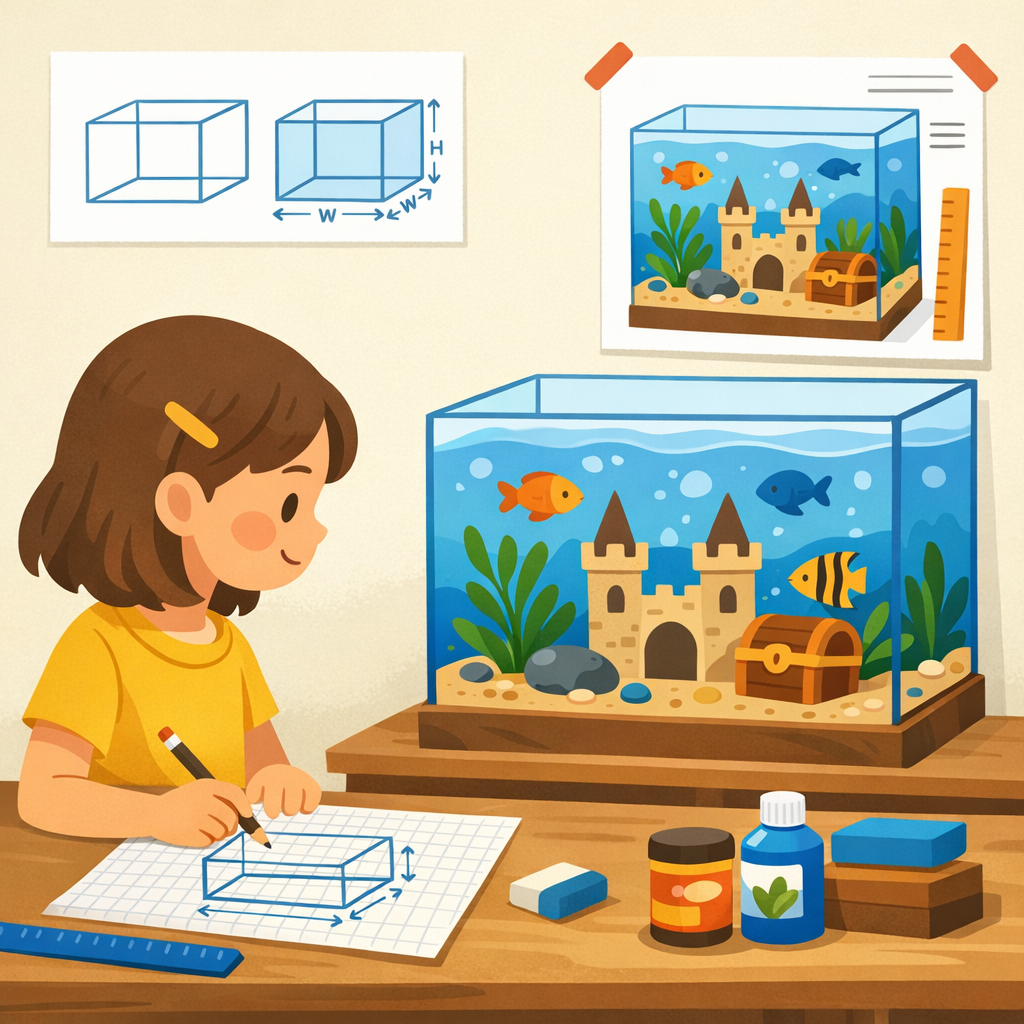
1-pager

Purpose

Students use volume and surface area to solve a real design problem by creating an aquarium that holds enough water while using materials efficiently. They investigate how dimensions, shape, and cost affect a tank design, then apply formulas, nets, models, and measurement evidence to justify their choices. Across the project, they build critical thinking through design revisions and strengthen communication by explaining their math in conferences, reflection routines, and a public showcase.

Learning goals

Students will calculate and compare the volume and surface area of rectangular prisms, including prisms with fractional edge lengths, using models, nets, and formulas to solve an aquarium design challenge. They will use measurements, cost notes, and material choices to revise a tank design so it holds the needed amount of water while using materials efficiently. Students will communicate their thinking clearly through labeled models, posters, and short presentations that explain dimensions, calculations, and design decisions. They will reflect on feedback, make design improvements, and work with teammates to justify how their aquarium best meets the fish home challenge.

Standards
  • [Common Core] CCSS.Math.Content.6.G.A.2 - Find the volume of a right rectangular prism with fractional edge lengths by packing it with unit cubes of the appropriate unit fraction edge lengths, and show that the volume is the same as would be found by multiplying the edge lengths of the prism. Apply the formulas V = l w h and V = b h to find volumes of right rectangular prisms with fractional edge lengths in the context of solving real-world and mathematical problems.
Competencies
  • Critical Thinking & Problem Solving - Students consider a variety of innovative approaches to address and understand complex questions that are authentic and important to their communities.
  • Effective Communication - Students practice listening to understand, communicating with empathy, and share their learning through exhibiting, presenting and reflecting on their work.

Products

Students will create sketch drafts, prism nets, and quick cardboard test models as they compare aquarium dimensions, water capacity, and material use across the project. By the end, each team will produce a labeled aquarium model or small 3D prototype, a scaled poster with dimensions, volume, surface area, nets, and cost notes, and a materials list that explains their design choices. Teams will also compile a short design portfolio with revised sketches, measurement calculations, exit-ticket reflections, and a brief presentation script for the gallery walk. These products should clearly show how the tank meets the fish home challenge while balancing fish space, shape, and material efficiency.

Launch

Open with a “Fish Home Challenge Reveal” in which students watch a short pet store scenario: a customer needs an aquarium that holds a specific amount of water, fits on a shelf, and uses affordable materials. In teams, students inspect 2–3 sample rectangular prism tank models or nets, predict which design holds more water and which uses less material, then test their ideas by measuring dimensions and discussing volume and surface area. Follow with a quick “Tank Tinker” sketch challenge where each team drafts a first aquarium design for a fish family and explains how shape, space, and cost influenced their choices. Close by introducing the gallery-style Design Tank Showcase so students know their final model, poster, and math notes will be shared with an audience.

Exhibition

Host a Design Tank Showcase as a gallery walk where teams display their labeled aquarium model, scaled poster, 3D prototype, and design portfolio on table stations. Invite classmates, families, and school staff to circulate, ask questions, and use a simple feedback form focused on how well each design balances water capacity, surface area, and material use. Each team gives a short presentation using their math card to explain their volume and surface area calculations, design revisions, and material choices. End with a brief audience vote or recognition for designs that best meet the fish home challenge with accurate math and thoughtful problem solving.