About Us Impact News Pricing Contact Us Explore
Make a copy
About Us Impact News Pricing Contact Us Explore
Tools
Project-Based Learning Performance Assessment Student-Led Conferences Digital Portfolios
Framework
Loading
Loading
    Products & Rubric
All grades  Project 6 weeks

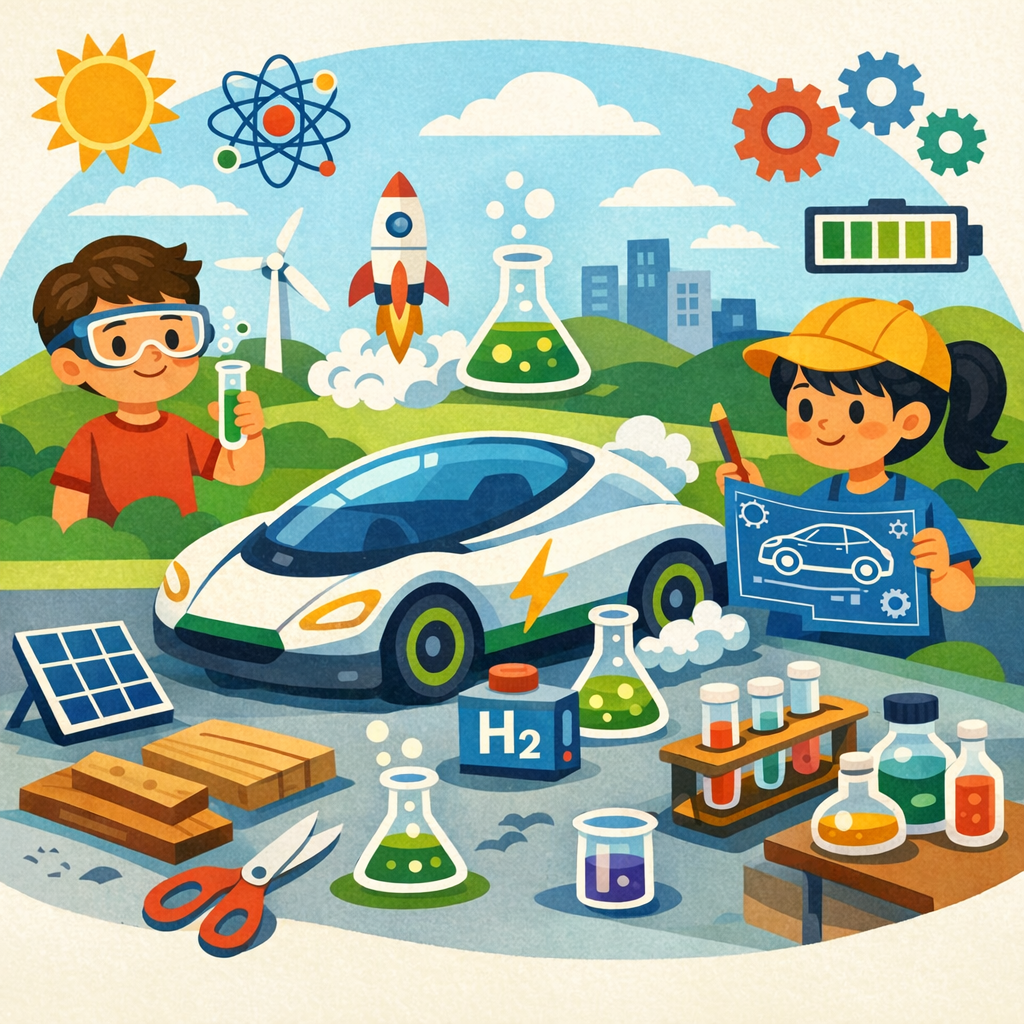
Zoom into the Future Car Factory!

Bryce H
Mar 17, 2026
Updated May 9, 2026
PS.Chm.1.3
PS.Chm.1.1
PS.Chm.1.2
PS.Chm.3.1
PS.Chm.3.2
+ 13 more
1-pager

Purpose

Students investigate how chemistry can shape cleaner transportation by designing and testing a future car that balances performance, cost, and environmental impact. Across six weeks, they use models of atomic structure, bonding, reaction energy, and stoichiometry to justify material choices, explain the chemical reaction or energy system that powers their prototype, and analyze how CO2 emissions contribute to water acidification. Through ongoing reflection, peer critique, and collaboration with automotive and environmental partners, students revise their ideas for a public showcase and Future Auto Expo where they communicate evidence-based solutions for reducing a car’s carbon footprint.

Learning goals

Students will explain how atomic structure, valence electrons, bonding, and intermolecular forces influence the properties of materials and fuels used in car design, using models, formulas, and the Periodic Table to justify choices. They will investigate and compare chemical reactions that could power a future car, including energy changes, conservation of mass, mole relationships, and percent composition, and use evidence to evaluate efficiency, safety, cost, and environmental impact. Students will model how CO2 emissions contribute to water acidification and communicate how alternative car designs can reduce harm to ecosystems through prototypes, peer critique, reflection wall posts, and a public expo presentation.

Standards
  • [North Carolina] PS.Chm.1.3 - Use models to explain how electrons are distributed in atoms.
  • [North Carolina] PS.Chm.1.1 - Use models to explain how the scientific understanding of atomic structure has evolved.
  • [North Carolina] PS.Chm.1.2 - Use models to compare nuclear reactions including alpha decay, beta decay and gamma decay; nuclear fusion and nuclear fission.
  • [North Carolina] PS.Chm.3.1 - Analyze and interpret data to explain the mechanisms and properties of the two main types of intramolecular (ionic and covalent) bonds.
  • [North Carolina] PS.Chm.3.2 - Construct an explanation to summarize the influences intermolecular forces have on the properties of chemical compounds.
  • [North Carolina] PS.Chm.3.3 - Use models to predict chemical names and formulas including ionic (binary & ternary), acidic, and binary covalent compounds.
  • [North Carolina] PS.Chm.2.1 - Use the Periodic Table as a model to predict the relative properties of elements based on the pattern of valence electrons in the outermost energy levels of atoms.
  • [North Carolina] PS.Chm.2.2 - Construct an explanation to infer the atomic size, reactivity, electronegativity, and ionization energy of an element based on its position in the Periodic Table.
  • [North Carolina] PS.Chm.4.1 - Use models to explain the exothermic or endothermic nature of chemical changes.
  • [North Carolina] PS.Chm.4.2 - Carry out investigations to predict the outcome of simple chemical reactions that obey the Law of Conservation of Mass.
  • [North Carolina] PS.Chm.4.4 - Use mathematics and computational thinking to apply the mole concept in the stoichiometric relationships inherent in chemical reactions.
  • [North Carolina] PS.Chm.4.3 - Use mathematics and computational thinking to analyze quantitatively the composition of a substance (empirical formula, molecular formula, percent composition, and mole conversions).
Competencies
  • Critical Thinking & Problem Solving - Students consider a variety of innovative approaches to address and understand complex questions that are authentic and important to their communities.
  • Collaboration - Students co-design projects with peers, exercise shared-decision making, strengthen relational agency, resolve conflict, and assume leadership roles.
  • Effective Communication - Students practice listening to understand, communicating with empathy, and share their learning through exhibiting, presenting and reflecting on their work.
  • Content Expertise - Students develop key competencies, skills, and dispositions with ample opportunities to apply knowledge and engage in work that matters to them.
  • Self Directed Learning - Students use teacher and peer feedback and self-reflection to monitor and direct their own learning while building self knowledge both in and out of the classroom.
  • Academic Mindset - Students establish a sense of place, identity, and belonging to increase self-efficacy while engaging in critical reflection and action.

Products

Teams will create a sequence of products across the six weeks: a concept sketch and materials-testing log for the car body, a chemical energy model with balanced reactions and annotated particle/atom diagrams, and a CO2-acidification investigation display that connects emissions to water quality impacts. They will also maintain reflection wall posts, peer critique notes, and revision records after each two-week checkpoint to document design changes and scientific reasoning. The final products will be a prototype or scale model of a future car powered by a chosen system, a digital presentation explaining material choices, bonding and reaction evidence, and environmental tradeoffs, and a public-facing exhibit for the Future Auto Expo and community showcase. Younger students can use labeled models, photos, and oral explanations, while older students add formulas, stoichiometric calculations, and comparative emissions data.

Launch

Open with a “Future Auto Challenge” gallery walk featuring a local vehicle expert, images or parts from traditional and alternative-fuel cars, and a short water acidification demo showing how added CO2 changes pH. Students then test a few sample body materials for weight, strength, and cost, and examine simple models of fuel reactions to begin asking how material choice and chemical energy affect performance and environmental impact. End the launch with teams posting first ideas and questions on the reflection wall tied to the essential questions, then introducing the 2-week design checkpoints, weekly peer critique routine, and the goal of presenting at the Future Auto Expo and community showcase.

Exhibition

End with a “Future Auto Expo” where teams display their car prototypes, materials test data, balanced chemical reaction models, and water-acidification investigations in a public gallery format. Students should give short presentations and demonstrations to families, peers, local automotive professionals, and environmental partners, explaining how their design choices affect performance, cost, energy production, and carbon impact. Include interactive stations where visitors can compare material samples, review digital design slides, and ask questions about emissions, CO2, and sustainable fuel options. Close with a community feedback protocol in which guests leave comments and questions that students use in a final reflection on their design process and scientific learning.

Plan
By Phase By Day Calendar
Launch User Research Synthesis Design Brief Creation Concepts Prototyped Prototype Validated Expo Showcase
Launch
Students will launch the Future Auto Challenge by observing a real-world phenomenon, testing starter materials, and building shared expectations for how they will design a future car that balances performance, chemical energy, and environmental impact. They will begin using evidence, questions, and early feedback routines that carry into later phases.
Days 1 - 3
🚗 Future Auto Challenge Gallery
Launch 75m
🧪 Car Body Material Test Lab
Knowledge/Skill Building 75m
✏️ Car Idea Sketch Critique
Deliverable 75m
No activities have been added to this phase yet.

Edit Phase

Loading...
User Research Synthesis
Students will synthesize interview, observation, and quick evidence from real users to identify transportation and environmental needs, build empathy artifacts, check assumptions against data, and refine the design problem their future car should address.
Days 4 - 9
👀 Transit Needs Interview Practice
Knowledge/Skill Building 75m
🗺️ User Notes to Empathy Map
Knowledge/Skill Building 75m
⚙️ Material Samples and Pollution Clues
Knowledge/Skill Building 75m
📞 Community Voices on Cleaner Cars
Community Experience 75m
🧩 Problem Themes and Need Statements
Deliverable 75m
✅ Empathy Evidence Checkpoint
Assessment 75m
No activities have been added to this phase yet.

Edit Phase

Loading...
Design Brief Creation
Students will turn user research and science evidence into a focused future-car design brief by defining a clear problem, checking assumptions against evidence, and setting measurable success criteria for materials, energy systems, and environmental impact before moving into concept generation.
Days 10 - 15
🧭 Future Car Needs Sort
Launch 75m
⚛️ Materials and Bonding Evidence Lab
Knowledge/Skill Building 75m
🧪 Fuel Reaction Decision Tools
Knowledge/Skill Building 75m
🌊 CO2 Impact Criteria Check
Research 75m
✍️ How Might We Brief Draft
Deliverable 75m
✅ Design Brief Milestone Review
Assessment 75m
No activities have been added to this phase yet.

Edit Phase

Loading...
Concepts Prototyped
Students will turn their design briefs into multiple future-car concepts, compare options with evidence-based criteria, build low-fidelity prototypes, and use peer and user feedback to revise a chosen direction for the next phase.
Days 16 - 21
🧪 Fuel Reaction Choice Lab
Knowledge/Skill Building 75m
🧱 Body Materials Bonding Sort
Knowledge/Skill Building 60m
✏️ Three Future Car Concepts
Project Work 75m
📐 Low-Tech Prototype Build
Deliverable 75m
💬 Prototype Feedback Carousel
Community Experience 75m
✅ Concept Gate Review
Assessment 75m
No activities have been added to this phase yet.

Edit Phase

Loading...
Prototype Validated Expo
Students will refine their future-car prototype through two documented feedback-and-revision cycles, validate design choices with a new user or community voice, and assemble an evidence-based Future Auto Expo presentation that explains materials, fuel chemistry, environmental impact, and next steps.
Days 22 - 27
🧪 Reaction Claims Mini-Clinic
Knowledge/Skill Building 60m
🛠️ Prototype Revision Sprint One
Project Work 75m
💬 Two-Peer Critique Protocol
Deliverable 75m
🌍 CO2 Water Impact Check
Knowledge/Skill Building 60m
🚗 Expert Validation and Sprint Two
Community Experience 90m
🖼️ Future Auto Expo Draft
Assessment 75m
No activities have been added to this phase yet.

Edit Phase

Loading...
Showcase
Students will finalize and present their future car solutions to an authentic audience, use audience and peer feedback to explain and defend their design decisions, and reflect on how chemistry evidence, user needs, and environmental impact shaped their prototype revisions.
Days 28 - 30
🧭 Future Auto Expo Rehearsal
Deliverable 75m
💬 Expo Feedback and Revision
Project Work 75m
🚗 Community Showcase Presentations
Assessment 75m
No activities have been added to this phase yet.

Edit Phase

Loading...
Launch Days 1–3
Day 1
🚗 Future Auto Challenge Gallery
Launch 75m
Day 2
🧪 Car Body Material Test Lab
Knowledge/Skill Building 75m
Day 3
✏️ Car Idea Sketch Critique
Deliverable 75m
User Research Synthesis Days 4–9
Day 4
👀 Transit Needs Interview Practice
Knowledge/Skill Building 75m
Day 5
🗺️ User Notes to Empathy Map
Knowledge/Skill Building 75m
Day 6
⚙️ Material Samples and Pollution Clues
Knowledge/Skill Building 75m
Day 7
📞 Community Voices on Cleaner Cars
Community Experience 75m
Day 8
🧩 Problem Themes and Need Statements
Deliverable 75m
Day 9
✅ Empathy Evidence Checkpoint
Assessment 75m
Design Brief Creation Days 10–15
Day 10
🧭 Future Car Needs Sort
Launch 75m
Day 11
⚛️ Materials and Bonding Evidence Lab
Knowledge/Skill Building 75m
Day 12
🧪 Fuel Reaction Decision Tools
Knowledge/Skill Building 75m
Day 13
🌊 CO2 Impact Criteria Check
Research 75m
Day 14
✍️ How Might We Brief Draft
Deliverable 75m
Day 15
✅ Design Brief Milestone Review
Assessment 75m
Concepts Prototyped Days 16–21
Day 16
🧪 Fuel Reaction Choice Lab
Knowledge/Skill Building 75m
Day 17
🧱 Body Materials Bonding Sort
Knowledge/Skill Building 60m
Day 18
✏️ Three Future Car Concepts
Project Work 75m
Day 19
📐 Low-Tech Prototype Build
Deliverable 75m
Day 20
💬 Prototype Feedback Carousel
Community Experience 75m
Day 21
✅ Concept Gate Review
Assessment 75m
Prototype Validated Expo Days 22–27
Day 22
🧪 Reaction Claims Mini-Clinic
Knowledge/Skill Building 60m
Day 23
🛠️ Prototype Revision Sprint One
Project Work 75m
Day 24
💬 Two-Peer Critique Protocol
Deliverable 75m
Day 25
🌍 CO2 Water Impact Check
Knowledge/Skill Building 60m
Day 26
🚗 Expert Validation and Sprint Two
Community Experience 90m
Day 27
🖼️ Future Auto Expo Draft
Assessment 75m
Showcase Days 28–30
Day 28
🧭 Future Auto Expo Rehearsal
Deliverable 75m
Day 29
💬 Expo Feedback and Revision
Project Work 75m
Day 30
🚗 Community Showcase Presentations
Assessment 75m

May 2026

Mon
Tue
Wed
Thu
Fri
25 Day 1
Launch
🚗 Future Auto Challenge Gallery
26 Day 2
🧪 Car Body Material Test Lab
27 Day 3
✏️ Car Idea Sketch Critique
28 Day 4
User Research Synthesis
👀 Transit Needs Interview Practice
29 Day 5
🗺️ User Notes to Empathy Map

June 2026

Mon
Tue
Wed
Thu
Fri
1 Day 6
⚙️ Material Samples and Pollution Clues
2 Day 7
📞 Community Voices on Cleaner Cars
3 Day 8
🧩 Problem Themes and Need Statements
4 Day 9
✅ Empathy Evidence Checkpoint
5 Day 10
Design Brief Creation
🧭 Future Car Needs Sort
8 Day 11
⚛️ Materials and Bonding Evidence Lab
9 Day 12
🧪 Fuel Reaction Decision Tools
10 Day 13
🌊 CO2 Impact Criteria Check
11 Day 14
✍️ How Might We Brief Draft
12 Day 15
✅ Design Brief Milestone Review
15 Day 16
Concepts Prototyped
🧪 Fuel Reaction Choice Lab
16 Day 17
🧱 Body Materials Bonding Sort
17 Day 18
✏️ Three Future Car Concepts
18 Day 19
📐 Low-Tech Prototype Build
19 Day 20
💬 Prototype Feedback Carousel
22 Day 21
✅ Concept Gate Review
23 Day 22
Prototype Validated Expo
🧪 Reaction Claims Mini-Clinic
24 Day 23
🛠️ Prototype Revision Sprint One
25 Day 24
💬 Two-Peer Critique Protocol
26 Day 25
🌍 CO2 Water Impact Check

July 2026

Mon
Tue
Wed
Thu
Fri
29 Day 26
🚗 Expert Validation and Sprint Two
30 Day 27
🖼️ Future Auto Expo Draft
1 Day 28
Showcase
🧭 Future Auto Expo Rehearsal
2 Day 29
💬 Expo Feedback and Revision
3 Day 30
🚗 Community Showcase Presentations
Share
Activities
Loading
Loading
Loading
Get it on Google Play
© 2026 Inkwire Inc
Contact Us Privacy Policy Terms of Service