8th Grade  Project 2 weeks

Plot Party: A Fun Data Dive!

Kara L
Updated
CCSS.Math.Content.8.SP.A.1
CCSS.Math.Content.8.SP.A.2
Collaboration
Effective Communication
Critical Thinking & Problem Solving
1-pager

Purpose

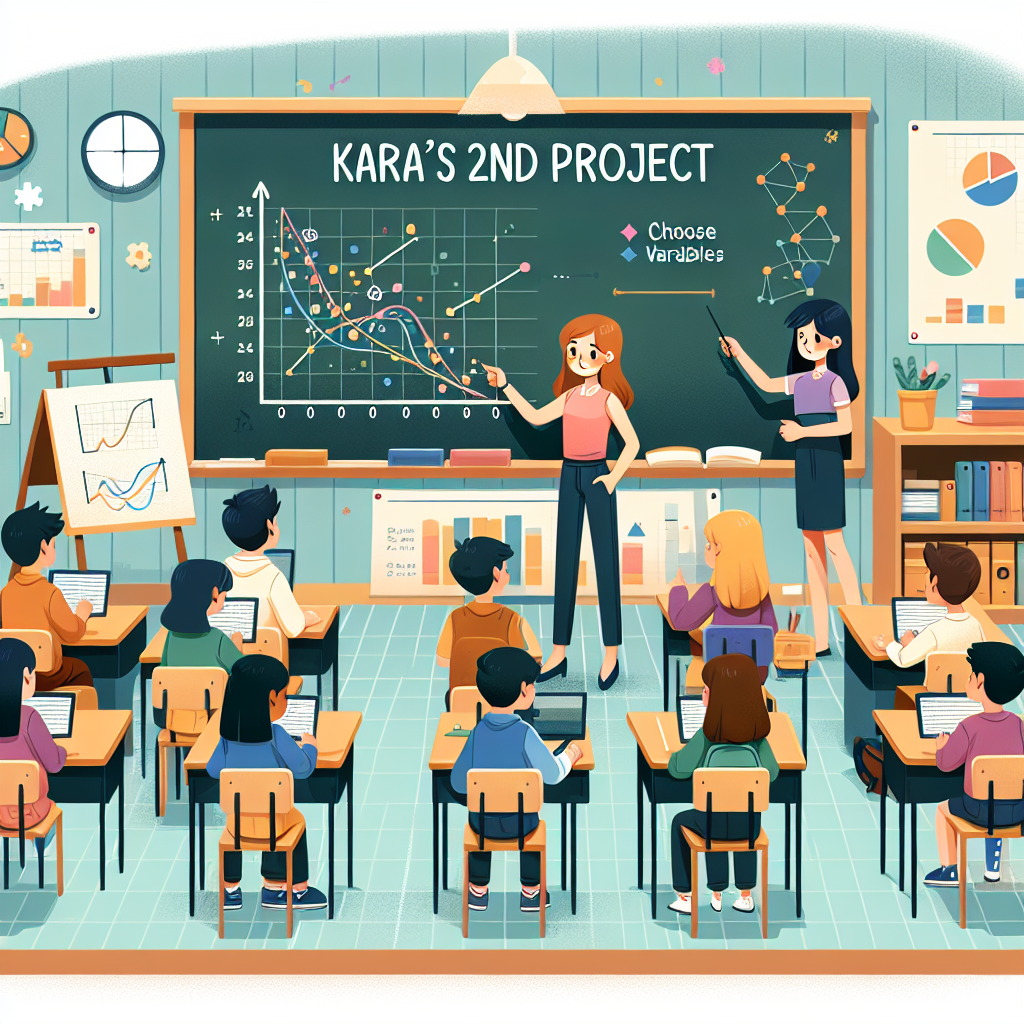
This scatter plot project serves to deepen students' understanding of data visualization and its real-world applications through hands-on experience. By investigating correlations between chosen variables, students will develop critical thinking skills and learn how to construct meaningful interpretations that inform future predictions. Through collaborative design and a variety of experiential activities, this project aims to cultivate effective communication, strengthen problem-solving abilities, and encourage students to explore the broader implications of data analysis in everyday situations.

Learning goals

Students will explore the use of scatter plots to uncover and predict trends in real-world situations, enhancing their critical thinking and problem-solving skills. Through collaboration, they will learn to co-design projects, make shared decisions, and assume varying roles, strengthening relational agency. They will also practice effective communication by presenting their learning in diverse formats, such as documentaries, infographics, and 3D models, fostering empathy and understanding through active listening and interaction.

Standards
  • [Common Core] CCSS.Math.Content.8.SP.A.1 - Construct and interpret scatter plots for bivariate measurement data to investigate patterns of association between two quantities. Describe patterns such as clustering, outliers, positive or negative association, linear association, and nonlinear association.
  • [Common Core] CCSS.Math.Content.8.SP.A.2 - Know that straight lines are widely used to model relationships between two quantitative variables. For scatter plots that suggest a linear association, informally fit a straight line, and informally assess the model fit by judging the closeness of the data points to the line.
Competencies
  • Collaboration - Students co-design projects with peers, exercise shared-decision making, strengthen relational agency, resolve conflict, and assume leadership roles.
  • Effective Communication - Students practice listening to understand, communicating with empathy, and share their learning through exhibiting, presenting and reflecting on their work.
  • Critical Thinking & Problem Solving - Students consider a variety of innovative approaches to address and understand complex questions that are authentic and important to their communities.

Products

Students will create a documentary-style video explaining their data collection, scatter plot construction, and interpretation processes. Additionally, they will develop an infographic illustrating the relationship between the studied variables and their real-world implications. As a physical representation, students will construct a 3D model mapping data points with a tangible line of best fit to show trends between x and y values. These products encourage hands-on learning and effective communication through varied media formats.

Launch

Begin the project with an interactive 'Data Detective Workshop' led by a guest data scientist, who will guide students through the exploration of a real-world case study. The scientist will demonstrate how to gather data, interpret scatter plots, and make predictions, stirring curiosity and setting the tone for an investigative approach to learning. Students will get hands-on experience, asking questions and participating in activities that exemplify the practical application of scatter plots in various fields. This approach will foster an engaging entry into the project and highlight the relevancy of data literacy in real-world decision-making processes.

Exhibition

Celebrate students' accomplishments by organizing a 'Real-World Data Talk Show,' where they present their projects as featured guests. They will engage in lively live discussions with a student moderator, exploring the implications of their findings and sharing deeper insights with an audience. This format encourages dynamic interaction, allowing students to articulate their learning and progress, while fostering a supportive environment for class-wide celebration and reflection on their work.