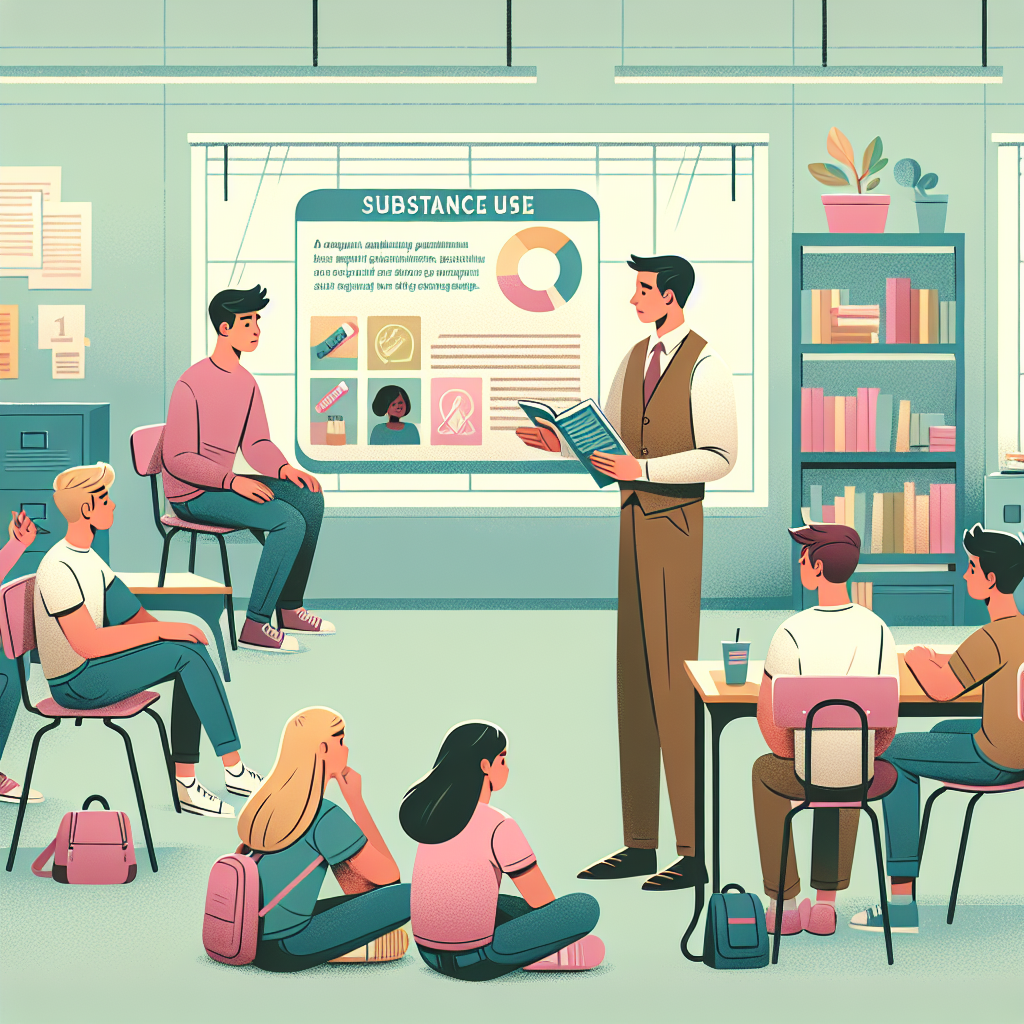
Substance use among young adults presents complex challenges for schools, affecting health, safety, and learning outcomes. Misunderstandings and stigma hinder open dialogue, requiring comprehensive approaches to foster supportive and informed school environments.
Challenge Question
How can educators and students collaboratively create a supportive school environment that effectively addresses substance use among young adults, while fostering open communication and community involvement, in alignment with updated health standards?
Standards
[Massachusetts] 12.1.SU.1 - Reflect on personal beliefs, choices, and values compared to cultural, community, and societal norms around substance use and misuse. [HPE]
[Massachusetts] 12.1.SU.2 - Evaluate situations and how various internal and external factors (e.g., peers, media, social norms, corporate practices) influence substance use and misuse. [HPE]
[Massachusetts] 12.1.SU.3 - Analyze the potential short- and long-term impacts (including addiction) of legal (e.g., prescription drugs prescribed to you, over-the-counter drugs, and [at a certain age] nicotine, electronic vapor products, alcohol, and marijuana) and illegal drugs (e.g., prescription drugs not prescribed to you, cocaine) on multiple dimensions of health (e.g., physical, mental, emotional, social, intellectual) and on other health risk behaviors (e.g., sexual activity, impaired driving). [HPE]
[Massachusetts] 12.1.SU.4 - Employ self-management skills to act on health-promoting decisions about legal drug use (e.g., prescription drugs prescribed to you, over-the-counter drugs, and [at a certain age] nicotine, electronic vapor products, alcohol, and marijuana). [HPE; SE]
[Massachusetts] 12.5.CE.1 - Explore the impact of social determinants of health (e.g., education, social environment, socioeconomic conditions, public safety) on individuals at different levels (e.g., interpersonal, intrapersonal, community, policy). [HPE]
[Massachusetts] 12.5.CE.2 - Evaluate the influence of social context/environment, not solely personal choices, on an individual’s health. [HPE]
[Massachusetts] 12.5.CE.3 - Identify contributing causes (e.g., public policy, industrial growth, racism, power, inequity/inequality) that can influence public, community, or environmental health and analyze strategies to address these causes in ways that may improve health outcomes. [HPE; SE]
[Massachusetts] 12.5.CE.6 - Analyze the relationship between the health of various groups in a community and its impact on overall community health. [HPE; SE]
[Massachusetts] 12.5.CE.7 - Analyze behaviors, policies and practices in the school community that promote dignity and respect and reduce stigma for all individuals. [HPE; SE]
Competencies
Self Directed Learning - Students use teacher and peer feedback and self-reflection to monitor and direct their own learning while building self knowledge both in and out of the classroom.
Academic Mindset - Students establish a sense of place, identity, and belonging to increase self-efficacy while engaging in critical reflection and action.
Critical Thinking & Problem Solving - Students consider a variety of innovative approaches to address and understand complex questions that are authentic and important to their communities.
Content Expertise - Students develop key competencies, skills, and dispositions with ample opportunities to apply knowledge and engage in work that matters to them.
Effective Communication - Students practice listening to understand, communicating with empathy, and share their learning through exhibiting, presenting and reflecting on their work.
Collaboration - Students co-design projects with peers, exercise shared-decision making, strengthen relational agency, resolve conflict, and assume leadership roles.
Learning Partners and Clients
Students will collaborate with the Railroad Street Youth Project, South Berkshire Community Health Coalition, school guidance counselors, health teachers, classroom teachers, and the director of curriculum and instruction. These partners will provide valuable insights and resources to help students develop a comprehensive understanding of substance use in young adults. Through these partnerships, students will engage in meaningful dialogues, gather diverse perspectives, and create impactful solutions that address the real-world challenge of navigating substance use in educational settings.
Phase Outcomes
Phase
Learning Outcome
Discover
I can identify the stigma surrounding substance use in young adults by engaging in discussions and activities that reveal its root causes and effects within the school community.
Examine
I can research the impact of substance use on students and educators by conducting interviews and analyzing data from various perspectives to understand the complexity of the issue.
Engineer
I can develop a comprehensive resource guide for educators that includes effective strategies and communication techniques to address substance use in schools.
Do
I can implement my solution by collaborating with school staff to test the resource guide's effectiveness and gather feedback on its impact in real-world scenarios.
Share
I can share my learning journey and the developed resource guide through a community forum, where I present insights and personal growth to peers, educators, and local organizations.