Kindergarten Grade  Project 4 weeks

Shape Shifters: Toy Design Challenge!

Lucero M
CCSS.Math.Content.K.G.A.3
CCSS.Math.Content.K.G.B.4
K-2-ETS1-2
Self Directed Learning
Academic Mindset
+ 1 more
1-pager

Purpose

In this four-week project, kindergarten students will explore the world of shapes by designing and constructing their own toy using both two-dimensional and three-dimensional shapes. Through hands-on activities, they will investigate how shapes fit together and analyze their properties to create a functional and enjoyable toy, demonstrating that everyone can create a toy. This project encourages students to engage in self-directed learning, critical thinking, and problem-solving, as they receive feedback and reflect on their design process. The experience aims to build students' confidence and sense of belonging while fostering a deeper understanding of mathematical and scientific concepts.

Learning goals

Students will explore and identify two-dimensional and three-dimensional shapes, understanding their characteristics and how they can be combined to create a toy. They will engage in sketching and modeling to illustrate how different shapes contribute to a toy's functionality and appeal. Through feedback and reflection, students will develop self-directed learning skills, enhancing their ability to assess and improve their designs. They will cultivate an academic mindset by connecting their identity and sense of belonging to the creative process. Finally, students will employ critical thinking and problem-solving to address the challenge of designing a toy that is both educational and enjoyable, recognizing that everyone has the ability to create a toy.
Standards
  • [Common Core] CCSS.Math.Content.K.G.A.3 - Identify shapes as two-dimensional (lying in a plane, "flat") or three-dimensional ("solid").
  • [Common Core] CCSS.Math.Content.K.G.B.4 - Analyze and compare two- and three-dimensional shapes, in different sizes and orientations, using informal language to describe their similarities, differences, parts (e.g., number of sides and vertices/"corners") and other attributes (e.g., having sides of equal length).
  • [Next Generation Science Standards] K-2-ETS1-2 - Develop a simple sketch, drawing, or physical model to illustrate how the shape of an object helps it function as needed to solve a given problem.
Competencies
  • Self Directed Learning - Students use teacher and peer feedback and self-reflection to monitor and direct their own learning while building self knowledge both in and out of the classroom.
  • Academic Mindset - Students establish a sense of place, identity, and belonging to increase self-efficacy while engaging in critical reflection and action.
  • Critical Thinking & Problem Solving - Students consider a variety of innovative approaches to address and understand complex questions that are authentic and important to their communities.

Products

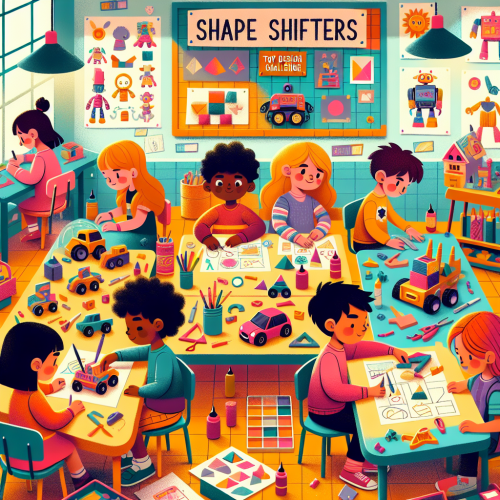
Throughout the learning experience, each student will create a series of sketches and physical models using both two-dimensional and three-dimensional shapes. By the end of the project, every student will have designed and built their own toy, showcasing their ability to combine shapes for both function and fun. These toys will be shared with preschool students, allowing kindergarteners to explain their design choices and the steps they took to solve design challenges.

Launch

Begin the project with a "Shape Exploration Day" where students engage in a hands-on scavenger hunt around the classroom or school to find and collect various two-dimensional and three-dimensional shapes. Encourage students to use tablets or cameras to take pictures of the shapes they find and discuss their observations with peers. Incorporate a storytime session featuring a book about shapes and their uses in everyday life, followed by a group discussion on how everyone can create a toy using these shapes. This will set the stage for understanding the essential questions and spark excitement for the toy design project.

Exhibition

At the end of the four-week project, students will host a "Toy Design Showcase" where they present their creations to classmates, teachers, family members, and preschool students. Each student will display their toy alongside a simple sketch or drawing that illustrates the design process and highlights the shapes used. Students will explain how their toy incorporates both two-dimensional and three-dimensional shapes and discuss the problem-solving strategies they employed. This exhibition will include interactive stations where attendees can play with the toys, providing feedback and engaging in discussions about the design choices and functionality.