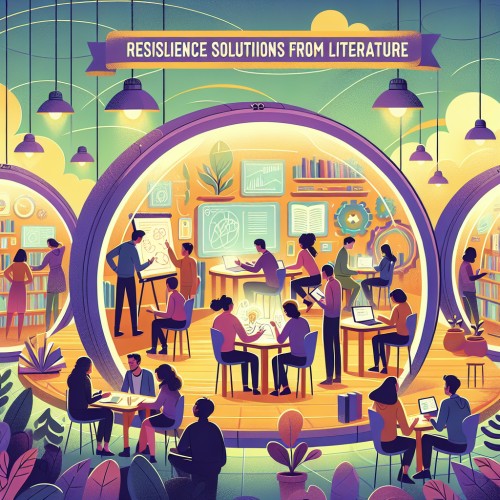
This project immerses sixth graders in a multidisciplinary exploration of resilience in the face of hardship, connecting historical, scientific, and mathematical concepts to real-world applications. Students will engage in hands-on research and design activities that challenge them to analyze migration patterns during the Great Depression, understand ecosystem changes during droughts, and apply principles of geometry and physics to create innovative solutions for disaster relief. Through collaborative model-building and critical writing exercises, students will develop a deeper understanding of how individuals and communities can adapt and thrive amidst adversity. The project culminates in a presentation to local emergency planners, where students showcase their resilience pods and proposals, demonstrating their ability to apply knowledge creatively and effectively. Activities will be designed to be inclusive and engaging for students in ELL and dual language classes, incorporating visual aids, bilingual resources, and opportunities for peer collaboration to ensure all students actively participate and succeed.
Learning goals
Students will engage in research and analysis of historical migration patterns and ecosystem changes during the Great Depression, using primary and secondary sources to build their understanding. They will apply mathematical concepts of geometry and volume to design and construct models of portable shelters, focusing on area and volume calculations. By exploring the physical properties of matter, students will propose practical solutions for disaster relief, enhancing their critical thinking and problem-solving skills. Through character analysis and explanatory writing, they will draw connections between fictional narratives and real-world survival strategies, improving their writing and communication abilities. Students will present their findings and models to local emergency planners, showcasing their ability to synthesize information and communicate effectively, with activities designed to be engaging and accessible for ELL and dual language learners.
Standards
6.10B - develop drafts into a focused, structured, and coherent piece of writing by: (i) organizing with purposeful structure, including an introduction, transitions, coherence within and across paragraphs, and a conclusion, and (ii) developing an engaging idea reflecting depth of thought with specific facts and details
6.10D - edit drafts using standard English conventions, including: (i) complete complex sentences with subject-verb agreement and avoidance of splices, run-ons, and fragments (ii) consistent, appropriate use of verb tenses (iii) conjunctive adverbs (iv) prepositions and prepositional phrases and their influence on subject-verb agreement (v) pronouns, including relative (vi) subordinating conjunctions to form complex sentences and correlative conjunctions such as either/or and neither/nor (vii) capitalization of proper nouns, including abbreviations, initials, acronyms, and organizations (viii) punctuation marks, including commas in complex sentences, transitions, and introductory elements, and (ix) correct spelling, including commonly confused terms such as its/it's, affect/effect, there/their/they're, and to/two/too
6.11B - compose informational texts, including multi-paragraph essays that convey information about a topic, using a clear controlling idea or thesis statement and genre characteristics and craft
CCSS.ELA-Literacy.RH.6-8.1 - Cite specific textual evidence to support analysis of primary and secondary sources.
CCSS.ELA-Literacy.RI.6.1 - Cite textual evidence to support analysis of what the text says explicitly as well as inferences drawn from the text.
CCSS.ELA-Literacy.RL.6.5 - Analyze how a particular sentence, chapter, scene, or stanza fits into the overall structure of a text and contributes to the development of the theme, setting, or plot.
6.8B - model area formulas for parallelograms, trapezoids, and triangles by decomposing and rearranging parts of these shapes
6.8C - write equations that represent problems related to the area of rectangles, parallelograms, trapezoids, and triangles and volume of right rectangular prisms where dimensions are positive rational numbers
6.8D - determine solutions for problems involving the area of rectangles, parallelograms, trapezoids, and triangles and volume of right rectangular prisms where dimensions are positive rational numbers.
6.6B - investigate the physical properties of matter to distinguish between pure substances, homogeneous mixtures (solutions), and heterogeneous mixtures
6.11A - describe and compare roles and responsibilities of citizens in various contemporary societies, including the United States
6.19B - analyze information by sequencing, categorizing, identifying cause-and-effect relationships, comparing, contrasting, finding the main idea, summarizing, making generalizations and predictions, and drawing inferences and conclusions
6.19C - organize and interpret information from outlines, reports, databases, and visuals, including graphs, charts, timelines, and maps
6.19E - formulate and communicate visually, orally, or in writing a claim supported by evidence and reasoning related to a social studies topic
Products
Throughout the project, students will collaboratively design and construct resilience pod models, integrating geometry and material science to ensure practicality and durability. They will craft disaster relief proposals, informed by historical and scientific research, to address real-world challenges. Each student will write an informational text that connects literary resilience to tangible survival strategies, enhancing their analytical and writing skills. These products will culminate in a final exhibition, where students present their work to local emergency planners, showcasing their insights and solutions in both English and their native languages to engage all learners effectively.
Launch
Students will embark on a virtual journey through time, exploring the Great Depression era via interactive digital archives and firsthand accounts, with multilingual support to ensure accessibility for all language learners. They will engage in a collaborative simulation where they experience the challenges of drought and migration, making decisions that impact their survival and community resilience, while incorporating visual aids and bilingual resources. This immersive launch will set the stage for their project, encouraging them to draw connections between historical hardships and contemporary crisis management strategies, fostering inclusivity and engagement for English Language Learners and dual language participants.
Exhibition
Students will host a community exhibition showcasing their resilience pods, maps, and disaster relief proposals, with bilingual presentations to engage all attendees. They will present their models and research findings to local emergency planners, demonstrating their understanding of the Great Depression migration, drought impact on ecosystems, and material properties. Through interactive displays and presentations, students will articulate their design process, connecting literary analysis of fictional resilience to real-world survival strategies. Attendees will engage in discussions, providing feedback and exploring students' innovative solutions to crisis management, with language support available to ensure accessibility for all participants.