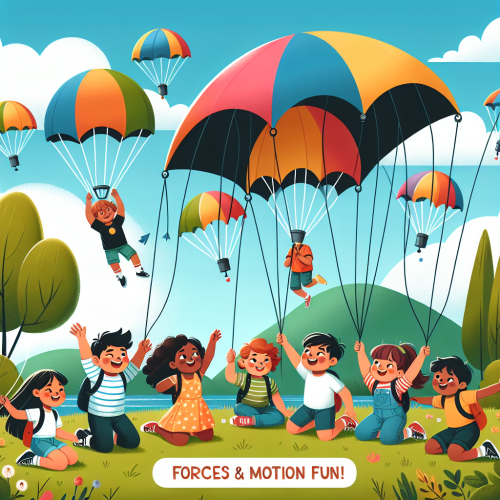
Students will embark on a dynamic, hands-on project inspired by "the candy bomber" who used parachutes to deliver candy during World War II, deepening their understanding of forces and motion through the design and testing of parachutes. By investigating real-world applications of scientific principles such as gravitational potential energy, air resistance, and kinetic energy, students will develop critical thinking and problem-solving skills. This project fosters collaboration and communication as students work in teams to innovate and refine their parachute designs, ultimately enhancing their scientific literacy and teamwork capabilities.
Learning goals
Students will develop a comprehensive understanding of forces and motion by exploring gravitational potential energy, kinetic energy, air resistance, and work. Inspired by "the candy bomber" who used parachutes to deliver candy during World War II, they will enhance their ability to calculate average velocity and analyze energy transfer through hands-on experiments and design activities. Additionally, students will cultivate teamwork and communication skills through collaborative brainstorming, peer review, and self-assessment exercises, setting personal goals for continuous improvement.
Standards
NGSS - HS-PS2-1: Analyze data to support the claim that Newton’s second law of motion describes the mathematical relationship among the net force on a macroscopic object, its mass, and its acceleration.
NGSS - HS-PS3-1: Create a computational model to calculate the change in the energy of one component in a system when the change in energy of the other component(s) and energy flows in and out of the system are known.
NGSS - HS-ETS1-3: Evaluate a solution to a complex real-world problem based on prioritized criteria and trade-offs that account for a range of constraints, including cost, safety, reliability, and aesthetics, as well as possible social, cultural, and environmental impacts.
Products
Introduce the project by exploring the story of "the candy bomber" who used parachutes to deliver candy during World War II, inspiring students to think creatively about parachute applications. Throughout this project, students will create detailed parachute prototypes, each incorporating unique design elements to test different variables affecting descent. By the end, students will compile a comprehensive project portfolio that includes their design process, data analysis, and reflections on the effectiveness of their parachute models. Additionally, students will produce a presentation that showcases their findings and insights gained from peer feedback sessions, demonstrating their understanding of forces and motion.
Launch
Begin the project with an engaging 'Forces and Motion Workshop' that includes a captivating introduction to "the candy bomber," who famously used parachutes to deliver candy during World War II. Rotate students through interactive stations demonstrating principles like gravity, air resistance, and kinetic energy. Involve them in hands-on activities such as dropping objects of various masses to observe energy transfer and using motion sensors to track descent rates. Conclude with a collaborative brainstorming session where students start conceptualizing their parachute designs, discussing how they might manipulate these forces for optimal performance.
Exhibition
At the conclusion of the project, organize a "Parachute Showcase Day" inspired by the story of "The Candy Bomber" from World War II, where students present their parachute designs and demonstrate their descent in a controlled environment. Begin the event with a brief recount of how parachutes were used to deliver candy, setting the historical context for their projects. Invite peers, teachers, and family members to observe and engage with students as they explain the scientific principles behind their designs and the iterative process they followed. Encourage students to display their data analyses and reflections, highlighting how they applied feedback to refine their parachutes. This event not only celebrates their achievements but also fosters a deeper understanding of forces and motion through real-world application.