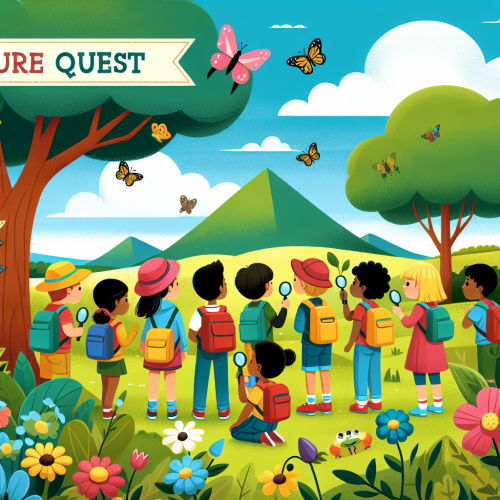
The purpose of this learning experience is to engage pre-k students in exploring their natural environment through a series of nature walks. These walks will encourage children to observe, recall, and apply information from nature to solve everyday problems. By integrating mathematical thinking, students will develop skills in counting, measuring, and pattern recognition as they interact with the world around them. This hands-on approach fosters curiosity, critical thinking, and a deeper understanding of how nature can inform practical solutions in their daily lives.
Learning goals
Students will develop observational skills by exploring and documenting their surroundings during nature walks. They will practice recalling and applying this information to solve simple, relatable problems, such as identifying patterns in nature or counting natural objects. Through hands-on activities, students will use basic mathematical concepts like sorting, comparing, and measuring to understand their environment and address everyday challenges.
Standards
Common Core - CCSS.MATH.CONTENT.K.CC.B.4: Understand the relationship between numbers and quantities; connect counting to cardinality.
Common Core - CCSS.ELA-LITERACY.SL.K.2: Confirm understanding of a text read aloud or information presented orally or through other media by asking and answering questions about key details and requesting clarification if something is not understood.
NGSS - K-ESS3-1: Use a model to represent the relationship between the needs of different plants or animals (including humans) and the places they live.
Products
Throughout the project, students will create a nature observation journal where they document their daily findings using drawings and simple words or sentences. By the end of the four weeks, they will collaboratively build a "Nature Problem-Solving Book," featuring solutions to everyday problems inspired by their observations, such as using leaves to create shade or sticks to make a simple structure. These products will showcase their ability to recall information and apply mathematical thinking in practical, creative ways.
Launch
Begin the project with a guided nature walk where students are encouraged to observe, collect, and discuss various natural items such as leaves, rocks, and twigs. Encourage them to ask questions and make predictions about how these items might be used to solve everyday problems, like building a shelter for small creatures or creating patterns. Back in the classroom, facilitate a circle time discussion where students share their findings and brainstorm potential uses for their collected items, setting the stage for deeper exploration and problem-solving throughout the project.
Exhibition
At the end of the four-week project, students will host a "Nature Discovery Day" where they will share their findings and problem-solving ideas with family and friends. Each child will create a simple display using natural materials they collected, such as leaves, rocks, and sticks, to demonstrate how these items can be used to solve everyday problems, like building a shelter or creating art. Students will also participate in a guided nature walk with their guests, explaining their observations and the mathematical concepts they explored, such as counting, sorting, and measuring. This exhibition will celebrate the children's learning journey and encourage them to articulate their understanding and creativity.