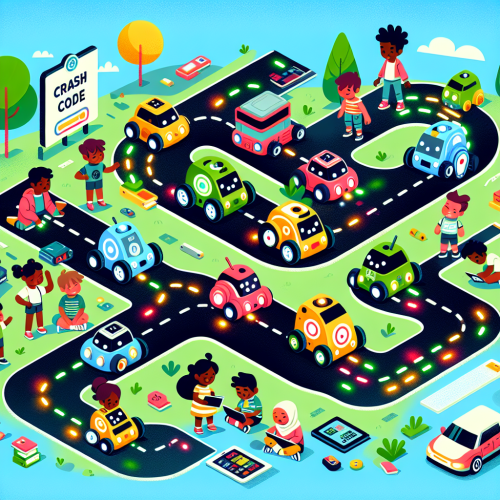
Students will engage in a dynamic project that combines coding, physics, and real-world automotive safety to address the challenge of preventing vehicle collisions. Through hands-on experimentation with microbits and cutebots, students will explore Newton's Third Law and develop innovative solutions to reduce contact forces in collisions. By collaborating with industry experts and presenting their findings, students will gain valuable insights into the practical applications of their work, fostering a deeper understanding of science and technology in everyday life.
Learning goals
Students will develop coding skills to create algorithms using microbits and cutebots that effectively detect and respond to contact forces, applying Newton's Third Law in real-world contexts. They will enhance their ability to plan and conduct scientific investigations, analyze data, and interpret graphical displays to understand the relationships between kinetic energy, mass, and speed. Additionally, students will engage in collaborative problem-solving, critique and revise their designs based on peer and expert feedback, and reflect on their learning process to improve their collision prevention models.
Standards
MS-PS2-1 - Apply Newton's Third Law to design a solution to a problem involving the motion of two colliding objects.
MS-PS2-2 - Plan an investigation to provide evidence that the change in an object's motion depends on the sum of the forces on the object and the mass of the object.
MS-PS3-1 - Construct and interpret graphical displays of data to describe the relationships of kinetic energy to the mass of an object and to the speed of an object.
MS-PS3-2 - Develop a model to describe that when the arrangement of objects interacting at a distance changes, different amounts of potential energy are stored in the system.
MS-PS3-5 - Construct, use, and present arguments to support the claim that when the kinetic energy of an object changes, energy is transferred to or from the object.
MS-PS4-3 - Integrate qualitative scientific and technical information to support the claim that digitized signals (sent as wave pulses) are a more reliable way to encode and transmit information.
MS-ETS1-2 - Evaluate competing design solutions using a systematic process to determine how well they meet the criteria and constraints of the problem.
MS-ETS1-3 - Analyze data from tests to determine similarities and differences among several design solutions to identify the best characteristics of each that can be combined into a new solution to better meet the criteria for success.
MS-LS1-8 - Gather and synthesize information that sensory receptors respond to stimuli by sending messages to the brain for immediate behavior or storage as memories.
Products
Students will design and build a 'Smart Collision Prevention Car' using microbits and cutebots, capable of autonomously detecting and avoiding obstacles. They will also construct a scale model of a vehicle with integrated sensors and microbits to demonstrate collision avoidance techniques. Additionally, students will produce a video documentary capturing the project journey, including coding sessions, data collection, and interviews with community partners, to highlight the real-world impact of their collision prevention models.
Launch
Kick off the project with a 'Tech Exploration Fair,' where students interact with industry experts who demonstrate cutting-edge automotive safety technologies. This event provides an immersive opportunity for students to engage with professionals and explore the practical applications of their upcoming project work. Follow this with a 'Newton's Law in Action' session, featuring interactive experiments that vividly illustrate Newton's Third Law, setting a strong foundation for understanding the physics behind their collision prevention designs.
Exhibition
Students will present their projects at a 'Collision Innovation Expo,' where they will set up interactive booths to demonstrate their microbit and cutebot creations, showcasing live data collection and collision prevention models. This event will be open to family, friends, and community partners, providing an opportunity for students to engage with a broader audience. Additionally, a 'Safety Solutions Showcase' at a local car dealership will invite industry experts to evaluate the projects, offering students valuable feedback and facilitating discussions on vehicle safety advancements.