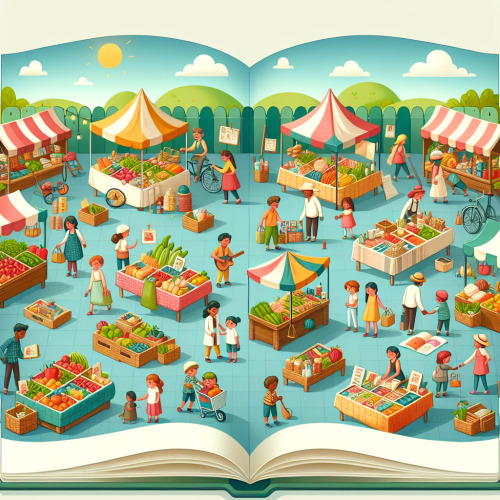
Students will engage in a dynamic roleplay that simulates the allocation of goods and services within a society, starting with a project launch activity featuring a guest speaker from a local food bank. This experiential learning activity will allow them to explore and understand the decision-making processes involved, investigating how different allocation methods and incentives influence economic behavior and societal outcomes. The project aims to deepen students' understanding of core economic concepts, such as resource allocation and incentives, by actively involving them in real-world scenarios. By participating in this roleplay, students will develop critical thinking and collaborative skills as they navigate the complexities of economic decision-making, culminating in a written or video reflection on their learning experience.
Learning goals
Students will explore how societies determine the allocation of goods and services through role-play activities that simulate real-world economic scenarios. They will analyze the impact of incentives on individual and collective decision-making, gaining a deeper understanding of resource allocation. By actively participating, students will demonstrate their grasp of economic principles and apply critical thinking to address the essential question: How do societies decide what to produce and for whom? The project will launch with a guest speaker from a local food bank, providing a real-world context, and conclude with a written or video reflection to synthesize learning and personal insights.
Standards
Common Core - CCSS.ELA-LITERACY.SL.9-10.1: Initiate and participate effectively in a range of collaborative discussions with diverse partners on grades 9-10 topics, texts, and issues, building on others' ideas and expressing their own clearly and persuasively.
Common Core - CCSS.ELA-LITERACY.RH.9-10.2: Determine the central ideas or information of a primary or secondary source; provide an accurate summary of how key events or ideas develop over the course of the text.
Common Core - CCSS.MATH.CONTENT.HSF.LE.A.1: Distinguish between situations that can be modeled with linear functions and with exponential functions.
Products
Students will collaboratively engage in a dynamic role-play simulation where they assume the roles of different societal stakeholders, such as government officials, business leaders, and consumers. The project will launch with a visit from a local food bank representative to provide real-world context and inspiration. Throughout the project, students will create a comprehensive plan for allocating resources and goods, demonstrating their understanding of economic incentives and resource allocation. By the end of the project, students will present their allocation strategies and decisions in a mock town hall meeting, showcasing their ability to apply economic concepts to real-world scenarios. Students will conclude with a written or video reflection on their learning experience and the impact of their decisions.
Launch
Kick off the project with a visit from a local food bank representative who will discuss real-world challenges in resource allocation and the role of incentives in their operations. Following the talk, engage students in an interactive simulation where they form small groups representing different societies with unique resources. Each group must decide what goods and services to produce and how to allocate them, responding to unexpected events or incentives like resource scarcity or trade opportunities. This immersive experience will lay the groundwork for exploring the essential question and core content.
Exhibition
At the end of the project, students will participate in a dynamic roleplay exhibition where they simulate a marketplace. Each student or group will represent different societal roles, such as government officials, business owners, and consumers, to demonstrate their understanding of resource allocation and incentives. Invite peers, teachers, and community members to observe and engage in discussions about the decisions made and the outcomes observed. This exhibition will provide an opportunity for students to articulate their learning and reflect on how different allocation methods impact societal choices. The project will launch with a guest speaker from a local food bank to provide real-world context, and students will conclude with a written or video reflection on their experiences and insights.