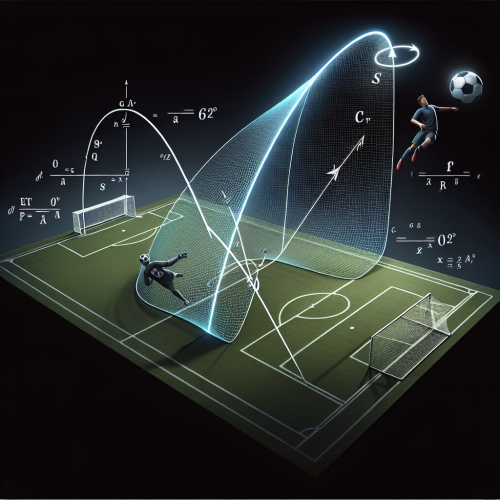
Soccer Trajectories: Scoring with Quadratic Equations
Eduardo R
Updated
CCSS.Math.Content.HSA-CED.A.1
CCSS.Math.Content.HSA-REI.B.4
CCSS.Math.Content.HSF-BF.A.1
CCSS.Math.Content.HSF-IF.B.4
CCSS.Math.Content.HSF-IF.C.7
1-pager
Purpose
This project aims to deepen students' understanding of quadratic functions through the engaging context of soccer. By modeling the projectile path of a soccer ball, students apply mathematical concepts to real-world scenarios, enhancing their problem-solving and analytical skills. The project encourages collaboration, critical thinking, and creativity, as students explore mathematical principles to improve gameplay strategies. Through hands-on experiments and peer interactions, students gain a comprehensive understanding of how mathematics can be used to predict and analyze motion in sports.
Learning goals
Students will develop a deep understanding of quadratic functions and their real-world applications, particularly in modeling the projectile motion of a soccer ball. They will gain proficiency in translating between vertex and standard forms of quadratic equations and use these skills to analyze and predict key trajectory points such as maximum height and distance. Through hands-on experiments and data collection, students will enhance their ability to apply mathematical concepts to solve practical problems, fostering critical thinking and collaborative learning.
Standards
Common Core - CCSS.MATH.CONTENT.HSF.IF.B.4: For a function that models a relationship between two quantities, interpret key features of graphs and tables in terms of the quantities, and sketch graphs showing key features given a verbal description of the relationship.
Common Core - CCSS.MATH.CONTENT.HSF.BF.A.1: Write a function that describes a relationship between two quantities.
Common Core - CCSS.MATH.CONTENT.HSA.CED.A.2: Create equations in two or more variables to represent relationships between quantities; graph equations on coordinate axes with labels and scales.
Products
Throughout this project, students will create detailed models of a soccer ball's trajectory using quadratic functions, culminating in a comprehensive poster presentation. They will also develop a data collection sheet from their hands-on experiments to track initial velocity and angles. By the end, students will produce a reflective report that incorporates peer feedback to refine their models and strategies.
Launch
Kick off the project with a dynamic Quadratic Function Scavenger Hunt, where students follow clues that integrate soccer scenarios and quadratic concepts. This interactive activity will lead them to uncover real-world applications of quadratic functions in sports. As they solve each clue, students will collaboratively explore how these mathematical principles can be applied to predict and enhance soccer gameplay, setting the stage for their upcoming project work.
Exhibition
At the end of the project, students will host an interactive exhibition where they present their poster sessions to an audience of peers, teachers, and community members. Each student will explain their quadratic models and demonstrate how these models can predict the soccer ball's trajectory. The exhibition will include a live demonstration area where attendees can see the practical application of the students' findings. This event will encourage dialogue and provide students with the opportunity to articulate their learning journey and insights gained from the project.