11th Grade  Project 6 weeks

Secrets, Press, and Democracy

Shannon M
Updated
CCSS.ELA-Literacy.SL.11-12.1
CCSS.ELA-Literacy.WHST.11-12.2
CCSS.ELA-Literacy.WHST.11-12.7
CCSS.ELA-Literacy.W.11-12.9
CCSS.ELA-Literacy.WHST.11-12.8
+ 9 more
1-pager

Purpose

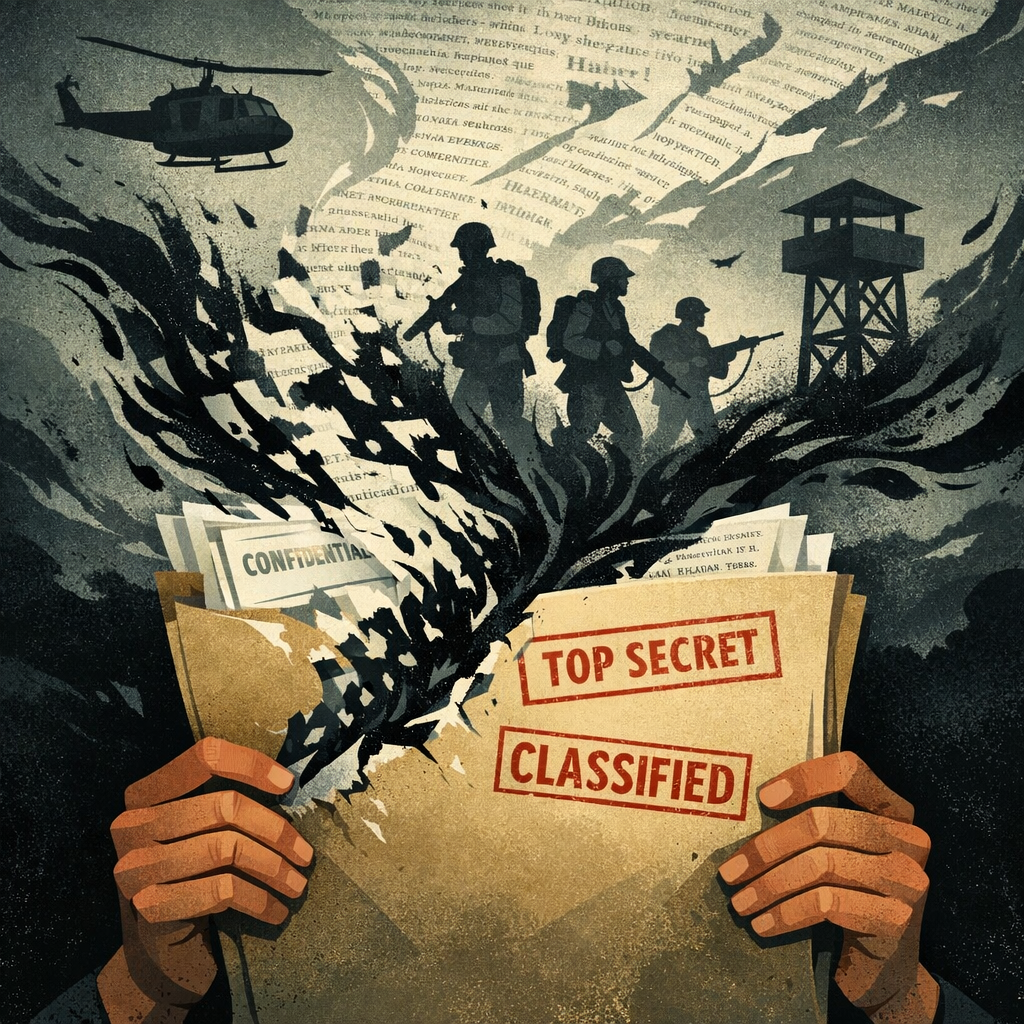
Students investigate how landmark whistleblower cases have shaped the balance between national security, press freedom, and democratic accountability in the United States. Through analysis of the Pentagon Papers, post-Cold War cases, legal protections, and the role of journalists, they build the research, discussion, and argument skills needed to answer complex civic questions with credible evidence. The experience culminates in a public presentation and publication-ready op-ed pitch for The Transparency Exchange, where students argue when revealing government secrets serves the public good. Throughout the project, self-check conferences and reflection push students to revise their thinking, strengthen their communication, and deepen their sense of civic responsibility.

Learning goals

Students will analyze the Pentagon Papers and later U.S. whistleblower cases to evaluate how secrecy, disclosure, constitutional principles, and press freedom shape democratic life. They will conduct sustained research using credible print, legal, and multimedia sources, assess source reliability, and synthesize evidence into clear claims about when revealing government secrets serves the public good. They will strengthen discussion, writing, and speaking by participating in seminars and expert-informed case study sessions, then creating a polished presentation and publication-ready op-ed pitch for a public audience. Throughout the project, they will use self-check conferences and revision goals to deepen civic responsibility, strengthen argumentation, and communicate respectfully across differing viewpoints.

Standards
  • [Common Core] CCSS.ELA-Literacy.SL.11-12.1 - Initiate and participate effectively in a range of collaborative discussions (one-on-one, in groups, and teacher-led) with diverse partners on grades 11—12 topics, texts, and issues, building on others' ideas and expressing their own clearly and persuasively.
  • [Common Core] CCSS.ELA-Literacy.WHST.11-12.2 - Write informative/explanatory texts, including the narration of historical events, scientific procedures/experiments, or technical processes.
  • [Common Core] CCSS.ELA-Literacy.WHST.11-12.7 - Conduct short as well as more sustained research projects to answer a question (including a self-generated question) or solve a problem; narrow or broaden the inquiry when appropriate; synthesize multiple sources on the subject, demonstrating understanding of the subject under investigation.
  • [Common Core] CCSS.ELA-Literacy.W.11-12.9 - Draw evidence from literary or informational texts to support analysis, reflection, and research.
  • [Common Core] CCSS.ELA-Literacy.WHST.11-12.8 - Gather relevant information from multiple authoritative print and digital sources, using advanced searches effectively; assess the strengths and limitations of each source in terms of the specific task, purpose, and audience; integrate information into the text selectively to maintain the flow of ideas, avoiding plagiarism and over-reliance on any one source and following a standard format for citation.
  • [Common Core] CCSS.ELA-Literacy.RI.11-12.8 - Delineate and evaluate the reasoning in seminal U.S. texts, including the application of constitutional principles and use of legal reasoning (e.g., in U.S. Supreme Court majority opinions and dissents) and the premises, purposes, and arguments in works of public advocacy (e.g., The Federalist, presidential addresses).
  • [Common Core] CCSS.ELA-Literacy.WHST.11-12.1 - Write arguments focused on discipline-specific content.
  • [Common Core] CCSS.ELA-Literacy.SL.11-12.2 - Integrate multiple sources of information presented in diverse formats and media (e.g., visually, quantitatively, orally) in order to make informed decisions and solve problems, evaluating the credibility and accuracy of each source and noting any discrepancies among the data.
  • [Common Core] CCSS.ELA-Literacy.W.11-12.7 - Conduct short as well as more sustained research projects to answer a question (including a self-generated question) or solve a problem; narrow or broaden the inquiry when appropriate; synthesize multiple sources on the subject, demonstrating understanding of the subject under investigation.
  • [Common Core] CCSS.ELA-Literacy.RI.11-12.9 - Analyze seventeenth-, eighteenth-, and nineteenth-century foundational U.S. documents of historical and literary significance (including The Declaration of Independence, the Preamble to the Constitution, the Bill of Rights, and Lincoln's Second Inaugural Address) for their themes, purposes, and rhetorical features.
Competencies
  • Engaged Citizen - Shows respect and empathy across differences, embraces diversity of opinion, seeks cultural understanding, participates in the democratic process to challenge the status quo, and makes a positive impact on their community and the world.
  • Effective Communicator - Engages diverse audiences respectfully by exchanging ideas and information responsibly, listening actively, speaking and writing clearly, and using print and digital media appropriately.
  • Critical Thinker - Thinks deeply and makes informed decisions to create solutions or new understanding supported by relevant and reliable evidence.
  • Empowered Learner - Demonstrates mastery and application of academic competencies. Develops the skills and dispositions to persist through difficulties and plan for a future of self-improvement.

Products

Students will create annotated case files on the Pentagon Papers and at least two post-Cold War whistleblower cases, including source evaluations, legal notes, and evidence trackers from redacted documents, media, and constitutional texts. Throughout the project, they will produce Socratic Seminar notes, case comparison charts, visual argument drafts, and self-check conference reflections that name one strength, one gap, and one revision goal after each major case study. By the end, each student will complete a publication-ready op-ed pitch and a polished public presentation with visuals and case evidence answering the essential question about whistleblowing, secrecy, and democracy. These final products will be shared at The Transparency Exchange with journalists, government representatives, and community partners, and may also be submitted for publication or civic advocacy.

Launch

Begin with “The Story Behind the Sealed Envelope,” where teams open envelopes containing redacted government documents, leaked-style memos, and conflicting press headlines, then build initial theories about what was hidden and why. Follow with the trailer for The Most Dangerous Man in America and a quick-write on when secrecy protects democracy and when it harms it. Bring in a First Amendment attorney or civil liberties advocate for a brief provocation on whistleblower protections, source confidentiality, and legal risk, then have students generate the questions they most want to investigate. Close by unveiling the public challenge: prepare a polished presentation and publication-ready op-ed pitch for The Transparency Exchange arguing when revealing government secrets serves the public good.

Exhibition

Host a public “Transparency Exchange” where students deliver polished 5–7 minute presentations with visuals and case evidence answering the essential question, then pitch publication-ready op-eds on when revealing government secrets serves the public good. Invite journalists, local government representatives, a First Amendment attorney or civil liberties advocate, families, and community partners to serve as panelists who ask questions and give feedback on clarity, credibility, and depth of understanding of whistleblower protections. Create a gallery component with redacted documents, case timelines, and key claims from each project so guests can engage with student research before and after presentations. Close with a celebration of learning that highlights strong civic reasoning, thoughtful revision, and students’ growing sense of responsibility in a democracy.