About Us Impact News Pricing Contact Us Explore
Make a copy
About Us Impact News Pricing Contact Us Explore
Tools
Project-Based Learning Performance Assessment Student-Led Conferences Digital Portfolios
Framework
Loading
Loading
    Products & Rubric
Kindergarten, 1st, 2nd Grades  Project 4 weeks

Stick It: Family Design Quest

Elizabeth D
Apr 29, 2026
Updated Apr 29, 2026
K-2.AF.6.2
MU:Cr3.2.K.a
MU:Cr2.1.1.a
K-2-ETS1-2
K-2-ETS1-1
+ 5 more
1-pager

Purpose

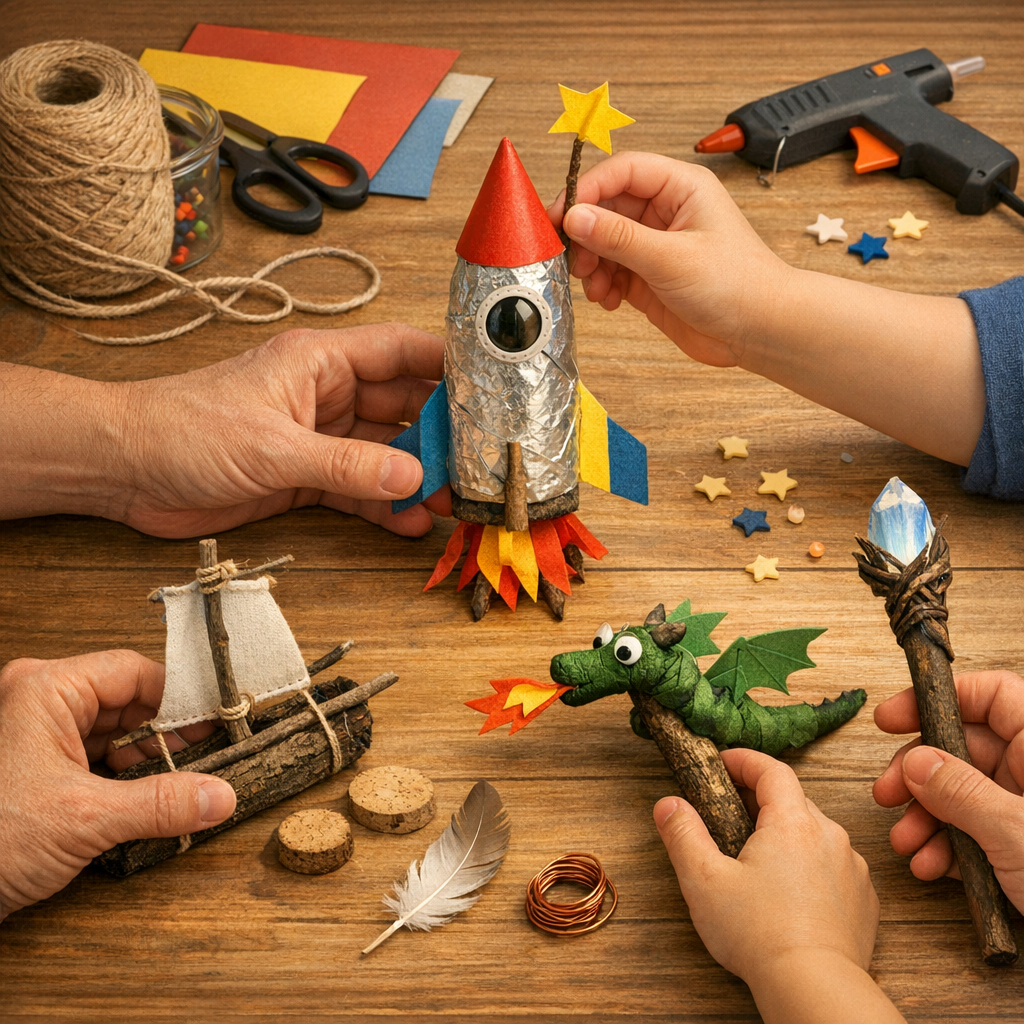
Students and families use Not a Stick as a launch point to turn an ordinary stick into a meaningful invention through drawing, building, storytelling, and simple design thinking at home. Parents can support the process by asking what the stick could become, helping the child sketch one idea, testing materials like tape, paper, string, or found items, and then prompting the child to improve the design after noticing what worked and what was hard. This work builds science understanding about shape, materials, and function; ELA skills through speaking, labeling, and storytelling; math thinking through measuring, comparing size and length, and noticing shapes; and social studies connections through sharing ideas, solving problems for play or daily life, and learning how family and community members create useful things. The experience prepares children to explain their thinking clearly, reflect with a parent, and contribute a finished invention to the Spruce Stick Museum display.

Learning goals

Students will use imagination, observation, and simple design thinking steps with a parent: ask what the stick could become, sketch an idea, build with home materials, test it in play or problem-solving, and revise it to work better. They will grow literacy by telling and recording the story of their stick invention, math by comparing length, shape, balance, or number of materials used, science by noticing how materials and structure affect function, and social studies by talking with family about how tools help people at home and in the community. Students will explain their choices, share their invention through speaking, storytelling, or a musical idea, and listen to feedback from parents and peers. They will finish by creating a display-ready invention and writing a short parent-student reflection that names one improvement made, one challenge solved, and one new idea to try for the Spruce Stick Museum.

Standards
  • [Next Generation Science Standards] K-2.AF.6.2 - Use tools and/or materials to design and/or build a device that solves a specific problem or a solution to a specific problem.
  • [National Core Arts Standards] MU:Cr3.2.K.a - With guidance, demonstrate a final version of personal musical ideas to peers.
  • [National Core Arts Standards] MU:Cr2.1.1.a - With limited guidance, demonstrate and discuss personal reasons for selecting musical ideas that represent expressive intent.
  • [Next Generation Science Standards] K-2-ETS1-2 - Develop a simple sketch, drawing, or physical model to illustrate how the shape of an object helps it function as needed to solve a given problem.
  • [Next Generation Science Standards] K-2-ETS1-1 - Ask questions, make observations, and gather information about a situation people want to change to define a simple problem that can be solved through the development of a new or improved object or tool.
Competencies
  • Collaboration - Students co-design projects with peers, exercise shared-decision making, strengthen relational agency, resolve conflict, and assume leadership roles.
  • Effective Communication - Students practice listening to understand, communicating with empathy, and share their learning through exhibiting, presenting and reflecting on their work.
  • Critical Thinking & Problem Solving - Students consider a variety of innovative approaches to address and understand complex questions that are authentic and important to their communities.
  • Content Expertise - Students develop key competencies, skills, and dispositions with ample opportunities to apply knowledge and engage in work that matters to them.
  • Self Directed Learning - Students use teacher and peer feedback and self-reflection to monitor and direct their own learning while building self knowledge both in and out of the classroom.

Products

Students will create idea sketches, shape and measurement drawings, story labels, and early stick prototypes at home with parent support, using paper, tape, string, glue, and found objects to imagine, test, and revise what the stick can become. Parents can guide the design process by asking what the stick should do, helping the child draw a plan, trying one version, testing how the shape works for play or a simple problem, and talking together about what to change next. Along the way, children will make short reflection products such as a dictated note, drawing, counting or comparing chart, or parent-recorded check-in that connects the stick invention to math, ELA, science, and social studies through measuring, storytelling, observing materials, and thinking about how people use tools. By the end, each child will produce a finished stick invention with a handwritten display label, a parent-student reflection note naming one improvement, one challenge solved, and one new idea to try, plus a short audio or video explanation for the Spruce Stick Museum table display.

Launch

Begin with a Family Imagination Kickoff using Not a Stick, where children and parents listen to the story, then talk about how one stick could connect to math through shape and measurement, ELA through storytelling and labeling, social studies through tools people use in communities, and science through materials, structure, and function. After the read-aloud, families go on a short stick hunt or choose a stick, explore a few simple examples, and name a pretend problem the stick invention could solve or how it could support play. Parents then guide children through clear design steps: ask what the stick could become, draw or act out one idea, build with simple materials, test how it works, and revise one part after talking together about what helped or what was tricky. Close by having each child share, “My stick could become ___ because ___,” and send families home with the stick, project one-pager, reflection questions, and directions for the final audio or video and parent reflection note for the Spruce Stick Museum.

Exhibition

Create a Stick Discovery Showcase where each child presents their invention on a small table with a handwritten label, the parent-student reflection note, and a QR code or device that plays the child’s short explanation. Families can visit displays and notice cross-curricular connections by listening for storytelling and vocabulary from ELA, counting or measuring features in math, observing materials and function in science, and discussing how tools and inventions help people in social studies. To prepare, parents can help children follow simple design steps at home: ask what the stick could become, sketch or talk through an idea, build with simple materials, test it in play or problem-solving, and revise based on what worked or did not work. End the event with a brief sharing circle where each child names one improvement made, one challenge solved, and one new idea to try for the museum display.

Plan
By Phase By Day Calendar
Empathize Define Ideate Draft Test Critique Notice & Reflect
Empathize
Students will listen to Not a Stick with their families, notice how a stick could help in play or at home, and share one user-centered idea about what their stick might become.
Day 1
📘 Not a Stick Book Bash
Launch 30m
No activities have been added to this phase yet.

Edit Phase

Loading...
Define
Students will turn observations from the read-aloud, stick hunt, and family talk into a simple problem statement about what their stick invention should do, who it is for, and why that need matters before they begin sketching and building.
Day 2
🪵 Stick Need Sentence Card
Deliverable 30m
No activities have been added to this phase yet.

Edit Phase

Loading...
Ideate
Students will brainstorm several possible stick inventions, sketch one promising idea, and choose a direction that fits a real play or home need they identified with family support.
Day 3
💡 Stick Idea Sketch Pick
Deliverable 30m
No activities have been added to this phase yet.

Edit Phase

Loading...
Draft
Students will turn their chosen idea into a first stick invention prototype by building with simple materials, checking that the design matches the problem they named, and preparing one clear part to improve after feedback in the next phase.
Day 4
🛠️ Stick Prototype Build
Deliverable 30m
No activities have been added to this phase yet.

Edit Phase

Loading...
Test
Students will test their stick invention draft with a peer and prepare to gather parent feedback by showing how the design works, listening to responses, and recording one change they should try next.
Day 4
🧪 Stick Prototype Test Talk
Deliverable 30m
No activities have been added to this phase yet.

Edit Phase

Loading...
Critique
Students will use a structured peer critique to share their stick prototype, listen closely to feedback from classmates, and choose one revision that will help the invention work better for play or a simple problem before the final reflection phase.
Day 4
🗣️ Stick Prototype Feedback Circle
Deliverable 30m
No activities have been added to this phase yet.

Edit Phase

Loading...
Notice & Reflect
Students will share their finished stick invention for the Spruce Stick Museum, explain how it changed through feedback, and complete a brief parent-student reflection note that captures learning, revision, and a next idea to try.
Day 4
🖼️ Spruce Stick Museum Share
Deliverable 30m
No activities have been added to this phase yet.

Edit Phase

Loading...
Empathize
📘 Not a Stick Book Bash
Launch 30m
Define
🪵 Stick Need Sentence Card
Deliverable 30m
Ideate
💡 Stick Idea Sketch Pick
Deliverable 30m
Draft
🛠️ Stick Prototype Build
Deliverable 30m
Test
🧪 Stick Prototype Test Talk
Deliverable 30m
Critique
🗣️ Stick Prototype Feedback Circle
Deliverable 30m
Notice & Reflect
🖼️ Spruce Stick Museum Share
Deliverable 30m

May 2026

Mon
Tue
Wed
Thu
Fri
11 Day 1
Empathize
📘 Not a Stick Book Bash
18 Day 2
Define
🪵 Stick Need Sentence Card
25 Day 3
Ideate
💡 Stick Idea Sketch Pick

June 2026

Mon
Tue
Wed
Thu
Fri
1 Day 4
Notice & Reflect
🛠️ Stick Prototype Build
🧪 Stick Prototype Test Talk
🗣️ Stick Prototype Feedback Circle
🖼️ Spruce Stick Museum Share
Share
Activities
Loading
Loading
Loading
Get it on Google Play
© 2026 Inkwire Inc
Contact Us Privacy Policy Terms of Service