About Us Impact News Pricing Contact Us Explore
Make a copy
About Us Impact News Pricing Contact Us Explore
Tools
Project-Based Learning Performance Assessment Student-Led Conferences Digital Portfolios
Framework
Loading
Loading
    Products & Rubric
Middle School Grade  Project 1 week

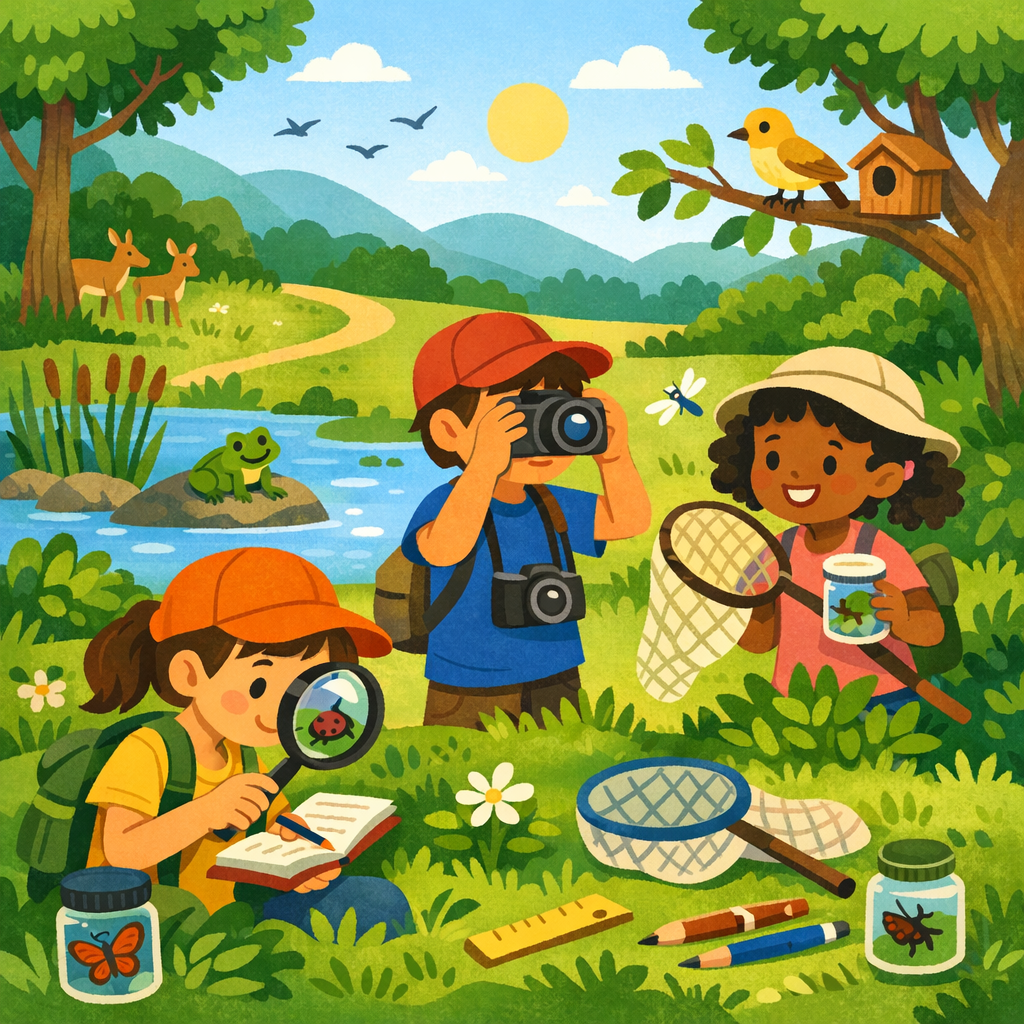
Nature Detectives Adventure: Uncover Hidden Secrets!

Emily A
Mar 17, 2026
Updated Mar 17, 2026
MS-LS2-1
MS-LS2-1
MS-LS1-4
MS-LS4-1
MS-LS1-4
+ 5 more
1-pager

Purpose

The learning experience is designed to immerse middle school students in hands-on environmental exploration, fostering a deep understanding of ecosystems and adaptations while nurturing critical thinking and collaborative skills. Through engaging field observations and interactive activities, students will investigate local habitats to analyze the impact of resource availability on organisms and devise innovative, sustainable solutions to environmental challenges. This project encourages students to communicate their findings effectively, contributing actively to environmental preservation insights within their community.

Learning goals

The learning goals for this experience include analyzing data to understand adaptation and resource availability in ecosystems, developing sustainable solutions, and engaging with local environmental challenges. Students will cultivate critical thinking by evaluating biodiversity and the impacts of human activity on ecosystems, using feedback for self-directed learning, and honing communication skills through presentations and peer-to-peer collaboration. They will gain content expertise by exploring real-world applications of ecological principles and proposing sustainability initiatives.

Standards
  • [Next Generation Science Standards] MS-LS2-1 - Analyze and interpret data to provide evidence for the effects of resource availability on organisms and populations of organisms in an ecosystem.
  • [Next Generation Science Standards] MS-LS2-1 - Analyze and interpret data to provide evidence for the effects of resource availability on organisms and populations of organisms in an ecosystem.
  • [Next Generation Science Standards] MS-LS1-4 - Use argument based on empirical evidence and scientific reasoning to support an explanation for how characteristic animal behaviors and specialized plant structures affect the probability of successful reproduction of animals and plants respectively.
  • [Next Generation Science Standards] MS-LS4-1 - Analyze and interpret data for patterns in the fossil record that document the existence, diversity, extinction, and change of life forms throughout the history of life on Earth under the assumption that natural laws operate today as in the past.
  • [Next Generation Science Standards] MS-LS1-4 - Use argument based on empirical evidence and scientific reasoning to support an explanation for how characteristic animal behaviors and specialized plant structures affect the probability of successful reproduction of animals and plants respectively.
Competencies
  • Critical Thinking & Problem Solving - Students consider a variety of innovative approaches to address and understand complex questions that are authentic and important to their communities.
  • Self Directed Learning - Students use teacher and peer feedback and self-reflection to monitor and direct their own learning while building self knowledge both in and out of the classroom.
  • Effective Communication - Students practice listening to understand, communicating with empathy, and share their learning through exhibiting, presenting and reflecting on their work.
  • Content Expertise - Students develop key competencies, skills, and dispositions with ample opportunities to apply knowledge and engage in work that matters to them.
  • Collaboration - Students co-design projects with peers, exercise shared-decision making, strengthen relational agency, resolve conflict, and assume leadership roles.

Products

Throughout the learning experience, students will create observation journals capturing qualitative and quantitative data from their field trip. They will also design skits and mini-presentations for the 'Green Innovation Summit' addressing sustainability solutions. By the end of the project, students will construct miniature terrariums exemplifying diverse habitats and adaptations. These products will culminate in a gallery walk showcase and be integral to a 'Live Ecosystem' exhibit, promoting peer and community engagement.

Launch

Kick off the project with "Adaptation Adventure Games," where students participate in team-based activities that mimic animal survival strategies tailored to local and global environments. These activities serve as an immersive introduction to the concept of adaptation, sparking curiosity and collaboration as students explore creative solutions to environmental challenges. Additionally, a "Survival Skills Workshop" will complement this launch, offering hands-on lessons in wilderness survival techniques, highlighted by discussions on species' adaptations, thereby grounding their experience in real-world contexts.

Exhibition

The exhibition will culminate in a 'Green Innovation Summit,' where students present solutions for sustainable practices they developed through dramatic presentations or skits. Each student will showcase their field trip observation journals and artifacts in a gallery walk setup, inviting peers and teachers to engage in meaningful dialogue and provide feedback. Additionally, students will construct and display live terrarium models representing various habitats, highlighting the specific adaptations of the flora and fauna within. This event will not only celebrate their learning but also raise awareness and inspire actionable change in environmental sustainability.

Plan
By Phase By Day Calendar
Question Design Collect Analyze Conclude
Question
Students will encounter a puzzling local habitat phenomenon, analyze adaptation and resource patterns, and develop a focused, investigable research question with a clear hypothesis to guide their field investigation.
Day 1
🎮 Adaptation Adventure Games Challenge
Launch 15m
🌿 Local Habitat Phenomenon Analysis
Knowledge/Skill Building 15m
❓ From Curiosity to Testable Questions
Knowledge/Skill Building 10m
No activities have been added to this phase yet.

Edit Phase

Loading...
Design
Students will design a systematic investigation plan that aligns with their habitat research question, identifying variables, selecting an appropriate methodology type, planning data collection procedures, conducting a brief background review, and revising their plan through structured peer feedback before beginning field data collection.
Day 2
📊 Variables & Sampling Workshop
Knowledge/Skill Building 15m
📝 Habitat Investigation Design Plan
Deliverable 15m
🔍 Peer Review: Methodology Critique
Assessment 15m
No activities have been added to this phase yet.

Edit Phase

Loading...
Collect
Students will systematically gather qualitative and quantitative field data aligned to their investigable research questions, document collection conditions and anomalies, conduct mid-collection quality checks, and prepare organized raw datasets that will serve as the evidence base for analysis in the next phase.
Day 3
📓 Organized Raw Data Submission
Deliverable 3m
🌿 Habitat Data Collection Rounds
Deliverable 25m
🔍 Mid-Collection Data Quality Check
Knowledge/Skill Building 5m
✅ Methodology Fidelity Check
Assessment 2m
No activities have been added to this phase yet.

Edit Phase

Loading...
Analyze
Students will transform raw field data into meaningful interpretations by creating visualizations, identifying patterns and anomalies, challenging one another’s interpretations, and determining whether their evidence supports, contradicts, or complicates their original hypotheses about adaptation and resource availability.
Day 4
No activities have been added to this phase yet.

Edit Phase

Loading...
Conclude
Students will draw evidence-based conclusions from their habitat investigations, explicitly acknowledge limitations, generate new research questions, and present their full investigative process—from question through methodology, data, analysis, and sustainability implications—at a culminating Green Innovation Summit.
Day 5
🧠 Writing Warranted CER Conclusions
Deliverable 15m
⚖️ Limitations & New Questions Section
Deliverable 10m
🤝 Peer Review Roundtable
Project Work 10m
No activities have been added to this phase yet.

Edit Phase

Loading...
Question Days 1–1
Day 1
🎮 Adaptation Adventure Games Challenge
Launch 15m
🌿 Local Habitat Phenomenon Analysis
Knowledge/Skill Building 15m
❓ From Curiosity to Testable Questions
Knowledge/Skill Building 10m
Design Days 2–2
Day 2
📊 Variables & Sampling Workshop
Knowledge/Skill Building 15m
📝 Habitat Investigation Design Plan
Deliverable 15m
🔍 Peer Review: Methodology Critique
Assessment 15m
Collect Days 3–3
Day 3
📓 Organized Raw Data Submission
Deliverable 3m
🌿 Habitat Data Collection Rounds
Deliverable 25m
🔍 Mid-Collection Data Quality Check
Knowledge/Skill Building 5m
✅ Methodology Fidelity Check
Assessment 2m
Analyze Days 4–4
Day 4
Conclude Days 5–5
Day 5
🧠 Writing Warranted CER Conclusions
Deliverable 15m
⚖️ Limitations & New Questions Section
Deliverable 10m
🤝 Peer Review Roundtable
Project Work 10m

June 2026

Mon
Tue
Wed
Thu
Fri
15 Day 1
Question
🎮 Adaptation Adventure Games Challenge
🌿 Local Habitat Phenomenon Analysis
❓ From Curiosity to Testable Questions
16 Day 2
Design
📊 Variables & Sampling Workshop
📝 Habitat Investigation Design Plan
🔍 Peer Review: Methodology Critique
17 Day 3
Collect
📓 Organized Raw Data Submission
🌿 Habitat Data Collection Rounds
🔍 Mid-Collection Data Quality Check
✅ Methodology Fidelity Check
18 Day 4
Analyze
19 Day 5
Conclude
🧠 Writing Warranted CER Conclusions
⚖️ Limitations & New Questions Section
🤝 Peer Review Roundtable
Share
Activities
Loading
Loading
Loading
Get it on Google Play
© 2026 Inkwire Inc
Contact Us Privacy Policy Terms of Service