11th, 12th Grades  Project 3 weeks

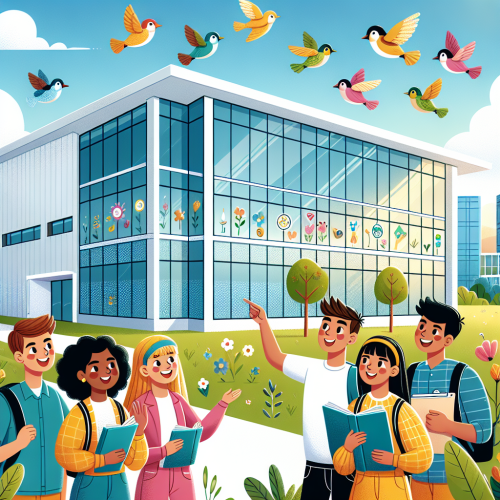
Bird-Safe Windows: Clash-Free Views!

Michael K
Critical Thinking & Problem Solving
Collaboration
Effective Communication
Content Expertise
Academic Mindset
1-pager

Purpose

Students will actively engage in real-world problem-solving by collaborating with the Denison Nature Center to develop innovative window features that reduce bird collisions. Applying biomimicry principles, they will design solutions that prioritize bird safety while ensuring visibility for humans. The project provides a hands-on experience that fosters critical thinking, collaboration, and effective communication, allowing students to create meaningful changes in their community's urban environments. Through critique and revision, students will refine their designs based on peer and community feedback, culminating in the implementation of their solutions in the school and beyond.

Learning goals

Students will engage in critical analysis and inventive problem-solving to devise window features that reduce bird collisions, collaborating with peers and community partners at Denison Nature Center. They will iteratively develop these designs with ongoing critique and revision through peer feedback. The final product, a practical solution to be implemented in school and local community windows, enhances content expertise in environmental science and design thinking. Students will effectively communicate their design process and findings through presentations and visual exhibits. Throughout, they will cultivate a strong academic mindset, connecting their identity and experiences to meaningful environmental advocacy work.
Competencies
  • Critical Thinking & Problem Solving - Students consider a variety of innovative approaches to address and understand complex questions that are authentic and important to their communities.
  • Collaboration - Students co-design projects with peers, exercise shared-decision making, strengthen relational agency, resolve conflict, and assume leadership roles.
  • Effective Communication - Students practice listening to understand, communicating with empathy, and share their learning through exhibiting, presenting and reflecting on their work.
  • Content Expertise - Students develop key competencies, skills, and dispositions with ample opportunities to apply knowledge and engage in work that matters to them.
  • Academic Mindset - Students establish a sense of place, identity, and belonging to increase self-efficacy while engaging in critical reflection and action.

Products

Students will collaboratively design and produce window decals or films incorporating patterns inspired by biomimicry to effectively deter bird collisions. They will partner with the Denison Nature Center to gain insight into bird behavior and leverage this knowledge in their designs. Final products will be installed on select windows in the school and community spaces, showcasing their work and providing a tangible solution to the problem. These installations offer students the opportunity to gather real-time feedback and iterate upon their designs, further refining their understanding and application of sustainable design principles.

Launch

Kick off the project with a guest presentation by experts from the Denison Nature Center, focusing on the impact of urban development on bird populations. Follow this with a guided exploration where students observe window collision areas on campus to identify problem spots. Facilitate a design-thinking workshop where students brainstorm initial ideas for bird-friendly window features using biomimicry concepts. Encourage students to capture their observations and early ideas in a project journal for later reflection and iteration.

Exhibition

At the conclusion of the project, students will host a "Bird-Safe Design Expo" at the Denison Nature Center. During this event, student teams will present their window feature designs, demonstrating their effectiveness through models and displays, and explaining their design process and the impact on reducing bird collisions. Community members, including wildlife experts from the Nature Center, will engage with students, provide feedback, and discuss possibilities for implementing these solutions in real-world settings. Students will also showcase their reflections and responses to peer critique received during the cafeteria design feedback sessions. This exhibition encourages dialogue between students and the local community, emphasizing the importance of innovative, community-focused solutions to environmental challenges.