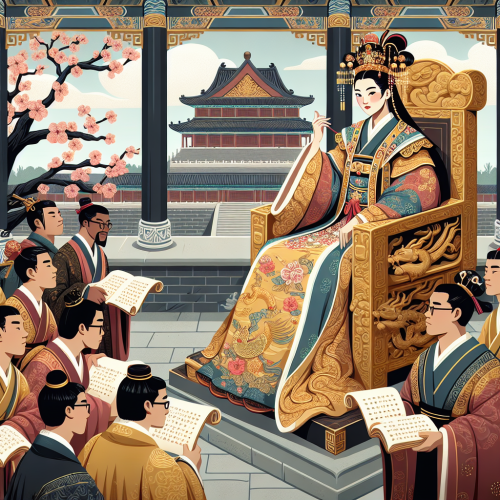
Students will engage in a dynamic exploration of Empress Wu's leadership, honing their ability to critically evaluate historical figures by analyzing diverse sources. Through a structured debate, they will collaboratively construct arguments, considering multiple perspectives to determine whether Empress Wu was a progressive leader or a cruel tyrant. This process will enhance their skills in critical thinking, collaboration, and effective communication, while deepening their understanding of political institutions and their impact on societies during the 600-1600 period.
Learning goals
Students will critically evaluate historical sources to construct informed arguments about Empress Wu's leadership, considering both progressive and tyrannical perspectives. They will develop skills in analyzing evidence from multiple viewpoints and engage in collaborative debate to articulate and defend their positions. Through this process, students will enhance their abilities in critical thinking, effective communication, and historical analysis, aligning with the standards and competencies outlined.
Standards
[Kentucky] 7.C.CP.1 - Compare political institutions and their impacts on people in empires between 600-1600.
[Kentucky] 7.C.CV.1 - Describe the methods used by non-democratic governments to create order, establish justice and meet the needs of their subjects between 600-1600.
[Kentucky] 7.C.PR.1 - Assess the effectiveness of law codes to create order, establish justice and meet the needs of their subjects between 600-1600.
[Kentucky] 7.E.IC.2 - Analyze the impact of growth and expansion on the allocation of resources and economic incentives.
[Kentucky] 7.H.CO.2 - Evaluate various motives for expansion among multiple empires between 600-1600.
[Kentucky] 7.I.Q.2 - Generate supporting questions, using the disciplines of social studies, to help answer compelling questions related to the growth and expansion of civilizations between 600-1600.
[Kentucky] 7.I.CC.2 - Construct arguments by drawing on multiple disciplinary lenses to analyze how a specific problem can manifest itself at local, regional and global levels over time, identifying its characteristics and causes and the challenges and opportunities faced by those trying to address the problem.
[Kentucky] 7.I.UE.2 - Analyze evidence from multiple perspectives and sources to support claims and refute opposing claims, noting evidentiary limitations to answer compelling and supporting questions.
[Kentucky] 7.I.UE.1 - Use multiple sources to develop claims in response to compelling and supporting questions.
[Kentucky] 7.I.UE.3 - Gather relevant information from multiple sources while using the origin, authority, structure and context of the sources to guide the selection to answer compelling and supporting questions.
Competencies
Productive Collaborator - Engages with others to achieve a common goal through building positive relationships, actively listening, showing empathy, and making individual contributions to a larger group.
Critical Thinker - Thinks deeply and makes informed decisions to create solutions or new understanding supported by relevant and reliable evidence.
Empowered Learner - Demonstrates mastery and application of academic competencies. Develops the skills and dispositions to persist through difficulties and plan for a future of self-improvement.
Products
Students will collaboratively create a debate presentation, synthesizing their analyses of the four documents on Empress Wu. Each student will contribute to a group three-paragraph essay, articulating their stance on whether Empress Wu was a progressive leader or a cruel tyrant. This essay will serve as the foundation for their debate, where students will present arguments, counterarguments, and rebuttals, demonstrating their critical thinking and collaborative skills.
Launch
To launch the investigation, begin with a reading that covers Empress Wu's life. Students will share their initial thoughts about her with one another using Think-Pair-Share.
Exhibition
At the end of the learning experience, students will participate in a structured debate where they present their arguments regarding Empress Wu as either a progressive leader or a cruel tyrant. This debate will be held in front of their peers, to provide a real audience. Students will use their three-paragraph essays as a foundation for their arguments, ensuring they incorporate evidence from the analyzed documents. The exhibition will conclude with a reflective discussion, allowing students to share insights and consider different perspectives presented during the debate.