High School Grade  Project 2 weeks

Marine Mysteries: Dive into Discovery Journal

Susannah O
CCSS.Math.Content.HSA-APR.A.1
CCSS.Math.Content.HSG-CO.B.7
CCSS.Math.Content.HSN-CN.C.8
CCSS.Math.Content.HSA-APR.B.2
+ 5 more
1-pager

Purpose

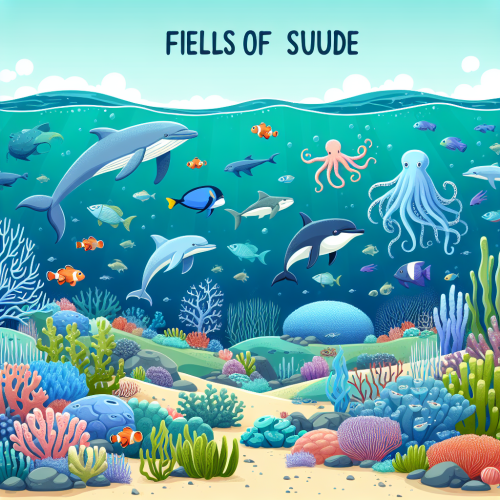
Students will immerse themselves in the exploration of marine biology, adopting the role of field scientists to investigate the adaptations and interactions of marine organisms. Through hands-on research and creative narrative writing, they will deepen their understanding of ecosystem dynamics while honing critical thinking and communication skills. This project fosters self-directed learning and academic mindset, encouraging students to reflect on their discoveries and share their insights in a community exhibition.

Learning goals

Students will develop expertise in a chosen marine field by conducting thorough research and documenting their findings in a scientific journal. They will engage in role-playing activities to simulate marine organism behaviors, enhancing their understanding of ecosystem dynamics. Through peer review and storytelling events, students will refine their narrative skills and practice effective communication. The project will foster critical thinking by challenging students to solve puzzles related to marine adaptations, encouraging innovative approaches to complex ecological questions.
Standards
  • [Common Core] CCSS.Math.Content.HSA-APR.A.1 - Understand that polynomials form a system analogous to the integers, namely, they are closed under the operations of addition, subtraction, and multiplication; add, subtract, and multiply polynomials.
  • [Common Core] CCSS.Math.Content.HSG-CO.B.7 - Use the definition of congruence in terms of rigid motions to show that two triangles are congruent if and only if corresponding pairs of sides and corresponding pairs of angles are congruent.
  • [Common Core] CCSS.Math.Content.HSG-CO.B.7 - Use the definition of congruence in terms of rigid motions to show that two triangles are congruent if and only if corresponding pairs of sides and corresponding pairs of angles are congruent.
  • [Common Core] CCSS.Math.Content.HSN-CN.C.8 - (+) Extend polynomial identities to the complex numbers.
  • [Common Core] CCSS.Math.Content.HSA-APR.B.2 - Know and apply the Remainder Theorem: For a polynomial p(x) and a number a, the remainder on division by x - a is p(a), so p(a) = 0 if and only if (x - a) is a factor of p(x).
Competencies
  • Self Directed Learning - Students use teacher and peer feedback and self-reflection to monitor and direct their own learning while building self knowledge both in and out of the classroom.
  • Academic Mindset - Students establish a sense of place, identity, and belonging to increase self-efficacy while engaging in critical reflection and action.
  • Critical Thinking & Problem Solving - Students consider a variety of innovative approaches to address and understand complex questions that are authentic and important to their communities.
  • Content Expertise - Students develop key competencies, skills, and dispositions with ample opportunities to apply knowledge and engage in work that matters to them.
  • Effective Communication - Students practice listening to understand, communicating with empathy, and share their learning through exhibiting, presenting and reflecting on their work.

Products

Throughout the project, students will develop a comprehensive Field Scientist Journal that includes detailed research, labeled drawings, and narrative entries based on their chosen marine field of study. They will also create props and costumes for the 'Storytelling by the Sea' event, enhancing their journal narratives with visual and dramatic elements. By the end of the project, students will have a polished scientific journal that showcases their understanding of marine organism adaptations, supported by peer-reviewed feedback.

Launch

Kick off the project with a 'Marine Adaptation Escape Room' challenge where students work in teams to solve puzzles related to the adaptations of marine organisms. As they unlock each puzzle, they gather critical information and clues that will guide their research and journal writing process. This immersive experience sets the stage for students to dive into their chosen marine fields of study, sparking curiosity and collaboration right from the start.

Exhibition

Students will participate in a 'Storytelling by the Sea' event, where they present excerpts from their scientific journals in a storytelling circle. They will use props and costumes to enhance their narratives, bringing their marine research to life for an audience of classmates and family members. This exhibition will allow students to showcase their understanding of marine adaptations and engage the community in their learning journey.