About Us News Pricing Contact Us Explore
Make a copy
About Us News Pricing Contact Us Explore
Tools
Project-Based Learning Performance Assessment Student-Led Conferences Digital Portfolios
HTH GSE Kaleidoscope
Personalize your design more by filling out the framework elements.
Designed by the Professional Learning team at the High Tech High Graduate School of Education.
Learn more
Essential Question
What question will guide the project and learning?
Community Partners
What organizations and individuals will collaborate and enhance the learning experience?
Reflection
What opportunities are there for us to reflect on our academic and socio-emotional development?
Assessment
In what ways can we demonstrate what we have learned and how we have grown?
Exhibition
How and who will we celebrate our learning with?
Project Launch
What shared experiences will engage us in the content, skills, and mindsets of the project?
Core Content
What will we need to learn and practice in order to engage in the project?
Critique and Revision
How will opportunities for feedback and refinement be embedded in the project?
Product
What will we make, build, or do that will have an impact on us or the world around us?
Next
What question will guide the project and learning?

1. In what ways can everyday choices—kindness, empathy, and inclusion—create big change?

2. How can we design a school community that makes every person feel seen, supported, and at home?

3. How can small sparks—acts of kindness, empathy, and inclusion—create big change in our school community and beyond?

    Design for Mastery Kit
    NEW
6th Grade  Project 8 weeks

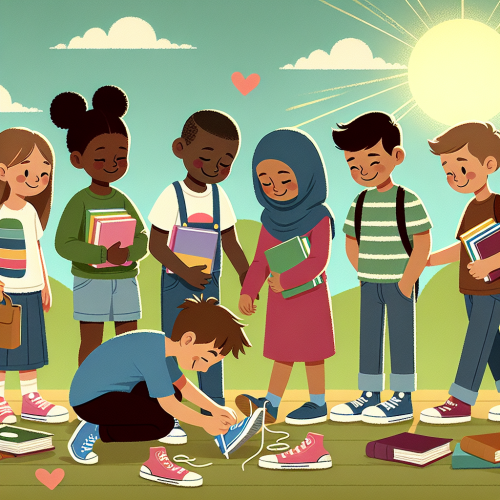
Kindness Konnection: Sparking Change Together!

Sheyla M
MS-PS4-3
CCSS.Math.Content.6.G.A.4
MS-ESS3-4
MS-LS1-6
6-8.AF.4.3
+ 11 more
1-pager

Purpose

This project aims to deepen students' understanding of how kindness and inclusion can transform communities, fostering a sense of belonging and safety. Through historical exploration, creative expression, and personal reflection, students will recognize the power of small acts to ignite significant change. By connecting past and present stories of humanity, they will actively contribute to a more welcoming school environment, embracing their role in shaping a supportive and inclusive community.

Learning goals

By the end of this project, students will have developed a deeper understanding of how acts of kindness and inclusion can transform communities, both historically and in their own lives. They will explore the impact of human actions on Earth's systems through qualitative scientific research, while also honing their critical thinking and problem-solving skills. Through collaboration and reflection, students will strengthen their communication abilities and build a sense of belonging and identity within their school community. Finally, they will create and present meaningful art pieces that express their personal commitment to fostering a more welcoming environment.
Standards
  • [Next Generation Science Standards] MS-PS4-3 - Integrate qualitative scientific and technical information to support the claim that digitized signals (sent as wave pulses) are a more reliable way to encode and transmit information.
  • [Common Core] CCSS.Math.Content.6.G.A.4 - Represent three-dimensional figures using nets made up of rectangles and triangles, and use the nets to find the surface area of these figures. Apply these techniques in the context of solving real-world and mathematical problems.
  • [Next Generation Science Standards] MS-ESS3-4 - Construct an argument supported by evidence for how increases in human population and per-capita consumption of natural resources impact Earth's systems.
  • [Next Generation Science Standards] MS-LS1-6 - Construct a scientific explanation based on evidence for the role of photosynthesis in the cycling of matter and flow of energy into and out of organisms.
  • [Next Generation Science Standards] 6-8.AF.4.3 - Distinguish between causal and correlational relationships in data.
  • [Next Generation Science Standards] MS-ESS2-1 - Develop a model to describe the cycling of Earth's materials and the flow of energy that drives this process.
  • [Next Generation Science Standards] MS-ESS2-4 - Develop a model to describe the cycling of water through Earth's systems driven by energy from the sun and the force of gravity.
  • [Next Generation Science Standards] MS-ESS1-1 - Develop and use a model of the Earth-sun-moon system to describe the cyclic patterns of lunar phases, eclipses of the sun and moon, and seasons.
  • [Next Generation Science Standards] MS-LS4-3 - Analyze displays of pictorial data to compare patterns of similarities in the embryological development across multiple species to identify relationships not evident in the fully formed anatomy.
  • [Next Generation Science Standards] MS-ESS2-2 - Construct an explanation based on evidence for how geoscience processes have changed Earth's surface at varying time and spatial scales.
Competencies
  • Self Directed Learning - Students use teacher and peer feedback and self-reflection to monitor and direct their own learning while building self knowledge both in and out of the classroom.
  • Academic Mindset - Students establish a sense of place, identity, and belonging to increase self-efficacy while engaging in critical reflection and action.
  • Critical Thinking & Problem Solving - Students consider a variety of innovative approaches to address and understand complex questions that are authentic and important to their communities.
  • Content Expertise - Students develop key competencies, skills, and dispositions with ample opportunities to apply knowledge and engage in work that matters to them.
  • Effective Communication - Students practice listening to understand, communicating with empathy, and share their learning through exhibiting, presenting and reflecting on their work.
  • Collaboration - Students co-design projects with peers, exercise shared-decision making, strengthen relational agency, resolve conflict, and assume leadership roles.

Products

Students will create a symbolic art piece that expresses their chosen changemaker's impact and how they foster belonging, choosing from options such as dance, drawing, painting, musical composition, or fabric creation. They will compile a research portfolio documenting their learning journey, craft a narrative piece connecting their changemaker's story to their own experiences, and write a personal Spark Statement committing to one action to enhance inclusivity in their school. These products collectively showcase their understanding and active contribution to a more connected community, focusing on humanities and social justice themes without incorporating math.

Launch

Start the project with a "Passing the Flame" circle, inviting students to share personal experiences of feeling welcomed or included. This shared storytelling activity builds emotional connections and sets the tone for the project. Introduce historical examples of "sparks of humanity" to inspire students and emphasize the project's focus on kindness and inclusion. This launch encourages students to recognize the impact of small acts and prepares them to explore these themes deeply in their creative and research work.

Exhibition

Students will host a Social Justice Storytelling Night and “We Create..” Gallery, where they share their symbolic art pieces, research portfolios, and narrative stories with families, peers, teachers, and community members. This exhibition invites visitors to engage with the students' work, reflect on the sparks of kindness and inclusion, and consider how they can contribute to a more welcoming school community. Through presentations and interactive displays, students will demonstrate their learning, growth, and commitment to fostering a sense of belonging and empathy within their community.
Plan
No plan yet!
Share
Loading
Loading
Get it on Google Play
© 2025 Inkwire Inc
Contact Us Privacy Policy Terms of Service