About Us Impact News Pricing Contact Us Explore
Make a copy
About Us Impact News Pricing Contact Us Explore
Tools
Project-Based Learning Performance Assessment Student-Led Conferences Digital Portfolios
HTH GSE Kaleidoscope
Personalize your design more by filling out the framework elements.
Designed by the Professional Learning team at the High Tech High Graduate School of Education.
Learn more
Essential Question
What question will guide the project and learning?
Community Partners
What organizations and individuals will collaborate and enhance the learning experience?
Reflection
What opportunities are there for us to reflect on our academic and socio-emotional development?
Assessment
In what ways can we demonstrate what we have learned and how we have grown?
Exhibition
How and who will we celebrate our learning with?
Project Launch
What shared experiences will engage us in the content, skills, and mindsets of the project?
Core Content
What will we need to learn and practice in order to engage in the project?
Critique and Revision
How will opportunities for feedback and refinement be embedded in the project?
Product
What will we make, build, or do that will have an impact on us or the world around us?
Next
What question will guide the project and learning?

How to distinguish between human and ai in chats

High School Grade  Project 4 weeks

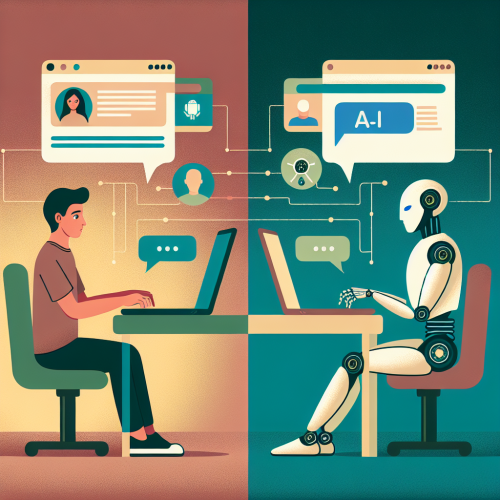
Chatbot or Not? AI vs. Human Chats!

Adem A
HS-PS2-6
CCSS.Math.Content.HSF-IF.B.4
CCSS.Math.Content.HSF-IF.B.6
TH:Cr3.HS1.b
CCSS.Math.Content.HSA-REI.D.12
+ 5 more
1-pager

Purpose

The purpose of this learning experience is to engage high school students in a focused exploration of how to distinguish AI-generated content from human communication. Through project-based learning, students will analyze chat data, work with interactive AI chatbots based on provided templates, and collaborate with community partners. In an optional extension, they will investigate how the molecular-level structure of materials used in computer hardware affects the functioning of devices that run AI systems. This project aims to enhance students’ critical thinking, problem-solving, and communication skills while fostering a sense of identity and belonging in their learning journey.

Learning goals

Students will develop the ability to analyze and interpret data using simple mathematical functions, graphs, and tables to identify basic patterns in AI- and human-generated chat content (for example, message length, response time, or frequency of questions). They will enhance their critical thinking and problem-solving skills by exploring and testing straightforward criteria to distinguish between AI and human interactions, and by justifying their decisions with clear evidence from their data. Through collaboration with a theater group, students will gain insights into authentic communication by exploring vocal and physical choices in performance. Additionally, they will cultivate effective communication skills by presenting their findings at the “AI vs. Human Expo” and engaging in structured reflective practices to assess their personal growth and views on AI.
Standards
  • [Next Generation Science Standards] HS-PS2-6 - Communicate scientific and technical information about why the molecular-level structure is important in the functioning of designed materials.
  • [Common Core] CCSS.Math.Content.HSF-IF.B.4 - For a function that models a relationship between two quantities, interpret key features of graphs and tables in terms of the quantities, and sketch graphs showing key features given a verbal description of the relationship.
  • [Common Core] CCSS.Math.Content.HSF-IF.B.6 - Calculate and interpret the average rate of change of a function (presented symbolically or as a table) over a specified interval. Estimate the rate of change from a graph.
  • [National Core Arts Standards] TH:Cr3.HS1.b - Explore physical, vocal and physiological choices to develop a performance that is believable, authentic, and relevant to a drama/theatre work.
  • [Common Core] CCSS.Math.Content.HSA-REI.D.12 - Graph the solutions to a linear inequality in two variables as a half-plane (excluding the boundary in the case of a strict inequality), and graph the solution set to a system of linear inequalities in two variables as the intersection of the corresponding half-planes.
Competencies
  • Self Directed Learning - Students use teacher and peer feedback and self-reflection to monitor and direct their own learning while building self knowledge both in and out of the classroom.
  • Academic Mindset - Students establish a sense of place, identity, and belonging to increase self-efficacy while engaging in critical reflection and action.
  • Critical Thinking & Problem Solving - Students consider a variety of innovative approaches to address and understand complex questions that are authentic and important to their communities.
  • Content Expertise - Students develop key competencies, skills, and dispositions with ample opportunities to apply knowledge and engage in work that matters to them.
  • Effective Communication - Students practice listening to understand, communicating with empathy, and share their learning through exhibiting, presenting and reflecting on their work.

Products

Students will configure and test an interactive AI chatbot based on a provided template that is designed to mimic human conversation, enabling users to test and analyze its responses without requiring advanced programming skills. They will create simple models in the form of graphs, tables, and basic decision rules (for example, “if message length is greater than X and response time is less than Y, the message is likely AI”) to present their findings on patterns in AI- and human-generated chat content. In an optional extension, some students may create a short explainer on how the molecular-level structure of a selected material used in AI-related hardware affects its function and why this matters for device performance. Additionally, all students will produce short reflective essays or recorded reflections describing their personal learning, how their view of AI vs. human communication has developed, and which critical thinking and problem-solving strategies they used.

Launch

Kick off the project with an engaging “AI vs. Human” debate, where students are divided into teams representing either AI systems or human communicators. Each team will research its perspective, collect sample AI- and human-generated messages, prepare arguments, and present them in a structured debate format. After the debate, the class will jointly compile initial hypotheses about how one might recognize AI-generated communication and a list of questions they want to investigate further with real chat data. This activity sparks curiosity and sets the stage for the project’s essential question: “How can we tell whether a message was written by a human or by AI?”

Exhibition

Students will host an “AI vs. Human Expo” where they showcase their interactive AI chatbots and present their analyses of AI versus human communication. They will set up booths with engaging visual displays, including graphs, tables, and simple decision rules, to illustrate their findings about patterns in AI- and human-generated chats and to explain how their criteria performed in practice. Visitors will be invited to interact with the chatbots, guess whether selected messages are AI or human, and compare their own judgments to the students’ decision rules. In cases where the extension is used, some booths will also present concise explanations of how designed materials used in AI-related hardware function at the molecular level and why this matters. Local experts and community partners will be invited to provide feedback, fostering a collaborative learning environment and offering real-world insights.
Rubric
Competency Progression Rubric Competency-first rubric
Category
Learning Goal
Stage 1
Stage 2
Stage 3
Stage 4
Deeper Learning Competencies
Self Directed Learning
  • I can reflect on feedback from my teacher and peers to identify ways I can improve my understanding of AI and human communication, and I can make a plan to apply this feedback to enhance my project work
  • I can use feedback from my teacher and peers to improve my ability to analyze chat data and recognize patterns in AI versus human communication
  • I am able to identify and describe basic features in graphs and tables, such as message length or response time, and explain my reasoning with simple mathematical functions
  • I explore different ways to make my presentations engaging and relevant, using vocal and physical choices to convey my findings clearly during the "AI vs
  • Human Expo
  • "
  • I can effectively use teacher and peer feedback to adjust my approach when analyzing chat data, and I can create clear graphs and tables that highlight patterns in AI and human communication
  • I can present my findings confidently, using both verbal and visual elements, and explain how I used data to support my conclusions
  • I can independently use feedback and self-reflection to guide my learning by setting specific goals and strategies for analyzing chat data
  • I effectively interpret graphs and tables to identify patterns in AI and human communication, and I confidently present my findings using clear, evidence-based criteria
  • I explore vocal and physical choices to enhance my understanding of authentic communication, and I communicate my insights clearly and engagingly at the "AI vs
  • Human Expo
  • "
Deeper Learning Competencies
Academic Mindset
  • I appreciate feedback from my teacher and peers to help me understand my progress, and I reflect on my learning journey by identifying areas where I feel confident and areas where I want to grow
  • I can describe the key features of graphs and tables that show patterns in AI and human communication, and I can share my findings in a way that helps others understand my perspective
  • I can explain my thought process and choices when analyzing data patterns in AI and human messages, using graphs and tables to support my conclusions
  • I can present my findings clearly and relate them to real-world applications, like understanding AI communication
  • I use feedback to improve my work and feel confident discussing the impact of molecular structures on AI hardware with peers and visitors at the expo
  • I can confidently present my analysis of AI versus human communication by using clear graphs and tables to highlight key patterns, and I can explain my reasoning with evidence from my data
  • I reflect on how my understanding of AI and human interactions has grown, and I actively engage with others by sharing my insights and considering their feedback, helping me feel more connected and confident in my learning journey
  • I can confidently share my insights and analyses on AI versus human communication by presenting clear and well-organized visual data displays, such as graphs and tables, that highlight key patterns and trends
  • I actively engage with visitors at the “AI vs
  • Human Expo,” using effective communication skills to explain my findings and decision rules in a way that is understandable and relatable
  • Through my work, I demonstrate a strong academic mindset by reflecting on my learning journey, showing growth in my understanding of AI and human interactions, and expressing how my identity and self-efficacy are strengthened by this project
Deeper Learning Competencies
Critical Thinking & Problem Solving
  • I can explore different methods to identify whether a message is from a human or AI by analyzing data patterns, such as message length and response time, and use this information to make decisions
  • I can describe my findings using graphs and tables, and I seek feedback to improve my understanding and approach
  • I can also engage in discussions to share my reasoning and consider new perspectives to enhance my problem-solving strategies
  • I can identify and describe basic patterns in AI- and human-generated chat content using simple mathematical functions, graphs, and tables, showing how message length and response time can help distinguish between the two
  • I explore different approaches and test criteria to solve the problem of recognizing AI communication, and I use clear evidence from my data to support my conclusions
  • I can effectively analyze chat data by identifying and interpreting key patterns, such as message length and response time, using simple mathematical functions, graphs, and tables
  • I use these patterns to develop and test criteria for distinguishing between AI- and human-generated messages, clearly justifying my decisions with evidence from my data
  • Additionally, I communicate my findings confidently and creatively at the “AI vs
  • Human Expo,” demonstrating my understanding through engaging presentations and interactive experiences
  • I can confidently analyze and interpret data using mathematical functions, graphs, and tables to identify patterns in AI- and human-generated chat content, such as message length and response time
  • I can effectively communicate my findings by presenting clear evidence and well-reasoned arguments to distinguish between AI and human interactions
  • I am able to create engaging presentations that showcase my understanding of communication dynamics through both technical analysis and creative expression, demonstrating my ability to connect my insights with real-world applications
Deeper Learning Competencies
Content Expertise
  • I can identify simple patterns in AI and human-generated chat content by using basic mathematical functions and graphs, and I can explain my findings with clear evidence
  • I can interpret and present simple mathematical data through graphs and tables, recognizing basic patterns in AI- and human-generated chat content, such as message length and response time
  • I can explain my findings using straightforward criteria and provide evidence from my data
  • I am able to explore and apply physical and vocal choices to communicate my ideas authentically during presentations
  • I can effectively configure and test an interactive AI chatbot using a provided template, identifying patterns in AI- and human-generated chat content through graphs and tables
  • I can clearly explain my findings and decision-making process during our "AI vs
  • Human Expo" and show how the molecular-level structure of materials impacts AI hardware function, when applicable
  • I can confidently analyze chat data using mathematical functions, graphs, and tables to identify patterns that distinguish AI-generated messages from human ones
  • I can clearly communicate my findings, using evidence from my data to support my conclusions, and articulate how the molecular-level structure of materials impacts AI hardware function in my presentations
  • I can effectively collaborate with peers and community partners, incorporating feedback to enhance my understanding and demonstrate my learning through engaging exhibits and performances
Deeper Learning Competencies
Effective Communication
  • I can clearly present my findings about AI and human communication by using graphs and tables to show patterns like message length and response time
  • I can explain my thinking and decision rules in a way that others can understand and relate to, using real-world examples and engaging visual displays
  • I can present basic findings about AI- and human-generated communication using clear graphs and tables, explaining key features like message length and response time
  • I can share my ideas confidently at the "AI vs
  • Human Expo," using simple decision rules to support my analysis and engaging visitors with thoughtful questions about my work
  • I can clearly present my findings about AI- and human-generated communication by using well-organized graphs and tables to highlight key patterns, and I can explain how different message characteristics helped me make my conclusions
  • I confidently engage with others during the “AI vs
  • Human Expo,” effectively communicating my ideas and listening to feedback to deepen my understanding and improve my presentation skills
  • I can effectively present my findings by clearly explaining the patterns I identified in AI and human-generated chat content using graphs and tables
  • I confidently use mathematical functions to interpret key features and justify my conclusions with evidence from the data
  • I engage visitors at the “AI vs
  • Human Expo” with an interactive and engaging booth, inviting them to test their skills with my AI chatbot and compare their judgments with my decision rules
  • I reflect on my learning journey, demonstrating growth in my understanding of AI communication and how molecular-level structures impact AI hardware
Learning Journey
Empathize
HS-PS2-6
CCSS.Math.Content.HSF-IF.B.4
TH:Cr3.HS1.b
Self Directed Learning
Critical Thinking & Problem Solving
Effective Communication
Students will engage in role-playing scenarios with a theater group to explore and understand vocal, physical, and physiological choices in AI and human interactions, fostering empathy and identifying key communication challenges for distinguishing AI from human chat content.
Days 1 - 4
Milestone Activities
No activities have been added to this phase yet.

Edit Phase

Loading...
Define
HS-PS2-6
CCSS.Math.Content.HSF-IF.B.4
CCSS.Math.Content.HSF-IF.B.6
TH:Cr3.HS1.b
Academic Mindset
Critical Thinking & Problem Solving
Content Expertise
Students will analyze chat log data, utilize mathematical functions to identify patterns distinguishing AI from human interactions, and collaboratively articulate the problem of differentiation as a foundation for subsequent ideation.
Days 5 - 7
Milestone Activities
No activities have been added to this phase yet.

Edit Phase

Loading...
Ideate
HS-PS2-6
TH:Cr3.HS1.b
CCSS.Math.Content.HSA-REI.D.12
Critical Thinking & Problem Solving
Content Expertise
Effective Communication
Students will brainstorm and explore diverse solutions for differentiating AI-generated text from human communication, creating sketches, models, and scenarios that will inform their upcoming prototype development.
Days 8 - 12
Milestone Activities
No activities have been added to this phase yet.

Edit Phase

Loading...
Prototype
HS-PS2-6
CCSS.Math.Content.HSF-IF.B.4
TH:Cr3.HS1.b
Critical Thinking & Problem Solving
Content Expertise
Effective Communication
Students will create low-fidelity prototypes of interactive booths for the 'AI vs. Human Expo,' using data visualizations and role-playing scenarios to differentiate AI-generated content from human communication, guided by feedback from peers and community partners.
Days 13 - 16
Milestone Activities
No activities have been added to this phase yet.

Edit Phase

Loading...
Test
HS-PS2-6
CCSS.Math.Content.HSF-IF.B.4
CCSS.Math.Content.HSF-IF.B.6
Self Directed Learning
Critical Thinking & Problem Solving
Effective Communication
Students will engage with community partners at the 'AI vs. Human Expo' to collect feedback on their interactive AI chatbot prototypes, using insights to refine their designs and enhance their understanding of distinguishing AI from human interactions.
Days 17 - 20
Milestone Activities
No activities have been added to this phase yet.

Edit Phase

Loading...
Plan
Week 1
Day 1
Day 2
Day 3
Day 4
Day 5
Phase
Empathize
Define
Activities
Project Launch: AI vs. Human Debate
Activity (Deprecated) 45m
Project Introduction and Essential Question Exploration
Activity (Deprecated) 20m
AI vs. Human Debate Preparation
Activity (Deprecated) 25m
Analyzing Chat Log Patterns
Activity (Deprecated) 45m
Research and Data Collection
Activity (Deprecated) 25m
Debate Practice and Strategy Development
Activity (Deprecated) 20m
Exploring Molecular-Level Structure
Activity (Deprecated) 20m
Analysis of Molecular-Level Structures
Activity (Deprecated) 25m
Theater Workshop: Authentic Communication
Activity (Deprecated) 25m
Graphing and Interpretation of Chat Data
Activity (Deprecated) 20m
Interactive AI Chatbot Design
Activity (Deprecated) 45m
Role-Playing Scenarios with Theater Group
Activity (Deprecated) 30m
Reflection on Personal Learning Goals
Activity (Deprecated) 15m
Defining Criteria for AI vs. Human Distinction
Activity (Deprecated) 45m
AI vs. Human Debate
Activity (Deprecated) 30m
Define Phase Introduction
Activity (Deprecated) 15m
Preparation
Week 2
Day 6
Day 7
Day 8
Day 9
Day 10
Phase
Define
Ideate
Activities
Define Phase Workshop
Activity (Deprecated) 20m
Refining Criteria for AI vs. Human Distinction
Activity (Deprecated) 45m
Research Synthesis and Goal Setting
Activity (Deprecated) 25m
Peer Review and Feedback Session
Activity (Deprecated) 25m
Data Analysis and Visualization
Activity (Deprecated) 30m
Reflection and Feedback Session
Activity (Deprecated) 15m
Reflection and Goal Setting
Activity (Deprecated) 20m
Introduction to Ideation
Activity (Deprecated) 20m
Ideation Phase Kickoff
Activity (Deprecated) 15m
Creative Brainstorming Workshop
Activity (Deprecated) 30m
Collaborative Ideation Workshop
Activity (Deprecated) 25m
Prototype Development
Activity (Deprecated) 45m
Concept Development and Prototyping
Activity (Deprecated) 30m
Peer Review and Iteration
Activity (Deprecated) 15m
Model Testing and Iteration
Activity (Deprecated) 45m
Role-Playing Exploration with Theater Group
Activity (Deprecated) 25m
Reflective Journaling
Activity (Deprecated) 20m
Preparation
Week 3
Day 11
Day 12
Day 13
Day 14
Day 15
Phase
Ideate
Prototype
Activities
Advanced Ideation Workshop
Activity (Deprecated) 20m
Innovative Solution Brainstorming
Activity (Deprecated) 20m
Feedback and Revision
Activity (Deprecated) 25m
Collaborative Ideation and Prioritization
Activity (Deprecated) 25m
Refining Innovative Solutions
Activity (Deprecated) 25m
Integration Planning
Activity (Deprecated) 20m
Peer Review of Refined Solutions
Activity (Deprecated) 20m
Prototype Development: AI Chatbot Enhancement
Activity (Deprecated) 45m
Prototype Development
Activity (Deprecated) 30m
Reflective Feedback Session
Activity (Deprecated) 15m
Prototype Testing
Activity (Deprecated) 25m
Enhancing User Experience
Activity (Deprecated) 25m
Iteration and Improvement
Activity (Deprecated) 20m
Role-Playing and Testing
Activity (Deprecated) 20m
Final Prototype Review
Activity (Deprecated) 25m
Finalizing Prototypes
Activity (Deprecated) 30m
Self-Reflection and Goal Setting
Activity (Deprecated) 15m
Preparation for AI vs. Human Expo
Activity (Deprecated) 20m
Preparation
Week 4
Day 16
Day 17
Day 18
Day 19
Day 20
Phase
Prototype
Test
Activities
Prototype Refinement
Activity (Deprecated) 20m
Prototype Presentation
Activity (Deprecated) 20m
User Interaction Testing
Activity (Deprecated) 25m
Expert Feedback Session
Activity (Deprecated) 25m
Refinement and Testing
Activity (Deprecated) 25m
Exhibition Planning
Activity (Deprecated) 20m
Feedback Incorporation
Activity (Deprecated) 25m
Data Analysis Workshop
Activity (Deprecated) 20m
Final Testing and Iteration
Activity (Deprecated) 25m
Final Prototype Testing
Activity (Deprecated) 25m
Peer Review and Collaboration
Activity (Deprecated) 20m
Expo Presentation Rehearsal
Activity (Deprecated) 20m
Expo Setup
Activity (Deprecated) 20m
Exhibition Preparation
Activity (Deprecated) 20m
Peer Review and Support
Activity (Deprecated) 25m
Rehearsal and Presentation Skills
Activity (Deprecated) 25m
AI vs. Human Expo
Activity (Deprecated) 30m
AI vs. Human Expo
Activity (Deprecated) 45m
Reflective Essay Writing
Activity (Deprecated) 15m
Preparation
Share
Loading
Loading
Get it on Google Play
© 2026 Inkwire Inc
Contact Us Privacy Policy Terms of Service