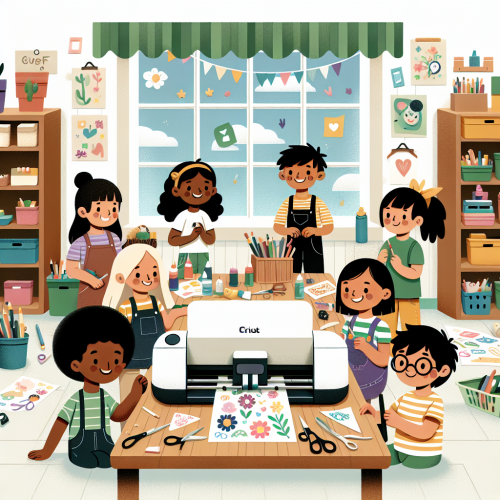
This project aims to immerse 5th and 6th-grade students in a real-world design experience, leveraging technology to enhance artistic expression. Through collaborative creation of classroom-themed decals using a Cricut, students will gain hands-on skills in digital design and critical thinking. By engaging with community partners and presenting their work, students will develop a deeper understanding of the intersection between technology, creativity, and entrepreneurship, fostering a sense of identity and belonging in their learning environment.
Learning goals
Students will collaboratively design and create classroom-themed decals using Cricut technology, enhancing their digital literacy and design thinking skills. They will develop competencies in self-directed learning by using feedback to refine their designs and critical thinking to address complex design challenges. Through effective communication, students will narrate their design process and artistic expression in video presentations, fostering a sense of identity and belonging. They will also engage with community partners to gain insights into entrepreneurship, applying their knowledge to develop small-scale product ideas.
Standards
[Next Generation Science Standards] MS-PS2-2 - Plan an investigation to provide evidence that the change in an object's motion depends on the sum of the forces on the object and the mass of the object.
[National Council for the Social Studies] D2.Geo.12.3-5 - Explain how natural and human-made catastrophic events in one place affect people living in other places.
[Next Generation Science Standards] MS-ESS1-4 - Construct a scientific explanation based on evidence from rock strata for how the geologic time scale is used to organize Earth's 4.6-billion-year-old history.
[Next Generation Science Standards] 6-8.AG.3.1 - Time, space, and energy phenomena can be observed at various scales using models to study systems that are too large or too small.
[Next Generation Science Standards] 6-8.AG.7.3 - Stability might be disturbed either by sudden events or gradual changes that accumulate over time.
[Next Generation Science Standards] MS-LS2-1 - Analyze and interpret data to provide evidence for the effects of resource availability on organisms and populations of organisms in an ecosystem.
[Common Core] CCSS.Math.Content.5.G.A.1 - Use a pair of perpendicular number lines, called axes, to define a coordinate system, with the intersection of the lines (the origin) arranged to coincide with the 0 on each line and a given point in the plane located by using an ordered pair of numbers, called its coordinates. Understand that the first number indicates how far to travel from the origin in the direction of one axis, and the second number indicates how far to travel in the direction of the second axis, with the convention that the names of the two axes and the coordinates correspond (e.g., x-axis and x-coordinate, y-axis and y-coordinate).
[Next Generation Science Standards] 6-8.AG.3.2 - The observed function of natural and designed systems may change with scale.
[National Council for the Social Studies] D2.Geo.10.3-5 - Explain why environmental characteristics vary among different world regions.
[Next Generation Science Standards] MS-PS1-5 - Develop and use a model to describe how the total number of atoms does not change in a chemical reaction and thus mass is conserved.
Competencies
Self Directed Learning - Students use teacher and peer feedback and self-reflection to monitor and direct their own learning while building self knowledge both in and out of the classroom.
Academic Mindset - Students establish a sense of place, identity, and belonging to increase self-efficacy while engaging in critical reflection and action.
Critical Thinking & Problem Solving - Students consider a variety of innovative approaches to address and understand complex questions that are authentic and important to their communities.
Content Expertise - Students develop key competencies, skills, and dispositions with ample opportunities to apply knowledge and engage in work that matters to them.
Effective Communication - Students practice listening to understand, communicating with empathy, and share their learning through exhibiting, presenting and reflecting on their work.
Collaboration - Students co-design projects with peers, exercise shared-decision making, strengthen relational agency, resolve conflict, and assume leadership roles.
Products
Students will collaboratively design and create a series of classroom-themed decals using Cricut technology, which will be applied to classroom walls or furniture. These decals will serve as tangible expressions of their learning and creativity, showcased during the gallery walk. Additionally, students will produce a video presentation narrating the story behind their project, highlighting the inspiration and design process, to be shared with community partners.
Launch
Kick off the project with a hands-on workshop where students explore the capabilities of the Cricut machine by creating simple, personalized name tags. This activity will introduce them to the design software and the machine's functions, sparking curiosity and excitement for the upcoming project. Invite the entrepreneur club to share inspiring examples of Cricut-made products, highlighting the intersection of technology and creativity.
Exhibition
Students will organize a 'Design Gallery Walk' to showcase their Cricut projects, transforming the classroom into an interactive exhibit space. Each project will feature a QR code linking to a student-narrated video presentation, allowing visitors to engage deeply with the design process and stories behind each creation. Community partners and peers will be invited to explore the gallery, fostering a shared learning experience and celebrating the students' artistic and technological achievements.