9th, High School Grades  Project 3 weeks

City Solutions: Transform Tomorrow's World

Montserrat P
CCSS.Math.Content.HSG-CO.A.2
CCSS.Math.Content.HSG-CO.A.3
CCSS.Math.Content.HSG-CO.A.4
CCSS.Math.Content.HSG-CO.A.5
CCSS.Math.Content.HSG-CO.B.6
+ 7 more
1-pager

Purpose

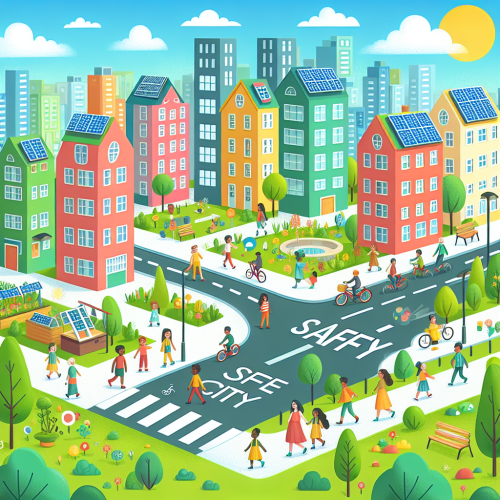
Students will collaboratively design a blueprint for a sustainable city that addresses environmental threats through geometric transformations. This project enables students to apply mathematical concepts to real-world problems, fostering critical thinking and problem-solving skills. By working with architects and engineers, students will gain insights into urban planning, enhancing their content expertise and communication skills. The project culminates in a gallery walk exhibition where students present their designs, reflecting on their learning journey and the impact of their solutions on community safety and accessibility.

Learning goals

Students will learn to apply geometric transformations to create innovative solutions for urban design challenges, focusing on safety, accessibility, and sustainability. They will develop critical thinking and problem-solving skills by exploring real-world issues and collaborating with peers to design a city blueprint that addresses environmental threats. Through effective communication, students will articulate their design rationale, mathematical processes, and socio-emotional growth, culminating in a gallery walk exhibition to share their work with the community.
Standards
  • [Common Core] CCSS.Math.Content.HSG-CO.A.2 - Represent transformations in the plane using, e.g., transparencies and geometry software; describe transformations as functions that take points in the plane as inputs and give other points as outputs. Compare transformations that preserve distance and angle to those that do not (e.g., translation versus horizontal stretch).
  • [Common Core] CCSS.Math.Content.HSG-CO.A.3 - Given a rectangle, parallelogram, trapezoid, or regular polygon, describe the rotations and reflections that carry it onto itself.
  • [Common Core] CCSS.Math.Content.HSG-CO.A.4 - Develop definitions of rotations, reflections, and translations in terms of angles, circles, perpendicular lines, parallel lines, and line segments.
  • [Common Core] CCSS.Math.Content.HSG-CO.A.5 - Given a geometric figure and a rotation, reflection, or translation, draw the transformed figure using, e.g., graph paper, tracing paper, or geometry software. Specify a sequence of transformations that will carry a given figure onto another.
  • [Common Core] CCSS.Math.Content.HSG-CO.B.6 - Use geometric descriptions of rigid motions to transform figures and to predict the effect of a given rigid motion on a given figure; given two figures, use the definition of congruence in terms of rigid motions to decide if they are congruent.
  • [Common Core] CCSS.Math.Content.HSG-SRT.A.1 - Verify experimentally the properties of dilations given by a center and a scale factor:
  • [Common Core] CCSS.Math.Content.HSG-SRT.A.2 - Given two figures, use the definition of similarity in terms of similarity transformations to decide if they are similar; explain using similarity transformations the meaning of similarity for triangles as the equality of all corresponding pairs of angles and the proportionality of all corresponding pairs of sides.
  • [Common Core] CCSS.Math.Content.HSG-MG.A.3 - Apply geometric methods to solve design problems (e.g., designing an object or structure to satisfy physical constraints or minimize cost; working with typographic grid systems based on ratios).
Competencies
  • Critical Thinking & Problem Solving - Students consider a variety of innovative approaches to address and understand complex questions that are authentic and important to their communities.
  • Collaboration - Students co-design projects with peers, exercise shared-decision making, strengthen relational agency, resolve conflict, and assume leadership roles.
  • Effective Communication - Students practice listening to understand, communicating with empathy, and share their learning through exhibiting, presenting and reflecting on their work.
  • Content Expertise - Students develop key competencies, skills, and dispositions with ample opportunities to apply knowledge and engage in work that matters to them.

Products

Students will collaboratively design a blueprint for a sustainable urban living area that addresses environmental threats using innovative geometric transformations. The final product will include a detailed written report showcasing the mathematical processes applied, such as rotations, reflections, and translations, to optimize city infrastructure for safety and accessibility. Additionally, students will maintain a reflection journal throughout the project to document their progress, challenges, and socio-emotional growth. The project will culminate in a gallery walk where students exhibit their designs and reports to peers, parents, and teachers, fostering effective communication and critical thinking skills.

Launch

Begin the project by inviting students to participate in a virtual tour of a city known for its innovative urban design, focusing on how geometric transformations are utilized to enhance safety and sustainability. Following the tour, facilitate a brainstorming session where students identify specific environmental threats and urban challenges they wish to address in their own city designs. Encourage students to form small groups to discuss their initial ideas and sketch preliminary designs, fostering collaboration and setting the stage for deeper exploration throughout the project.

Exhibition

Students will showcase their city designs during a gallery walk, where they present their blueprints and written reports to peers, parents, and community members, including architects and engineers. Each student will have the opportunity to explain the geometric transformations applied and how these contribute to the city's safety and sustainability. The exhibition will include interactive elements, such as digital simulations or models, allowing attendees to visualize the proposed city infrastructure in action. This event will also serve as a platform for students to receive feedback and engage in meaningful dialogue about their design choices and the mathematical concepts employed.