3rd Grade  Project 1 week

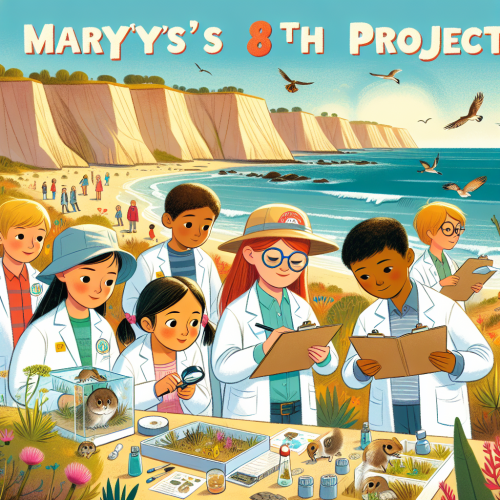
Pocket Mouse Protectors: San Diego's Eco Heroes!

Mary P
CCSS.ELA-Literacy.RI.3.8
CCSS.Math.Content.3.MD.C.5
CCSS.ELA-Literacy.RL.3.4
CCSS.Math.Content.3.G.A.2
CCSS.Math.Content.3.OA.C.7
+ 5 more
1-pager

Purpose

The purpose of this learning experience is to engage third-grade students in real-world conservation efforts by transforming them into Junior Conservation Biologists. Through hands-on activities and collaboration with local experts, students will explore the importance of protecting endangered species in San Diego. They will develop critical thinking and communication skills as they collect and analyze data, create public awareness campaigns, and present their findings to the community, fostering a sense of responsibility and connection to their local environment.

Learning goals

Students will develop their skills in scientific observation and data interpretation by actively participating in data collection and analysis of local endangered species. They will enhance their communication abilities by creating and presenting public awareness campaigns, integrating art and science to effectively convey their findings. Through collaboration with community partners and participation in hands-on activities, students will build a deeper understanding of biodiversity and conservation, fostering critical thinking and problem-solving skills. Additionally, they will cultivate self-directed learning and reflection, using feedback to refine their work and contribute meaningfully to their community's environmental efforts.
Standards
  • [Common Core] CCSS.ELA-Literacy.RI.3.8 - Describe the logical connection between particular sentences and paragraphs in a text (e.g., comparison, cause/effect, first/second/third in a sequence).
  • [Common Core] CCSS.Math.Content.3.MD.C.5 - Recognize area as an attribute of plane figures and understand concepts of area measurement.
  • [Common Core] CCSS.ELA-Literacy.RL.3.4 - Determine the meaning of words and phrases as they are used in a text, distinguishing literal from nonliteral language.
  • [Common Core] CCSS.Math.Content.3.G.A.2 - Partition shapes into parts with equal areas. Express the area of each part as a unit fraction of the whole.
  • [Common Core] CCSS.Math.Content.3.OA.C.7 - Fluently multiply and divide within 100, using strategies such as the relationship between multiplication and division (e.g., knowing that 8 × 5 = 40, one knows 40 ÷ 5 = 8) or properties of operations. By the end of Grade 3, know from memory all products of two one-digit numbers.
Competencies
  • Self Directed Learning - Students use teacher and peer feedback and self-reflection to monitor and direct their own learning while building self knowledge both in and out of the classroom.
  • Academic Mindset - Students establish a sense of place, identity, and belonging to increase self-efficacy while engaging in critical reflection and action.
  • Critical Thinking & Problem Solving - Students consider a variety of innovative approaches to address and understand complex questions that are authentic and important to their communities.
  • Content Expertise - Students develop key competencies, skills, and dispositions with ample opportunities to apply knowledge and engage in work that matters to them.
  • Effective Communication - Students practice listening to understand, communicating with empathy, and share their learning through exhibiting, presenting and reflecting on their work.

Products

Students will create educational videos showcasing local endangered species, using footage from their birdwatching activities and virtual tours. They will design 3D models of habitats, highlighting human impact and conservation strategies. An interactive digital map will be developed to display species distribution data collected during the project. A collaborative mural illustrating ecosystem interconnectedness will be crafted, and a booklet of student-created poems and stories will be compiled, all to be featured at the Eco-Art Gallery.

Launch

Kick off the project with an engaging 'Conservation Quest' scavenger hunt around the school or local community. Students will solve clues related to local endangered species and their habitats, encouraging teamwork and reinforcing the project's essential question. This activity will spark curiosity and set the stage for their roles as Junior Conservation Biologists, fostering excitement and a sense of purpose from the outset.

Exhibition

Students will host an 'Eco-Art Gallery' at a local community center, showcasing their research-inspired artwork, such as posters, 3D habitat models, and a collaborative mural. The gallery will also feature educational videos and an interactive digital map, providing a comprehensive view of local endangered species and conservation efforts. Community members, local artists, and environmentalists will be invited to engage with students, offering feedback and discussing the role of art and science in conservation. Additionally, students will share a booklet of their poems and stories, emphasizing the importance of biodiversity, during this public exhibition.