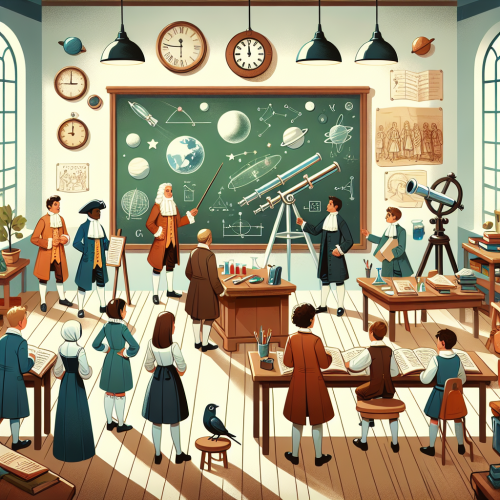
10th Grade  Project 2 weeks

Scientific Revolution: Unleash Your Inner Einstein!

Dillon R
CCSS.ELA-Literacy.RH.9-10.10
HS.WH.I.CC.1
HS.WH.I.CC.2
Self Directed Learning
Academic Mindset
+ 1 more
1-pager

Purpose

This project aims to immerse 10th-grade students in the transformative period of the Scientific Revolution by engaging them in hands-on creation and collaborative exploration. Through designing and building models of early scientific instruments, students will deepen their understanding of historical advancements while developing critical thinking and problem-solving skills. Working with community partners, including the school's science teacher, students will reflect on their learning journey, fostering self-directed learning and academic mindset. The culminating exhibition will provide a platform for students to communicate their insights and showcase their achievements, promoting a sense of identity and belonging within the learning community.

Learning goals

Students will explore the key figures and innovations of the Scientific Revolution, engaging in hands-on activities to understand their historical impact. They will collaboratively design and construct a model of an early scientific instrument, such as Galileo's telescope, to deepen their comprehension of its role in advancing scientific thought. Through peer reflection and feedback, students will refine their understanding and presentation skills, culminating in a collaborative exhibition with the science teacher that showcases their projects and insights.
Standards
  • [Common Core] CCSS.ELA-Literacy.RH.9-10.10 - By the end of grade 10, read and comprehend history/social studies texts in the grades 9—10 text complexity band independently and proficiently.
  • [Kentucky] HS.WH.I.CC.1 - Engage in meaningful discussions/democratic discourse and respect diverse opinions relevant to compelling/supporting questions in world history.
  • [Kentucky] HS.WH.I.CC.2 - Engage in disciplinary thinking and construct arguments, explanations or public communications relevant to compelling/supporting questions in world history.
Competencies
  • Self Directed Learning - Students use teacher and peer feedback and self-reflection to monitor and direct their own learning while building self knowledge both in and out of the classroom.
  • Academic Mindset - Students establish a sense of place, identity, and belonging to increase self-efficacy while engaging in critical reflection and action.
  • Critical Thinking & Problem Solving - Students consider a variety of innovative approaches to address and understand complex questions that are authentic and important to their communities.

Products

Students will design and build a model of an early scientific instrument, such as Galileo's telescope, using accessible materials. They will collaborate with the science teacher to understand the instrument's historical context and scientific principles. The final product will be showcased in a collaborative exhibition where students explain the instrument's impact on the scientific revolution, incorporating peer feedback and self-reflection throughout the process.

Launch

To kick off the project, students will collaborate with the science teacher to explore the historical context and significance of the scientific revolution. They will engage in an interactive discussion about the essential question, focusing on how scientific instruments, like Galileo's telescope, transformed scientific inquiry. Students will brainstorm ideas for their model designs, considering innovative approaches and diverse perspectives. This launch will set the stage for meaningful exploration and reflection throughout the project.

Exhibition

Students will collaborate with the science teacher to design and build models of early scientific instruments, such as Galileo's telescope. They will present their creations and explain the impact of these instruments on the scientific revolution during a school-wide exhibition. This exhibition will include interactive demonstrations and discussions, allowing students to engage with peers, teachers, and community members, fostering a deeper understanding of the historical significance and fostering diverse perspectives.