About Us Impact News Pricing Contact Us Explore
Make a copy
About Us Impact News Pricing Contact Us Explore
Tools
Project-Based Learning Performance Assessment Student-Led Conferences Digital Portfolios
HTH GSE Kaleidoscope
Personalize your design more by filling out the framework elements.
Designed by the Professional Learning team at the High Tech High Graduate School of Education.
Learn more
Essential Question
What question will guide the project and learning?
Community Partners
What organizations and individuals will collaborate and enhance the learning experience?
Reflection
What opportunities are there for us to reflect on our academic and socio-emotional development?
Assessment
In what ways can we demonstrate what we have learned and how we have grown?
Exhibition
How and who will we celebrate our learning with?
Project Launch
What shared experiences will engage us in the content, skills, and mindsets of the project?
Core Content
What will we need to learn and practice in order to engage in the project?
Critique and Revision
How will opportunities for feedback and refinement be embedded in the project?
Product
What will we make, build, or do that will have an impact on us or the world around us?
Next
What question will guide the project and learning?

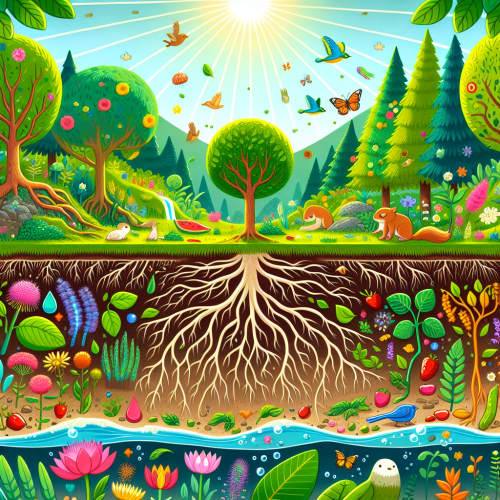
What are the relationships between the structure and function of plant roots, stems, and leaves, and how can we use models to illustrate these connections?

    Design for Mastery Kit
    NEW
High School Grade  Project 2 weeks

"Plantastic: The Power of Roots & Shoots!"

Nick W
HS-LS1-2
Self Directed Learning
Academic Mindset
Critical Thinking & Problem Solving
1-pager

Purpose

This project immerses high school students in an exploration of plant structures, fostering a deeper understanding of the hierarchical organization within multicellular organisms. By engaging in hands-on experiments, reflective journaling, and collaborative critique, students develop critical thinking and problem-solving skills while connecting their learning to ecological systems. The experience encourages self-directed learning and cultivates an academic mindset, empowering students to draw meaningful connections between scientific concepts and their real-world applications.

Learning goals

Students will develop a comprehensive understanding of the hierarchical organization and functions of plant roots, stems, and leaves through hands-on experimentation and modeling. They will enhance their self-directed learning skills by seeking information, reflecting on feedback, and refining their hypotheses. Additionally, students will cultivate critical thinking and problem-solving abilities by engaging in peer reviews and analyzing real-world ecological connections.
Standards
  • [Next Generation Science Standards] HS-LS1-2 - Develop and use a model to illustrate the hierarchical organization of interacting systems that provide specific functions within multicellular organisms.
Competencies
  • Self Directed Learning - Students use teacher and peer feedback and self-reflection to monitor and direct their own learning while building self knowledge both in and out of the classroom.
  • Academic Mindset - Students establish a sense of place, identity, and belonging to increase self-efficacy while engaging in critical reflection and action.
  • Critical Thinking & Problem Solving - Students consider a variety of innovative approaches to address and understand complex questions that are authentic and important to their communities.

Products

Students will create a video documentary showcasing their experiments on plant structures and environmental variables, demonstrating their understanding of plant physiology. They will also compile a digital photo journal from a plant structure scavenger hunt, featuring photographs and analyses of various plant parts. These products will be shared during peer review sessions, where students provide and receive feedback to refine their work.

Launch

To kick off the learning experience, students will embark on an exploratory walk around the school grounds or a nearby park, equipped with magnifying glasses and notebooks. They will observe and sketch various plant structures, noting their initial thoughts on the functions of roots, stems, and leaves. This hands-on exploration will spark curiosity and set the stage for the upcoming project, encouraging students to generate questions and hypotheses about plant physiology.

Exhibition

At the conclusion of the project, students will host an interactive exhibition showcasing their digital photo journals and video documentaries. This event will invite peers, teachers, and community members to explore the students' findings on plant structures and their functions. Attendees can engage with students through Q&A sessions, providing an opportunity for students to articulate their learning process and insights. The exhibition will also feature a guided plant structure scavenger hunt, allowing visitors to experience the students' learning journey firsthand.
Learning Journey
Project Activities
Days 1 - 10
Milestone Activities
No activities have been added to this phase yet.

Edit Phase

Loading...
Plan
Week 1
Day 1
Day 2
Day 3
Day 4
Day 5
Phase
Project Activities
Activities
Exploration Walk
Activity 20m
Hypothesis Development
Activity 20m
Model Building
Activity 20m
Research and Reflection
Activity 20m
Peer Feedback Session
Activity 20m
Preparation
Week 2
Day 6
Day 7
Day 8
Day 9
Day 10
Phase
Project Activities
Activities
Model Testing and Data Collection
Activity 20m
Data Analysis and Interpretation
Activity 20m
Video Documentary Planning
Activity 20m
Video Documentation and Editing
Activity 20m
Reflective Journal Entry and Peer Review
Activity 20m
Preparation
Share
Loading
Loading
Get it on Google Play
© 2026 Inkwire Inc
Contact Us Privacy Policy Terms of Service