Middle School Grade  Lesson 45 minutes

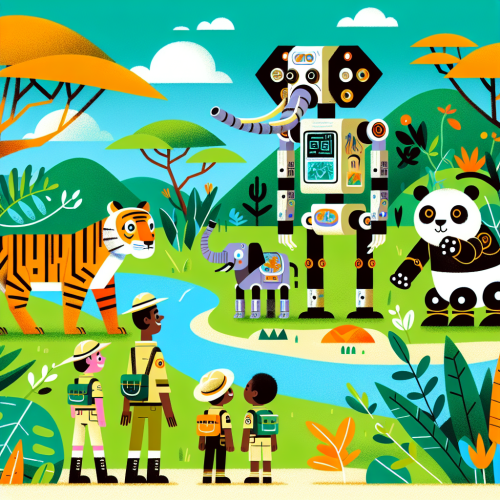
Endangered Animatronic Safari Adventure

Amy W
TH:Cn11.2.8.b
6-8.AF.2.8
TH:Cn11.2.7.b
Self Directed Learning
Academic Mindset
+ 1 more
1-pager

Purpose

Students will explore the intersection of art, history, and science by creating automatons that represent endangered animals, fostering a deeper understanding of both historical artifacts and contemporary environmental issues. This project encourages students to engage critically with the design process, using creativity and innovation to address real-world challenges. Through hands-on creation and public exhibition, students will develop self-directed learning skills, enhance their academic mindset, and contribute to meaningful conversations about biodiversity and conservation.

Learning goals

Students will explore the mechanics and history of automatons to understand how these devices function and their relevance to artistic expression. They will research endangered animals, examining their unique characteristics and conservation challenges, to inform their automaton designs. Through creating and presenting their automatons and accompanying slide shows, students will engage in critical reflection, receive feedback, and refine their projects, thereby enhancing their self-directed learning and academic mindset. The project will culminate in an art show exhibition, allowing students to share their work and insights on endangered species with a broader audience, fostering a sense of community and responsibility.
Standards
  • [National Core Arts Standards] TH:Cn11.2.8.b - Identify and use artifacts from a time period and place to develop performance and design choices in a drama/theatre work.
  • [Next Generation Science Standards] 6-8.AF.2.8 - Develop and/or use a model to generate data to test ideas about phenomena in natural or designed systems, including those representing inputs and outputs, and those at unobservable scales.
  • [National Core Arts Standards] TH:Cn11.2.7.b - Examine artifacts from a time period and geographic location to better understand performance and design choices in a drama/theatre work.
Competencies
  • Self Directed Learning - Students use teacher and peer feedback and self-reflection to monitor and direct their own learning while building self knowledge both in and out of the classroom.
  • Academic Mindset - Students establish a sense of place, identity, and belonging to increase self-efficacy while engaging in critical reflection and action.
  • Critical Thinking & Problem Solving - Students consider a variety of innovative approaches to address and understand complex questions that are authentic and important to their communities.

Products

Students will create a functional automaton representing an endangered animal using cardboard, showcasing their understanding of both the animal's characteristics and the mechanics of automatons. Alongside the automaton, they will develop a slide show presentation that highlights the animal's unique traits, conservation status, and the design process of their automaton. These projects will be exhibited in an art show, allowing students to share their work and raise awareness about endangered species with the broader community.

Launch

Begin the lesson by presenting a short video or interactive presentation on the history and mechanics of automatons, highlighting their evolution and cultural significance. Follow this with a brief discussion on the concept of endangered animals, using vivid images and stories to capture students' interest. Encourage students to brainstorm in pairs about how automatons can be used to represent and raise awareness for these animals, setting the stage for their creative projects.

Exhibition

Students will showcase their cardboard automatons of endangered animals at a school-wide art show, inviting peers, teachers, and family members to explore their creations. Each display will include a slideshow presentation that highlights the unique features of the animal, the design process, and the conservation message. This exhibition will provide an opportunity for students to engage with the audience, answer questions, and discuss the importance of protecting endangered species through artistic and technological expressions.