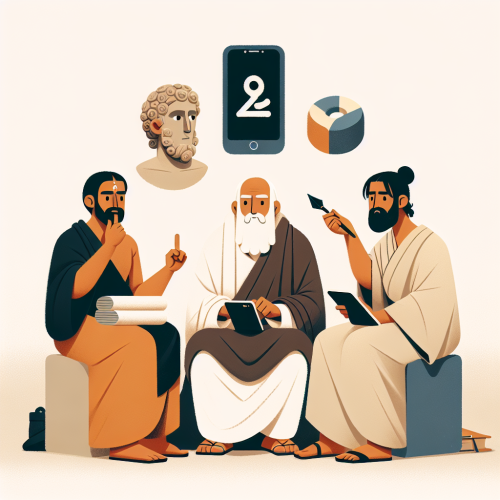
The purpose of this learning experience is to engage students in exploring the relevance of ancient Greek philosophies to modern-day challenges, encouraging them to think critically and creatively about social justice, technology, and communication. Through interactive activities, students will connect historical ideas with contemporary issues, fostering a deeper understanding of civic virtues and democratic principles. This project-based approach aims to cultivate self-directed learning, critical thinking, and a strong academic mindset, empowering students to reflect on their identities and roles within their communities.
Learning goals
Students will analyze and apply the philosophies of Socrates, Plato, and Aristotle to modern-day challenges, fostering a deeper understanding of historical context and its relevance to current issues. They will develop critical thinking and problem-solving skills by exploring innovative approaches to social justice and equality through the lens of ancient Greek thought. Students will enhance their self-directed learning and academic mindset by engaging in reflective discussions and collaborative projects, building a sense of identity and belonging while addressing complex questions relevant to their communities.
Standards
[National Council for the Social Studies] D4.6.6-8 - Draw on multiple disciplinary lenses to analyze how a specific problem can manifest itself at local, regional, and global levels over time, identifying its characteristics and causes, and the challenges and opportunities faced by those trying to address the problem.
[National Council for the Social Studies] D2.Civ.10.6-8 - Explain the relevance of personal interests and perspectives, civic virtues, and democratic principles when people address issues and problems in government and civil society.
[National Council for the Social Studies] D1.1.6-8 - Explain how a question represents key ideas in the field.
Competencies
Self Directed Learning - Students use teacher and peer feedback and self-reflection to monitor and direct their own learning while building self knowledge both in and out of the classroom.
Academic Mindset - Students establish a sense of place, identity, and belonging to increase self-efficacy while engaging in critical reflection and action.
Critical Thinking & Problem Solving - Students consider a variety of innovative approaches to address and understand complex questions that are authentic and important to their communities.
Products
Students will collaboratively create an infographic that visually connects Greek philosophical ideas to contemporary social justice issues, which will be published on a Padlet for public viewing. Additionally, they will produce digital mind maps that explore the application of Greek philosophies to modern problems. Throughout the project, students will also engage in debates and Socratic seminars, culminating in reflective journal entries that document their evolving perspectives on social issues through the lens of ancient philosophy.
Launch
Kick off the learning experience with a 'Philosopher's Walk,' where students embark on an exploratory journey around the school or local area. At each designated station, students engage in interactive activities that introduce the core ideas of Socrates, Plato, and Aristotle. These activities will connect their philosophies to current world issues, sparking curiosity and setting the stage for deeper exploration throughout the lesson.
Exhibition
Students will showcase their collaborative infographic on the Padlet with a public link, inviting peers, teachers, and family members to view and comment on their work. This exhibition will include an interactive component where students can engage with viewers by explaining their thought processes and the connections they've drawn between Greek philosophical ideas and contemporary social justice issues. Additionally, students will have the opportunity to present their findings and reflections in a class exhibition, where they can discuss their learning journey and the impact of Greek philosophy on their understanding of modern-day challenges.