About Us Impact News Pricing Contact Us Explore
Make a copy
About Us Impact News Pricing Contact Us Explore
Tools
Project-Based Learning Performance Assessment Student-Led Conferences Digital Portfolios
HTH GSE Kaleidoscope
Personalize your design more by filling out the framework elements.
Designed by the Professional Learning team at the High Tech High Graduate School of Education.
Learn more
Essential Question
What question will guide the project and learning?
Community Partners
What organizations and individuals will collaborate and enhance the learning experience?
Reflection
What opportunities are there for us to reflect on our academic and socio-emotional development?
Assessment
In what ways can we demonstrate what we have learned and how we have grown?
Exhibition
How and who will we celebrate our learning with?
Project Launch
What shared experiences will engage us in the content, skills, and mindsets of the project?
Core Content
What will we need to learn and practice in order to engage in the project?
Critique and Revision
How will opportunities for feedback and refinement be embedded in the project?
Product
What will we make, build, or do that will have an impact on us or the world around us?
Next
What question will guide the project and learning?

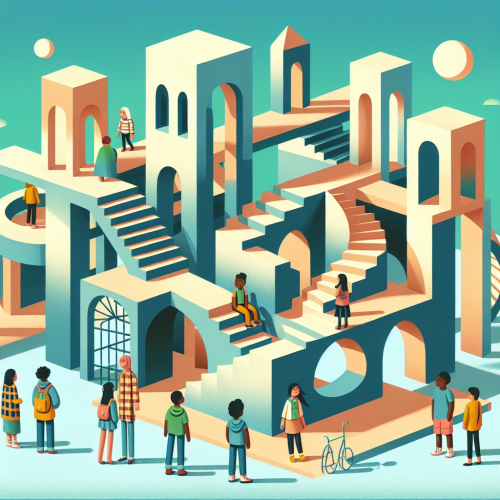
How can the principles of M.C. Escher's art be applied to create a new 3D optical illusion that challenges perception?

    Design for Mastery Kit
    NEW
All grades  Project 4 weeks

"Escher's Illusion Expedition: Crafting 3D Wonders"

Kira C
CCSS.Math.Content.HSG-MG.A.3
CCSS.ELA-Literacy.W.11-12.7
HS.H.1
Self Directed Learning
+ 2 more
1-pager

Purpose

The purpose of this project is to immerse students in the world of M.C. Escher, blending art, mathematics, and history to foster a deeper understanding of optical illusions and their impact on perception. Through hands-on design work, students will apply geometric methods to create their own 3D illusions, while engaging in critical thinking and self-directed learning. This experience aims to cultivate an academic mindset, encouraging students to explore their identities and communities through the lens of Escher's art, ultimately producing a documentary-style video that showcases their creative journey and insights.

Learning goals

Students will explore the life and contributions of M.C. Escher, focusing on his use of geometry and perspective to create optical illusions, and apply these principles to design their own 3D illusions. They will engage in research projects to understand the historical and artistic context of Escher's work, synthesizing information from multiple sources. Through hands-on activities and reflection, students will develop self-directed learning skills, enhance their academic mindset, and apply critical thinking and problem-solving to create innovative art pieces that challenge perception.
Standards
  • [Common Core] CCSS.Math.Content.HSG-MG.A.3 - Apply geometric methods to solve design problems (e.g., designing an object or structure to satisfy physical constraints or minimize cost; working with typographic grid systems based on ratios).
  • [Common Core] CCSS.Math.Content.HSG-MG.A.3 - Apply geometric methods to solve design problems (e.g., designing an object or structure to satisfy physical constraints or minimize cost; working with typographic grid systems based on ratios).
  • [Common Core] CCSS.ELA-Literacy.W.11-12.7 - Conduct short as well as more sustained research projects to answer a question (including a self-generated question) or solve a problem; narrow or broaden the inquiry when appropriate; synthesize multiple sources on the subject, demonstrating understanding of the subject under investigation.
  • [] HS.H.1 - Apply the historical method of inquiry to formulate compelling questions, evaluate primary and secondary sources, analyze and interpret data, and argue for an interpretation defended by textual evidence.
Competencies
  • Self Directed Learning - Students use teacher and peer feedback and self-reflection to monitor and direct their own learning while building self knowledge both in and out of the classroom.
  • Academic Mindset - Students establish a sense of place, identity, and belonging to increase self-efficacy while engaging in critical reflection and action.
  • Critical Thinking & Problem Solving - Students consider a variety of innovative approaches to address and understand complex questions that are authentic and important to their communities.

Products

Students will create a series of 3D optical illusions inspired by M.C. Escher, starting with sketches and progressing to physical models using materials like paper, cardboard, and 3D printing. Throughout the project, they will maintain a weekly reflection journal documenting their artistic journey and insights, which will culminate in a documentary-style video showcasing their design process and final creations. Additionally, students will participate in an interactive exhibition where they present their illusions and engage with peers and visitors, explaining the geometric principles and historical context behind their work.

Launch

Kick off the project with an immersive 'Escher Exploration Day,' where students engage in interactive stations featuring activities such as creating tessellations, experimenting with perspective drawing, and exploring virtual reality simulations of Escher's work. Follow this with a 'Perception Puzzle Hunt,' where students solve puzzles and riddles inspired by Escher's art, leading them to uncover clues about the essential question and project goals. These activities will spark curiosity and set the stage for their creative journey into the world of optical illusions.

Exhibition

Host a "Perception Art Gallery" where students present their 3D optical illusions alongside their documentary videos, inviting peers, teachers, and family members to experience the art. Set up interactive stations where visitors can engage with the illusions, providing feedback and reflections on the students' work. Encourage students to facilitate discussions about their design process, the historical context of Escher's work, and their personal growth throughout the project.
Learning Journey
Project Activities
Days 1 - 12
Milestone Activities
No activities have been added to this phase yet.

Edit Phase

Loading...
Plan
Week 1
Day 1
Day 2
Day 3
Phase
Project Activities
Activities
Introduction to M.C. Escher
Activity
Escher's Artistic Techniques
Activity
Hands-On Tessellation Creation
Activity
Preparation
Week 2
Day 4
Day 5
Day 6
Phase
Project Activities
Activities
Research on Optical Illusions
Activity
Reflection Journal Entry
Activity
Sketching Illusion Concepts
Activity
Peer Feedback Session
Activity
Refining Sketches
Activity
Preparation
Week 3
Day 7
Day 8
Day 9
Phase
Project Activities
Activities
Model Construction: Building the Framework
Activity
3D Model Refinement
Activity
Reflection Journal Entry
Activity
Finalizing 3D Model
Activity
Documentary Filming: Part 1
Activity
Preparation
Week 4
Day 10
Day 11
Day 12
Phase
Project Activities
Activities
Documentary Filming: Part 2
Activity
Peer Review and Feedback
Activity
Final Documentary Editing
Activity
Reflection Journal Completion
Activity
Exhibition Preparation
Activity
Exhibition and Presentation
Activity
Preparation
Share
Loading
Loading
Get it on Google Play
© 2026 Inkwire Inc
Contact Us Privacy Policy Terms of Service